Department of Biomedical Engineering, University of Strathclyde, Glasgow, UK.
Department of Trauma and Orthopaedics, Glasgow Royal Infirmary, Glasgow, UK.
Bone Joint J. 2021 Jun;103-B(6):1088-1095. doi: 10.1302/0301-620X.103B6.BJJ-2020-1355.R2.
Unicompartmental knee arthroplasty (UKA) is a bone-preserving treatment option for osteoarthritis localized to a single compartment in the knee. The success of the procedure is sensitive to patient selection and alignment errors. Robotic arm-assisted UKA provides technological assistance to intraoperative bony resection accuracy, which is thought to improve ligament balancing. This paper presents the five-year outcomes of a comparison between manual and robotically assisted UKAs.
The trial design was a prospective, randomized, parallel, single-centre study comparing surgical alignment in patients undergoing UKA for the treatment of medial compartment osteoarthritis (ISRCTN77119437). Participants underwent surgery using either robotic arm-assisted surgery or conventional manual instrumentation. The primary outcome measure (surgical accuracy) has previously been reported, and, along with secondary outcomes, were collected at one-, two-, and five-year timepoints. Analysis of five-year results and longitudinal analysis for all timepoints was performed to compare the two groups.
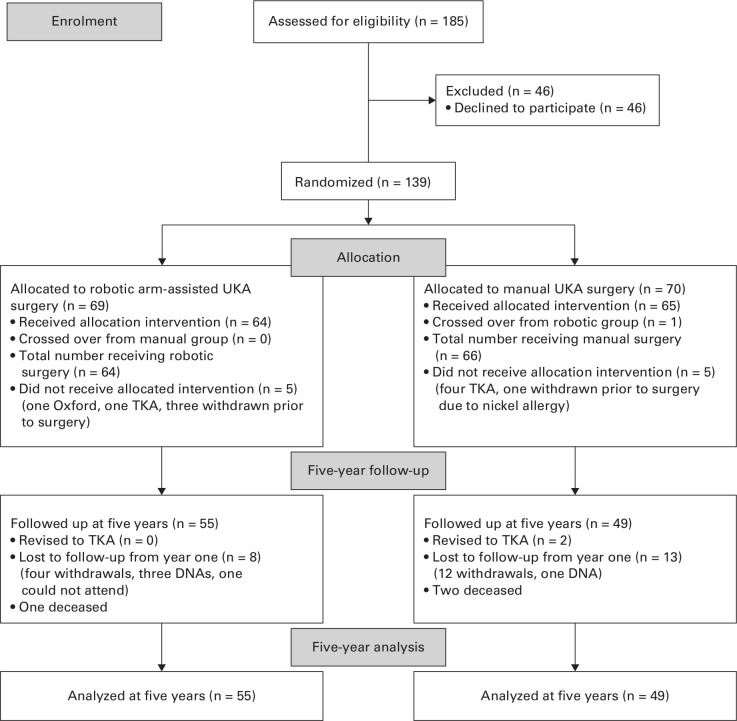
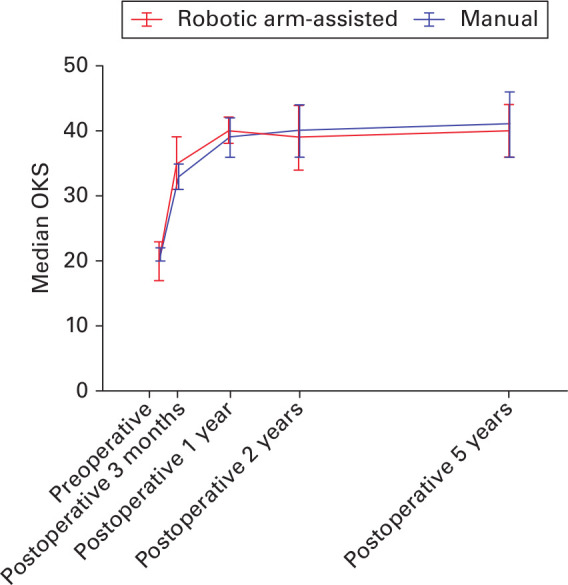
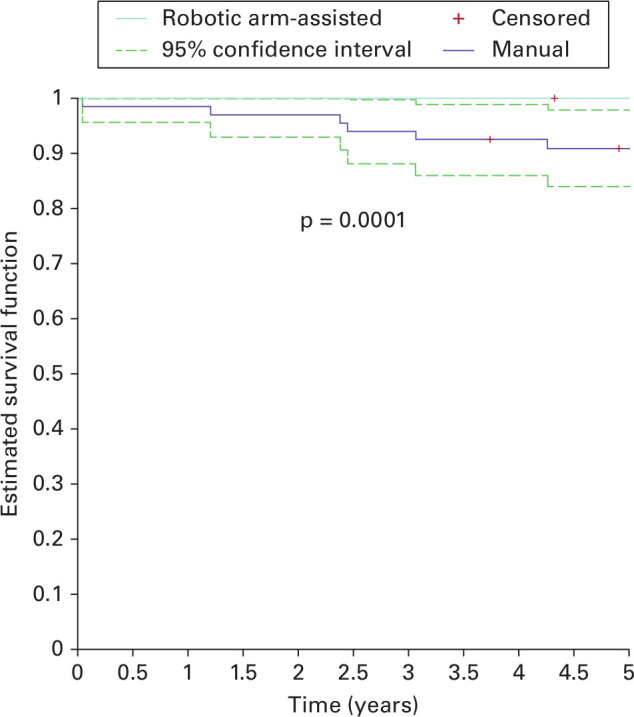
Overall, 104 (80%) patients of the original 130 who received surgery were available at five years (55 robotic, 49 manual). Both procedures reported successful results over all outcomes. At five years, there were no statistical differences between the groups in any of the patient reported or clinical outcomes. There was a lower reintervention rate in the robotic arm-assisted group with 0% requiring further surgery compared with six (9%) of the manual group requiring additional surgical intervention (p < 0.001).
This study has shown excellent clinical outcomes in both groups with no statistical or clinical differences in the patient-reported outcome measures. The notable difference was the lower reintervention rate at five years for roboticarm-assisted UKA when compared with a manual approach. Cite this article: 2021;103-B(6):1088-1095.
单髁膝关节置换术(UKA)是一种保骨治疗方法,适用于膝关节单室骨关节炎。手术的成功取决于患者选择和对线误差。机器人辅助 UKA 为术中骨切除的准确性提供了技术辅助,这被认为可以改善韧带平衡。本文介绍了一项比较手动和机器人辅助 UKA 的五年结果的研究。
该试验设计为前瞻性、随机、平行、单中心研究,比较了接受 UKA 治疗内侧间室骨关节炎(ISRCTN77119437)的患者的手术对线。参与者接受了机器人辅助手术或传统手动器械的手术。主要结局测量(手术准确性)以前已经报道过,以及次要结局,在一年、两年和五年时间点收集。对两组患者的五年结果和所有时间点的纵向分析进行了分析。
总体而言,在接受手术的 130 名患者中,104 名(80%)患者在五年时可获得(55 名机器人辅助,49 名手动)。两种手术在所有结果中均报告了成功的结果。在五年时,两组患者报告的任何结果或临床结果之间均无统计学差异。机器人辅助组的再干预率较低,0%需要进一步手术,而手动组有 6 名(9%)需要额外手术干预(p < 0.001)。
本研究显示两组患者的临床结果均非常出色,患者报告的结果测量指标无统计学或临床差异。显著的区别是机器人辅助 UKA 在五年时的再干预率较低,而手动方法的再干预率较高。