Boissonnault Ève, Higgins Johanne, LaGarde Geneviève, Barthélemy Dorothy, Lamarre Céline, H Dagher Jehane
Physical Medicine and Rehabilitation Service, Université de Montréal, Montreal, QC, Canada.
Institut universitaire sur la réadaptation en déficience physique de Montréal (IURDPM), 6300, avenue de Darlington (Pavillon Gingras), Montréal, QC, H3S 2J4, Canada.
Pilot Feasibility Stud. 2021 May 31;7(1):115. doi: 10.1186/s40814-021-00859-3.
After a traumatic brain injury, disturbances in the attentional processes have a direct negative effect on functional recovery and on return to complex activities. To date, there is no good attention remediation treatment available. The primary objective of this review and pilot study is to provide an overview of the research evidence and to evaluate the feasibility of implementing a tDCS protocol to improve attention disorders in patients with mild complicated to severe subacute TBI, hospitalized in an inpatient rehabilitation facility. Our secondary objective is to extract preliminary data and observational information on participants' response to treatment.
Participants were recruited from a consecutive series of patients admitted to the TBI unit of a subspecialized regional rehabilitation center. They received a 20-min tDCS stimulation 3 times a week for 3 weeks. A neuropsychological evaluation was performed before and after the intervention. We collected participants' sociodemographic and clinical characteristics as well as information about satisfaction, tolerability, and adverse effects.
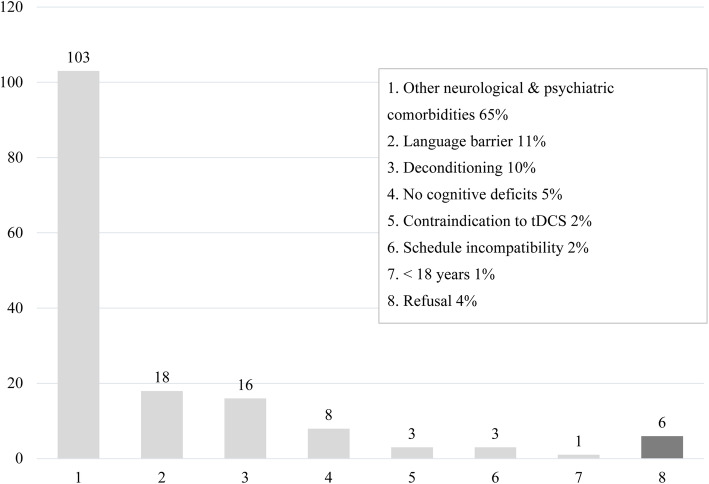
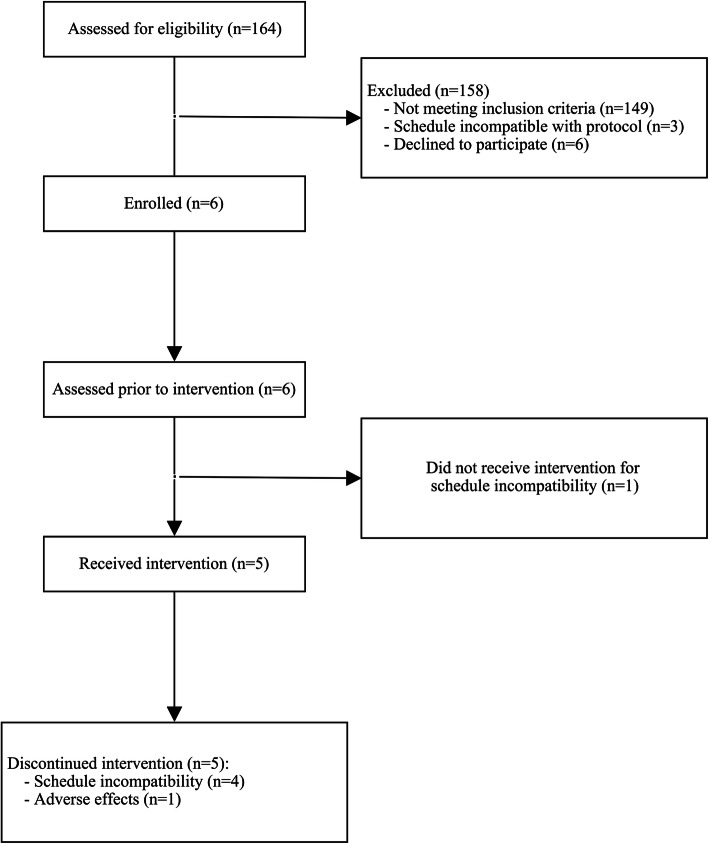
One hundred sixty-four patients were admitted between September 2018 and January 2020. One hundred fifty-eight were excluded, and 6 patients with presumed attentional deficits were enrolled. None completed the protocol as intended. No major side effects occurred.
Non-invasive brain neurostimulation is promising to enhance attention deficits in patients with TBI. Implementation of a tDCS protocol to fulfill this purpose in an intensive inpatient rehabilitation center has its limitations. We made recommendations to facilitate the implementation of similar projects in the future.
ISRCTN, ISRCTN55243064 . Registered 14 October 2020-retrospectively registered.
创伤性脑损伤后,注意力过程的紊乱对功能恢复和恢复复杂活动有直接负面影响。迄今为止,尚无有效的注意力康复治疗方法。本综述和试点研究的主要目的是概述研究证据,并评估在住院康复机构中实施经颅直流电刺激(tDCS)方案以改善轻度复杂至重度亚急性创伤性脑损伤患者注意力障碍的可行性。我们的次要目的是提取关于参与者对治疗反应的初步数据和观察信息。
从一家专科区域康复中心的创伤性脑损伤病房连续收治的患者中招募参与者。他们每周接受3次、每次20分钟的tDCS刺激,共持续3周。在干预前后进行神经心理学评估。我们收集了参与者的社会人口统计学和临床特征以及关于满意度、耐受性和不良反应的信息。
2018年9月至2020年1月期间共收治164例患者。158例被排除,6例疑似存在注意力缺陷的患者被纳入研究。无人按计划完成方案。未发生重大副作用。
非侵入性脑神经刺激有望改善创伤性脑损伤患者的注意力缺陷。在强化住院康复中心实施tDCS方案以实现这一目的存在局限性。我们提出了建议,以促进未来类似项目的实施。
国际标准随机对照试验编号(ISRCTN),ISRCTN55243064。于2020年10月14日注册——追溯注册。