Obstetrics and Gynecology, University of Turku, Turku, Finland
Obstetrics and Gynecology, TYKS Turku University Hospital, Turku, Finland.
BMJ Open Diabetes Res Care. 2021 May;9(1). doi: 10.1136/bmjdrc-2020-002022.
Recent research has demonstrated the benefits of metformin treatment in gestational diabetes (GDM) on short-term pregnancy outcomes (including excessive fetal growth and pre-eclampsia), but its effects on fetal metabolism remain mostly unknown. Our aim was to study the effects of metformin treatment compared with insulin or diet on the cord serum metabolome and also to assess how these metabolites are related to birth weight (BW) in pregnancies complicated by GDM.
Cord serum samples were available from 113, 97, and 98 patients with GDM treated with diet, insulin, and metformin, respectively. A targeted metabolome was measured using nuclear magnetic resonance spectroscopy. The patients in the metformin and insulin groups had participated in a previous randomized trial (NCT01240785).
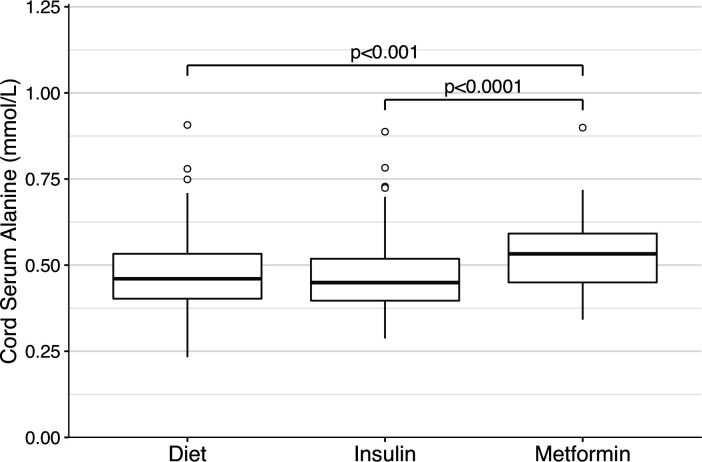
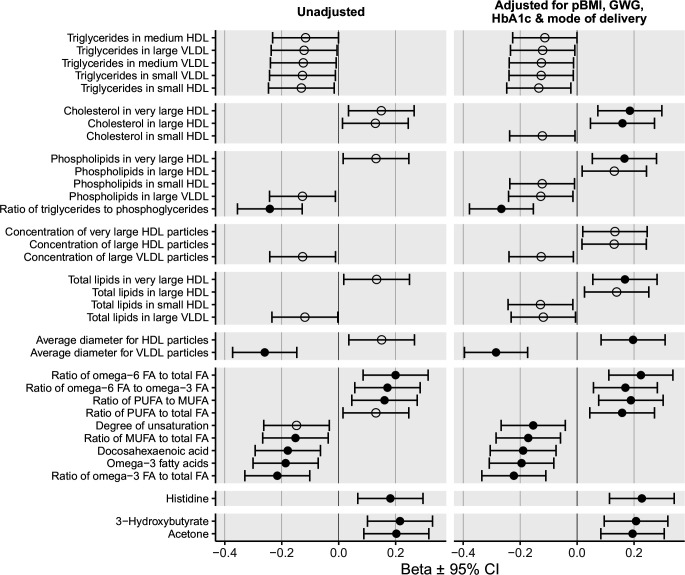
Cord serum alanine was elevated in the metformin group (0.53 mmol/L) compared with the insulin (0.45 mmol/L, p<0.001) and the diet groups (0.46 mmol/L, p<0.0001). All other measured metabolites were similar between the groups. The triglyceride (TG)-to-phosphoglyceride ratio, average very low-density lipoprotein particle diameter, docosahexaenoic acid, omega-3 fatty acids (FAs), and ratios of omega-3 and monounsaturated FA to total FA were inversely related to BW. The omega-6-to-total-FA and omega-6-to-omega-3-FA ratios were positively related to BW. Cholesterol in very large and large high-density lipoprotein (HDL) was positively (p<0.01) associated with BW when adjusted for maternal prepregnancy body mass index, gestational weight gain, glycated hemoglobin, and mode of delivery.
Metformin treatment in GDM leads to an increase in cord serum alanine. The possible long-term implications of elevated neonatal alanine in this context need to be evaluated in future studies. Although previous studies have shown that metformin increased maternal TG levels, the cord serum TG levels were not affected. Cord serum HDL cholesterol and several FA variables are related to the regulation of fetal growth in GDM. Moreover, these associations seem to be independent of maternal confounding factors.
NCT01240785.
最近的研究表明,二甲双胍治疗妊娠期糖尿病(GDM)对短期妊娠结局(包括胎儿过度生长和子痫前期)有益,但它对胎儿代谢的影响仍知之甚少。我们的目的是研究与胰岛素或饮食相比,二甲双胍治疗对脐带血清代谢组的影响,并评估这些代谢物与 GDM 妊娠中胎儿体重(BW)的关系。
113、97 和 98 例 GDM 患者分别接受饮食、胰岛素和二甲双胍治疗,其脐带血清样本可供研究。采用核磁共振波谱法测定靶向代谢组。二甲双胍和胰岛素组的患者参加了一项先前的随机试验(NCT01240785)。
与胰岛素组(0.45mmol/L,p<0.001)和饮食组(0.46mmol/L,p<0.0001)相比,二甲双胍组的脐带血清丙氨酸升高(0.53mmol/L)。各组之间的其他测量代谢物均相似。甘油三酯(TG)/磷酸甘油酯比值、平均极低密度脂蛋白颗粒直径、二十二碳六烯酸、ω-3 脂肪酸(FA)以及 ω-3 和单不饱和 FA 与总 FA 的比值与 BW 呈负相关。ω-6/总 FA 和 ω-6/ω-3-FA 比值与 BW 呈正相关。经产妇孕前体重指数、孕期体重增加、糖化血红蛋白和分娩方式校正后,大、高密度脂蛋白(HDL)中的胆固醇与 BW 呈正相关(p<0.01)。
GDM 中使用二甲双胍治疗会导致脐带血清丙氨酸升高。在这种情况下,新生儿丙氨酸升高的长期影响需要在未来的研究中进行评估。尽管之前的研究表明二甲双胍会增加母体 TG 水平,但脐带血清 TG 水平不受影响。GDM 中胎儿生长的调节与脐带血清 HDL 胆固醇和几种 FA 变量有关。此外,这些关联似乎独立于母体混杂因素。
NCT01240785。