Department of Anesthesiology, Zhongshan Hospital, Fudan University, Shanghai, China.
Department of Orthopedics, Zhongshan Hospital, Fudan University, Shanghai, China.
Lab Invest. 2021 Sep;101(9):1238-1253. doi: 10.1038/s41374-021-00606-5. Epub 2021 May 31.
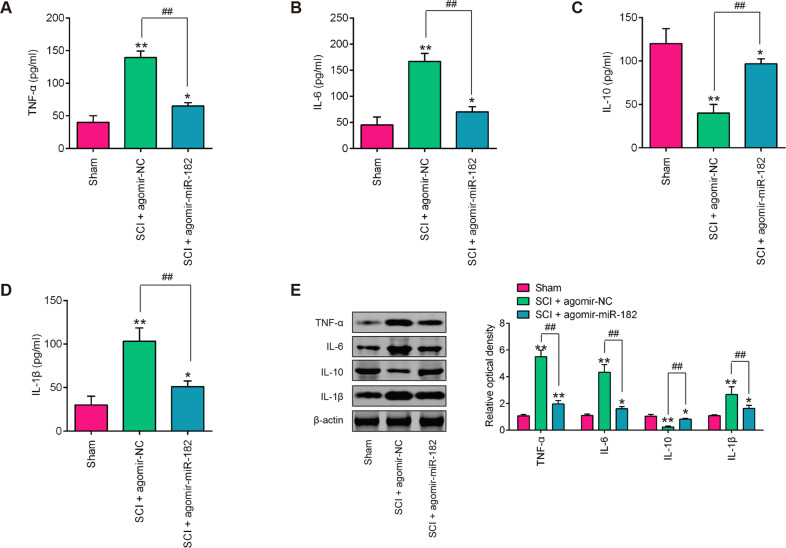
Spinal cord injury (SCI) is one common neurological condition which involves primary injury and secondary injury. Neuron inflammation and apoptosis after SCI is the most important pathological process of this disease. Here, we tried to explore the influence and mechanism of miRNAs on the neuron inflammatory response and apoptosis after SCI. First, by re-analysis of Gene Expression Omnibus dataset (accession GSE19890), miR-182 was selected for further study because of its suppressive effects on the inflammatory response in the various types of injuries. Functional experiments demonstrated that miR-182 overexpression promoted functional recovery, reduced histopathological changes, and alleviated spinal cord edema in mice. It was also observed that miR-182 overexpression reduced apoptosis and attenuated the inflammatory response in spinal cord tissue, as evidenced by the reduction of tumor necrosis factor (TNF)-α, interleukin (IL)-6, and IL-1β, and the induction of IL-10. Using a lipopolysaccharide (LPS)-induced SCI model in BV-2 cells, we found that miR-182 was downregulated in the BV-2 cells following LPS stimulation, and upregulation of miR-182 improved LPS-induced cell damage, as reflected by the inhibition of apoptosis and the inflammatory response. IκB kinase β (IKKβ), an upstream target of the NF-κB pathway, was directly targeted by miR-182 and miR-182 suppressed its translation. Further experiments revealed that overexpression of IKKβ reversed the anti-apoptosis and anti-inflammatory effects of miR-182 in LPS stimulated BV-2 cells. Finally, we found that miR-182 overexpression blocked the activation of the NF-κB signaling pathway in vitro and in vivo, as demonstrated by the downregulation of phosphorylated (p‑) IκB-α and nuclear p-p65. Taken together, these data indicate that miR-182 improved SCI-induced secondary injury through inhibiting apoptosis and the inflammatory response by blocking the IKKβ/NF-κB pathway. Our findings suggest that upregulation of miR-182 may be a novel therapeutic target for SCI.
脊髓损伤(SCI)是一种常见的神经系统疾病,涉及原发性损伤和继发性损伤。SCI 后神经元炎症和细胞凋亡是该疾病最重要的病理过程。在这里,我们试图探讨 miRNA 对 SCI 后神经元炎症反应和凋亡的影响及其机制。首先,通过重新分析基因表达综合数据库(GEO 数据库, accession GSE19890),选择 miR-182 进行进一步研究,因为它对各种损伤的炎症反应具有抑制作用。功能实验表明,miR-182 过表达促进了功能恢复,减少了组织病理学变化,并减轻了小鼠脊髓水肿。还观察到 miR-182 过表达减少了脊髓组织中的细胞凋亡和炎症反应,这表现在肿瘤坏死因子(TNF)-α、白细胞介素(IL)-6 和 IL-1β 的减少以及 IL-10 的诱导。在 LPS 诱导的 SCI 模型中,我们发现 LPS 刺激后 BV-2 细胞中的 miR-182 下调,上调 miR-182 可改善 LPS 诱导的细胞损伤,表现为抑制细胞凋亡和炎症反应。NF-κB 通路的上游靶标 IκB 激酶β(IKKβ)被 miR-182 直接靶向,miR-182 抑制其翻译。进一步的实验表明,过表达 IKKβ 逆转了 miR-182 在 LPS 刺激的 BV-2 细胞中抗凋亡和抗炎作用。最后,我们发现 miR-182 过表达在体外和体内阻断 NF-κB 信号通路的激活,表现为磷酸化(p)-IκB-α和核 p-p65 的下调。总之,这些数据表明,miR-182 通过抑制 IKKβ/NF-κB 通路来改善 SCI 诱导的继发性损伤,从而改善 SCI 诱导的继发性损伤。我们的研究结果表明,上调 miR-182 可能是 SCI 的一种新的治疗靶点。