Primary Immunodeficiency Unit, Allergy and Immunology Research Centre, Institute for Medical Research, Ministry of Health, Selangor, Malaysia.
Institute of Biological Sciences, Faculty of Science, University of Malaya, Kuala Lumpur, Malaysia.
Clin Exp Immunol. 2021 Nov;206(2):119-128. doi: 10.1111/cei.13626. Epub 2021 Jul 13.
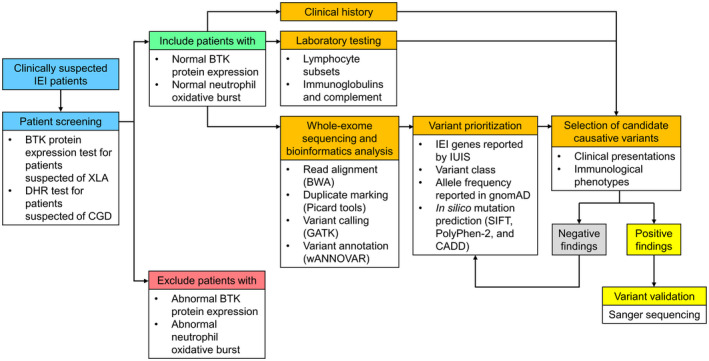
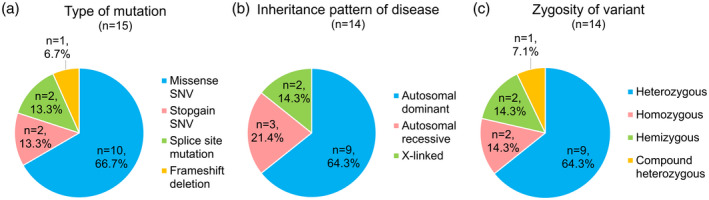
Primary immunodeficiency diseases refer to inborn errors of immunity (IEI) that affect the normal development and function of the immune system. The phenotypical and genetic heterogeneity of IEI have made their diagnosis challenging. Hence, whole-exome sequencing (WES) was employed in this pilot study to identify the genetic etiology of 30 pediatric patients clinically diagnosed with IEI. The potential causative variants identified by WES were validated using Sanger sequencing. Genetic diagnosis was attained in 46.7% (14 of 30) of the patients and categorized into autoinflammatory disorders (n = 3), diseases of immune dysregulation (n = 3), defects in intrinsic and innate immunity (n = 3), predominantly antibody deficiencies (n = 2), combined immunodeficiencies with associated and syndromic features (n = 2) and immunodeficiencies affecting cellular and humoral immunity (n = 1). Of the 15 genetic variants identified, two were novel variants. Genetic findings differed from the provisional clinical diagnoses in seven cases (50.0%). This study showed that WES enhances the capacity to diagnose IEI, allowing more patients to receive appropriate therapy and disease management.
原发性免疫缺陷病是指影响免疫系统正常发育和功能的先天性免疫缺陷。IEI 的表型和遗传异质性使得其诊断具有挑战性。因此,本研究采用外显子组测序(WES)来鉴定 30 名临床诊断为 IEI 的儿科患者的遗传病因。通过 Sanger 测序对 WES 鉴定出的潜在致病变异进行验证。在 46.7%(30 例中的 14 例)的患者中获得了遗传诊断,并分为自身炎症性疾病(n=3)、免疫失调疾病(n=3)、固有和先天免疫缺陷(n=3)、主要抗体缺陷(n=2)、伴有和综合征特征的联合免疫缺陷(n=2)和影响细胞和体液免疫的免疫缺陷(n=1)。在鉴定的 15 个遗传变异中,有两个是新的变异。在 7 例(50.0%)患者中,遗传发现与临时临床诊断不同。本研究表明,WES 提高了诊断 IEI 的能力,使更多患者能够接受适当的治疗和疾病管理。