Hung Tzu-Chao, Kiraly Brian, Strik Julian H, Khajetoorians Alexander A, Wegner Daniel
Institute for Molecules and Materials, Radboud University, 6525 AJ Nijmegen, The Netherlands.
Nano Lett. 2021 Jun 23;21(12):5006-5012. doi: 10.1021/acs.nanolett.1c00788. Epub 2021 Jun 1.
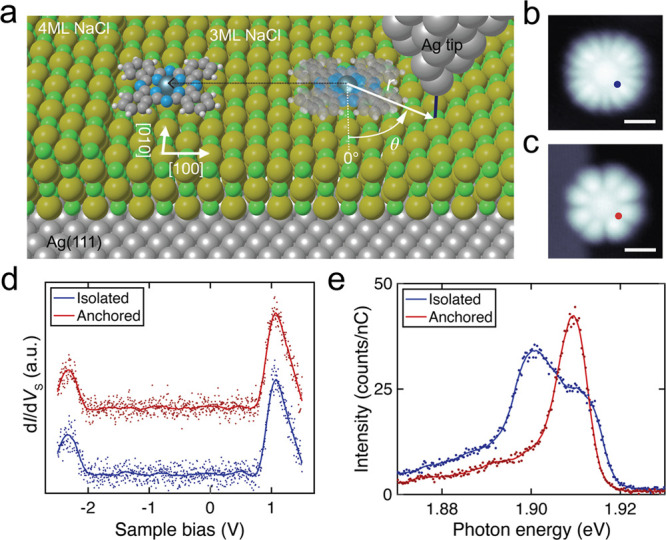
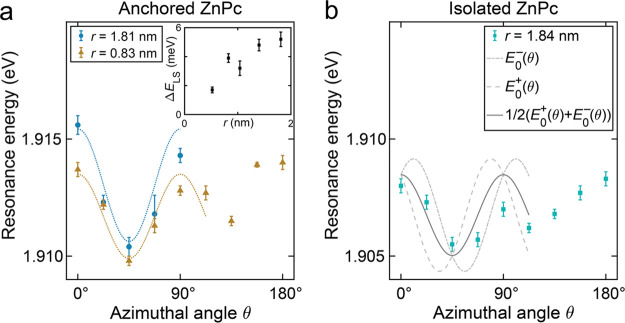
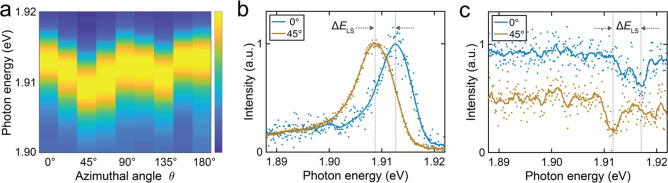
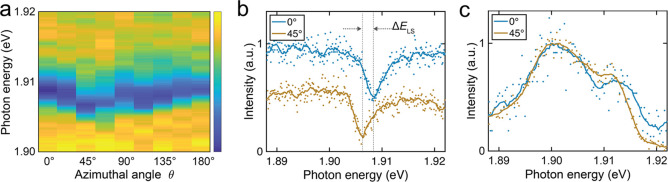
We demonstrate that nanocavity plasmons generated a few nanometers away from a molecule can induce molecular motion. For this, we study the well-known rapid shuttling motion of zinc phthalocyanine molecules adsorbed on ultrathin NaCl films by combining scanning tunneling microscopy (STM) and spectroscopy (STS) with STM-induced light emission. Comparing spatially resolved single-molecule luminescence spectra from molecules anchored to a step edge with isolated molecules adsorbed on the free surface, we found that the azimuthal modulation of the Lamb shift is diminished in case of the latter. This is evidence that the rapid shuttling motion is remotely induced by plasmon-molecule coupling. Plasmon-induced molecular motion may open an interesting playground to bridge the nanoscopic and mesoscopic worlds by combining molecular machines with nanoplasmonics to control directed motion of single molecules without the need for local probes.
我们证明,在距离分子几纳米处产生的纳米腔等离子体激元能够诱导分子运动。为此,我们通过将扫描隧道显微镜(STM)和光谱学(STS)与STM诱导发光相结合,研究了吸附在超薄氯化钠薄膜上的酞菁锌分子的著名快速穿梭运动。将固定在台阶边缘的分子与吸附在自由表面的孤立分子的空间分辨单分子发光光谱进行比较,我们发现,在后一种情况下,兰姆位移的方位调制减弱。这证明快速穿梭运动是由等离子体激元-分子耦合远程诱导的。等离子体激元诱导的分子运动可能会开辟一个有趣的领域,通过将分子机器与纳米等离子体学相结合来控制单分子的定向运动,而无需局部探针,从而在纳米世界和介观世界之间架起桥梁。