COMSATS University, Islamabad, Pakistan.
PLoS One. 2021 Jun 1;16(6):e0252344. doi: 10.1371/journal.pone.0252344. eCollection 2021.
Fibroblast (FGFs) and insulin (IGF) growth factor pathways are among 10 most recurrently altered genomic pathways in pancreatic ductal adenocarcinoma (PDAC). However, the prognostic and therapeutic relevance of FGF and IGF pathways in PDAC is largely unknown.
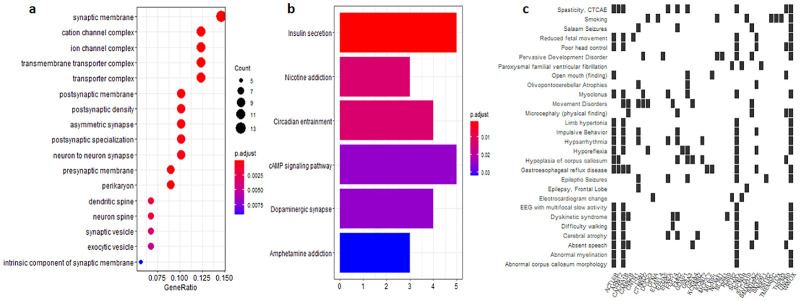
We investigated the relationship between fibroblast and insulin pathway gene expression and clinicopathological features in three independent transcriptomic cohorts of 532 PDAC patients. Furthermore, we have examined the coexpressed genes specific to the prognostic marker identified from these cohorts. Statistical tests including Fisher-exact\Chi-square, Kaplan-Meier, Pearson Correlation and cox regression analyses were performed. Additionally, pathway analysis of gene-specific co-expressed genes was also performed.
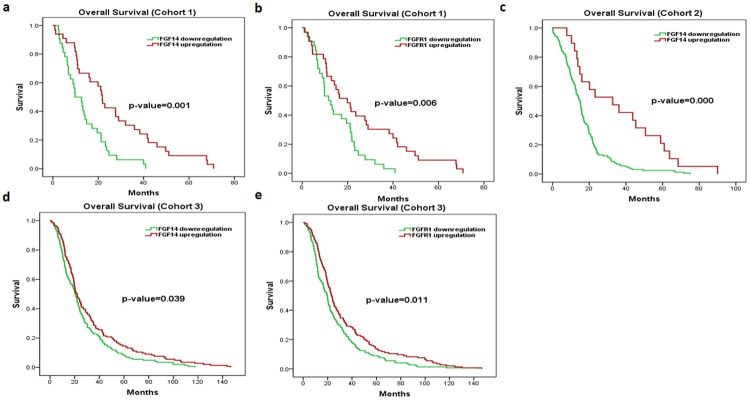
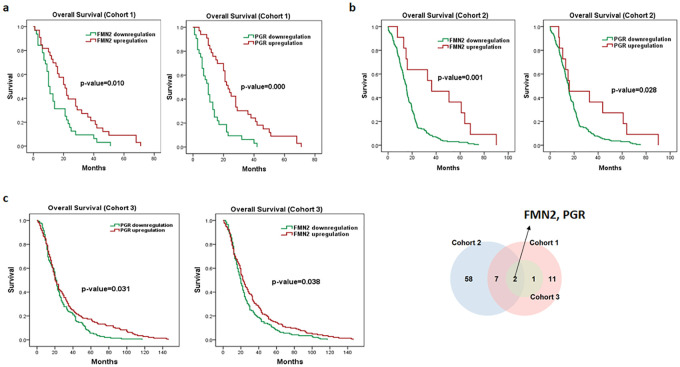
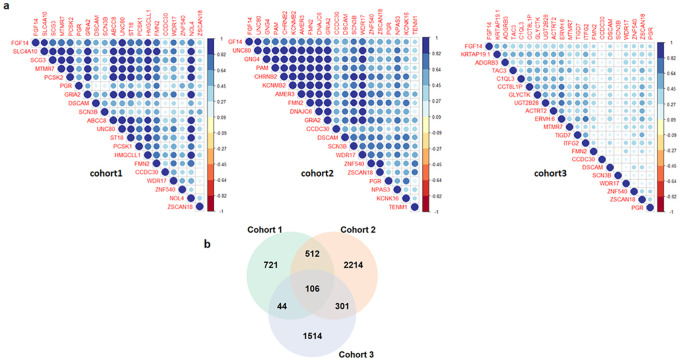
The dysregulation of six genes including FGF9, FGF14, FGFR1, FGFR4, IGF2BP2 and IGF2BP3 were significantly associated with different clinical characteristics (including grade, stage, recurrence and nodes) in PDAC cohorts. 11 genes (including FGF9, FGF13, FGF14, FGF17, FGFR1, FGFRL1, FGFBP3, IGFBP3, IGF2BP2, IGF2BP3 and IGFBPL1) showed association with overall survival in different PDAC cohorts. Interestingly, overexpression of FGF14 was found associated with better overall survival (OS) in all three cohorts. Of note, multivariate analysis also revealed FGF14 as an independent prognostic marker for better OS in all three cohorts. Furthermore, FMN2 and PGR were among the top genes that correlated with FGF14 in all 3 cohorts. Of note, overexpression of FMN2 and PGR was found significantly associated with good overall survival in PDAC patients, suggesting FMN2 and PGR can also act as potential markers for the prediction of prognosis in PDAC patients.
FGF14 may define a distinct subset of PDAC patients with better prognosis. Moreover, FGF14-based sub-classification of PDAC suggests that FMN2 and PGR can be employed as good prognostic markers in PDAC and this classification may lead to new therapeutic approaches.
成纤维细胞(FGFs)和胰岛素(IGF)生长因子途径是胰腺导管腺癌(PDAC)中最常改变的 10 个基因组途径之一。然而,FGF 和 IGF 途径在 PDAC 中的预后和治疗相关性在很大程度上尚不清楚。
我们研究了纤维母细胞和胰岛素途径基因表达与 532 例 PDAC 患者的三个独立转录组队列的临床病理特征之间的关系。此外,我们还检查了从这些队列中确定的预后标志物的共表达基因。进行了包括 Fisher-exact\Chi-square、Kaplan-Meier、Pearson Correlation 和 cox 回归分析在内的统计检验。此外,还对基因特异性共表达基因进行了途径分析。
在 PDAC 队列中,六个基因(包括 FGF9、FGF14、FGFR1、FGFR4、IGF2BP2 和 IGF2BP3)的失调与不同的临床特征(包括分级、分期、复发和淋巴结)显著相关。11 个基因(包括 FGF9、FGF13、FGF14、FGF17、FGFR1、FGFRL1、FGFBP3、IGFBP3、IGF2BP2、IGF2BP3 和 IGFBPL1)在不同的 PDAC 队列中与总生存相关。有趣的是,在所有三个队列中,FGF14 的过表达与更好的总生存(OS)相关。值得注意的是,多变量分析还揭示了 FGF14 是所有三个队列中 OS 的独立预后标志物。此外,在所有 3 个队列中,FMN2 和 PGR 都是与 FGF14 相关的最高基因之一。值得注意的是,在 PDAC 患者中,FMN2 和 PGR 的过表达与良好的总生存显著相关,这表明 FMN2 和 PGR 也可以作为 PDAC 患者预后预测的潜在标志物。
FGF14 可能定义了一组具有更好预后的 PDAC 患者。此外,基于 FGF14 的 PDAC 分类表明,FMN2 和 PGR 可以作为 PDAC 的良好预后标志物,这种分类可能会导致新的治疗方法。