Department of Liver Surgery, Liver Cancer Institute, Zhongshan Hospital, Fudan University and Key Laboratory of Carcinogenesis and Cancer Invasion, Ministry of Education, Shanghai, China.
Department of General, Visceral and Cancer Surgery, University Hospital of Cologne, Cologne, Germany.
Int J Biol Sci. 2019 Aug 22;15(11):2282-2295. doi: 10.7150/ijbs.32899. eCollection 2019.
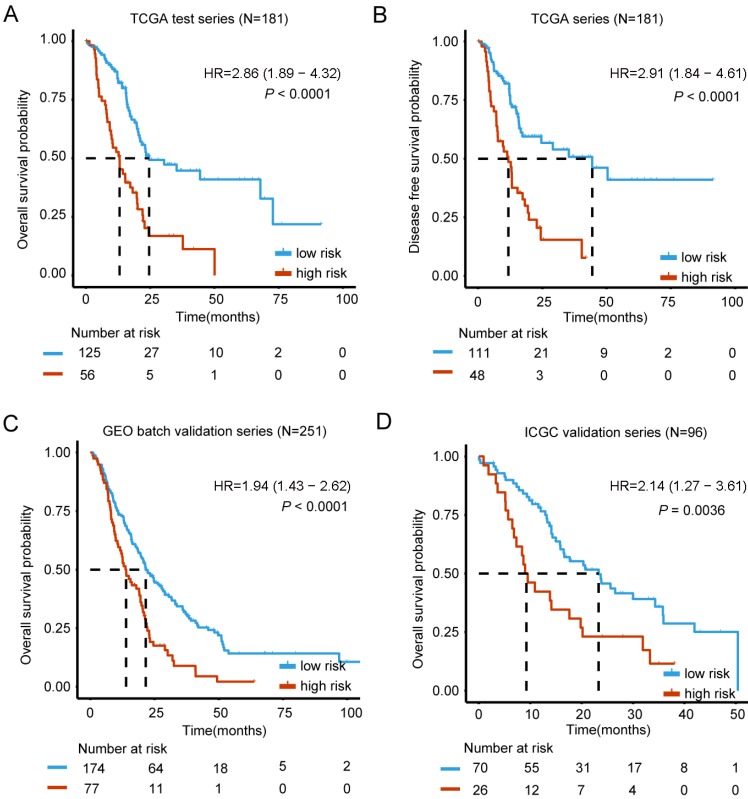
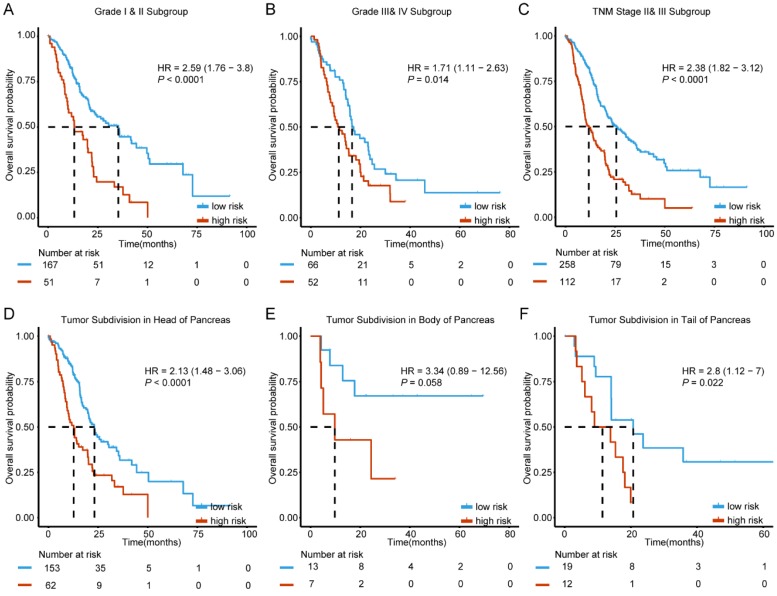
Pancreatic ductal adenocarcinoma (PDAC) is one of the most fatal malignancies worldwide. PDAC prognostic and diagnostic biomarkers are still being explored. The aim of this study is to establish a robust molecular signature that can improve the ability to predict PDAC prognosis. 155 overlapping differentially expressed genes between tumor and non-tumor tissues from three Gene Expression Omnibus (GEO) datasets were explored. A least absolute shrinkage and selection operator method (LASSO) Cox regression model was employed for selecting prognostic genes. We developed a 6-mRNA signature that can distinguish high PDAC risk patients from low risk patients with significant differences in overall survival (OS). We further validated this signature prognostic value in three independent cohorts (GEO batch, < 0.0001; ICGC, = 0.0036; Fudan, = 0.029). Furthermore, we found that our signature remained significant in patients with different histologic grade, TNM stage, locations of tumor entity, age and gender. Multivariate cox regression analysis showed that 6-mRNA signature can be an independent prognostic marker in each of the cohorts. Receiver operating characteristic curve (ROC) analysis also showed that our signature possessed a better predictive role of PDAC prognosis. Moreover, the gene set enrichment analysis (GSEA) analysis showed that several tumorigenesis and metastasis related pathways were indeed associated with higher scores of risk. In conclusion, identifying the 6-mRNA signature could provide a valuable classification method to evaluate clinical prognosis and facilitate personalized treatment for PDAC patients. New therapeutic targets may be developed upon the functional analysis of the classifier genes and their related pathways.
胰腺导管腺癌(PDAC)是全球最致命的恶性肿瘤之一。PDAC 的预后和诊断生物标志物仍在探索中。本研究旨在建立一个稳健的分子特征,以提高预测 PDAC 预后的能力。从三个基因表达综合(GEO)数据集的肿瘤和非肿瘤组织中探索了 155 个重叠的差异表达基因。采用最小绝对收缩和选择算子方法(LASSO)Cox 回归模型选择预后基因。我们开发了一个 6-mRNA 特征,可以区分高风险和低风险的 PDAC 患者,在总生存期(OS)方面有显著差异。我们进一步在三个独立队列(GEO 批次, < 0.0001;ICGC, = 0.0036;复旦, = 0.029)中验证了该特征的预后价值。此外,我们发现我们的特征在不同组织学分级、TNM 分期、肿瘤实体位置、年龄和性别患者中仍然显著。多变量 Cox 回归分析表明,6-mRNA 特征在每个队列中都是独立的预后标志物。接收器操作特征曲线(ROC)分析也表明,我们的特征在预测 PDAC 预后方面具有更好的作用。此外,基因集富集分析(GSEA)分析表明,几个肿瘤发生和转移相关途径确实与较高的风险评分相关。总之,鉴定 6-mRNA 特征可以为评估临床预后提供有价值的分类方法,并为 PDAC 患者提供个性化治疗。通过对分类器基因及其相关途径的功能分析,可能会开发出新的治疗靶点。