Centre for Integrative Ecology, School of Biological Sciences, University of Canterbury, Christchurch, New Zealand.
Department of Renewable Resources, University of Alberta, Edmonton, Canada.
PLoS One. 2021 Jun 1;16(6):e0252448. doi: 10.1371/journal.pone.0252448. eCollection 2021.
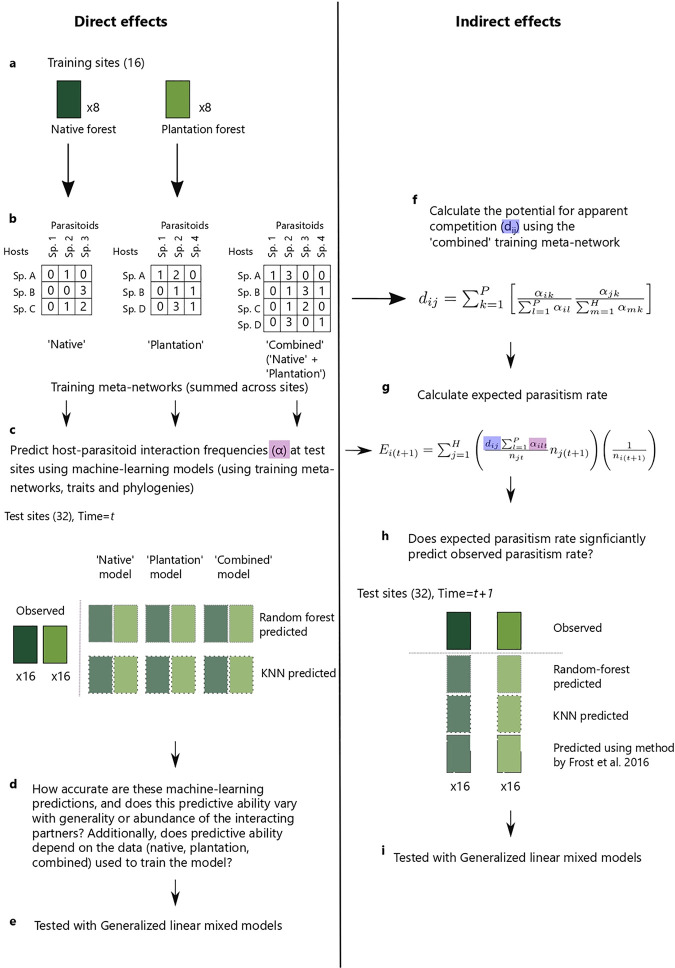
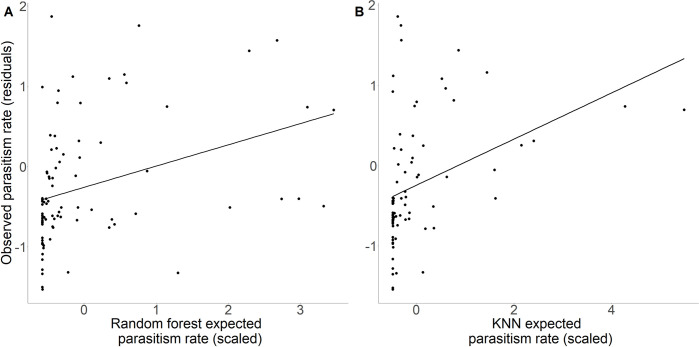
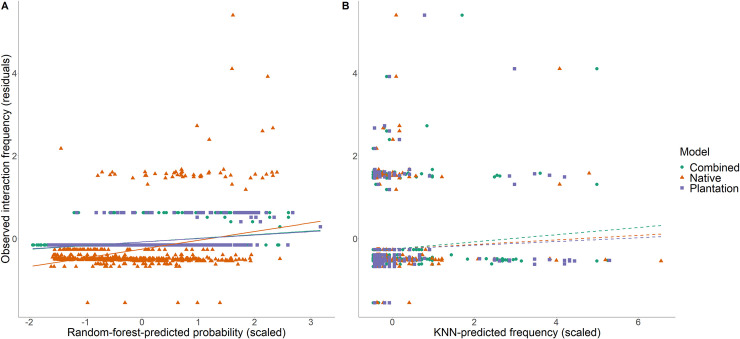
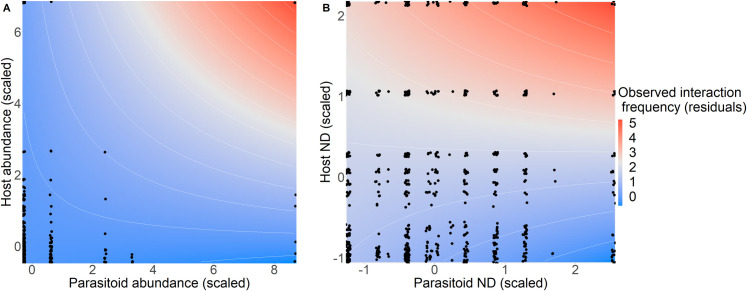
Biological pest control (i.e. 'biocontrol') agents can have direct and indirect non-target impacts, and predicting these effects (especially indirect impacts) remains a central challenge in biocontrol risk assessment. The analysis of ecological networks offers a promising approach to understanding the community-wide impacts of biocontrol agents (via direct and indirect interactions). Independently, species traits and phylogenies have been shown to successfully predict species interactions and network structure (alleviating the need to collect quantitative interaction data), but whether these approaches can be combined to predict indirect impacts of natural enemies remains untested. Whether predictions of interactions (i.e. direct effects) can be made equally well for generalists vs. specialists, abundant vs. less abundant species, and across different habitat types is also untested for consumer-prey interactions. Here, we used two machine-learning techniques (random forest and k-nearest neighbour; KNN) to test whether we could accurately predict empirically-observed quantitative host-parasitoid networks using trait and phylogenetic information. Then, we tested whether the accuracy of machine-learning-predicted interactions depended on the generality or abundance of the interacting partners, or on the source (habitat type) of the training data. Finally, we used these predicted networks to generate predictions of indirect effects via shared natural enemies (i.e. apparent competition), and tested these predictions against empirically observed indirect effects between hosts. We found that random-forest models predicted host-parasitoid pairwise interactions (which could be used to predict attack of non-target host species) more successfully than KNN. This predictive ability depended on the generality of the interacting partners for KNN models, and depended on species' abundances for both random-forest and KNN models, but did not depend on the source (habitat type) of data used to train the models. Further, although our machine-learning informed methods could significantly predict indirect effects, the explanatory power of our machine-learning models for indirect interactions was reasonably low. Combining machine-learning and network approaches provides a starting point for reducing risk in biocontrol introductions, and could be applied more generally to predicting species interactions such as impacts of invasive species.
生物防治(即“生物防治”)剂可能对非靶标产生直接和间接的影响,预测这些影响(特别是间接影响)仍然是生物防治风险评估的核心挑战。生态网络分析为理解生物防治剂对整个群落的影响(通过直接和间接相互作用)提供了一种很有前途的方法。独立地,物种特征和系统发育已被证明可以成功预测物种相互作用和网络结构(减轻了收集定量相互作用数据的需要),但这些方法是否可以结合起来预测天敌的间接影响仍有待检验。对于消费者-猎物相互作用,是否可以同样准确地预测一般物种与专门物种、丰富物种与较少丰富物种以及不同生境类型之间的相互作用(即直接影响),也尚未经过检验。在这里,我们使用了两种机器学习技术(随机森林和 K 最近邻;KNN)来测试我们是否可以使用特征和系统发育信息准确预测经验观察到的定量宿主-寄生蜂网络。然后,我们测试了机器学习预测的相互作用的准确性是否取决于相互作用伙伴的一般性或丰富性,或者取决于训练数据的来源(生境类型)。最后,我们使用这些预测网络生成通过共同天敌(即明显竞争)产生的间接效应预测,并将这些预测与宿主之间经验观察到的间接效应进行比较。我们发现,随机森林模型比 KNN 模型更成功地预测了宿主-寄生蜂的成对相互作用(可用于预测非靶标宿主物种的攻击)。这种预测能力取决于 KNN 模型中相互作用伙伴的一般性,而随机森林和 KNN 模型都取决于物种的丰富度,但不取决于用于训练模型的数据来源(生境类型)。此外,尽管我们的机器学习方法可以显著预测间接效应,但我们的机器学习模型对间接相互作用的解释能力相当低。将机器学习和网络方法相结合为减少生物防治引入的风险提供了一个起点,并可更广泛地应用于预测物种相互作用,例如入侵物种的影响。