Panyushkina Anna, Bulaev Aleksandr, Belyi Aleksandr V
Winogradsky Institute of Microbiology, Research Centre of Biotechnology of the Russian Academy of Sciences, Leninsky Ave., 33, bld. 2, 119071 Moscow, Russia.
JSC "Polyus Krasnoyarsk", Research Center, Poligonnaya Str., 15, 660118 Krasnoyarsk, Russia.
Microorganisms. 2021 May 1;9(5):984. doi: 10.3390/microorganisms9050984.
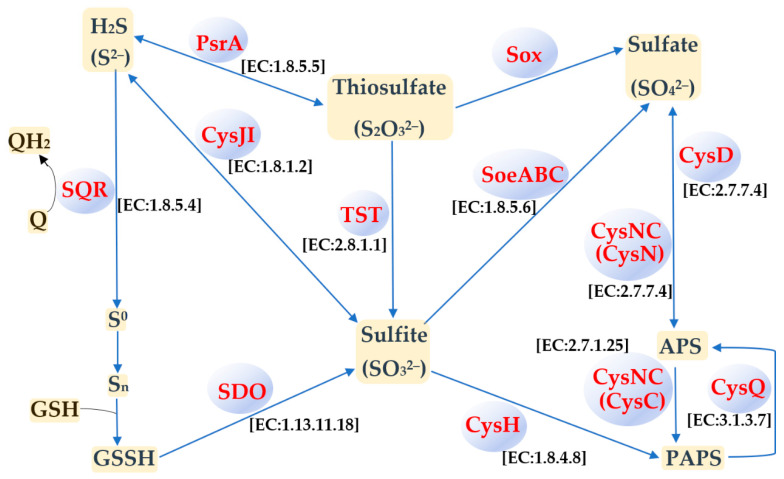
LMS is an acidophile isolated from industrial bioreactors during the processing of the gold-bearing pyrite-arsenopyrite concentrate at 38-42 °C. Most strains of this species are obligate organoheterotrophs that do not use ferrous iron or reduced sulfur compounds as energy sources. However, the LMS strain was identified as one of the predominant sulfur oxidizers in acidophilic microbial consortia. In addition to efficient growth under strictly heterotrophic conditions, the LMS strain proved to be an active sulfur oxidizer both in the presence or absence of organic compounds. Interestingly, LMS was able to succeed more common sulfur oxidizers in microbial populations, which indicated a previously underestimated role of this bacterium in industrial bioleaching operations. In this study, the first draft genome of the sulfur-oxidizing was sequenced and annotated. Based on the functional genome characterization, sulfur metabolism pathways were reconstructed. The LMS strain possessed a complicated multi-enzyme system to oxidize elemental sulfur, thiosulfate, sulfide, and sulfite to sulfate as the final product. Altogether, the phenotypic description and genome analysis unraveled a crucial role of in some biomining processes and revealed unique strain-specific characteristics, including the genes conferring arsenic resistance, which are similar to those of phylogenetically distinct microorganisms.
LMS是一种嗜酸菌,在38-42°C处理含金黄铁矿-毒砂精矿的过程中,从工业生物反应器中分离得到。该物种的大多数菌株是专性有机异养菌,不将亚铁或还原态硫化合物用作能源。然而,LMS菌株被鉴定为嗜酸微生物群落中主要的硫氧化菌之一。除了在严格的异养条件下能高效生长外,LMS菌株在有无有机化合物存在的情况下都被证明是一种活跃的硫氧化菌。有趣的是,LMS能够在微生物群体中取代更常见的硫氧化菌,这表明该细菌在工业生物浸出操作中的作用此前被低估。在本研究中,对硫氧化菌的基因组草图进行了测序和注释。基于功能基因组特征,重建了硫代谢途径。LMS菌株拥有一个复杂的多酶系统,可将元素硫、硫代硫酸盐、硫化物和亚硫酸盐氧化为最终产物硫酸盐。总之,表型描述和基因组分析揭示了其在某些生物采矿过程中的关键作用,并揭示了独特的菌株特异性特征,包括赋予抗砷性的基因,这些基因与系统发育上不同的微生物的基因相似。