Hematologic Malignancies and Cellular Therapy, Duke University School of Medicine, Durham, NC 27705, USA.
Division of Medical Oncology, Duke University School of Medicine, Durham, NC 27710, USA.
Cells. 2021 May 11;10(5):1165. doi: 10.3390/cells10051165.
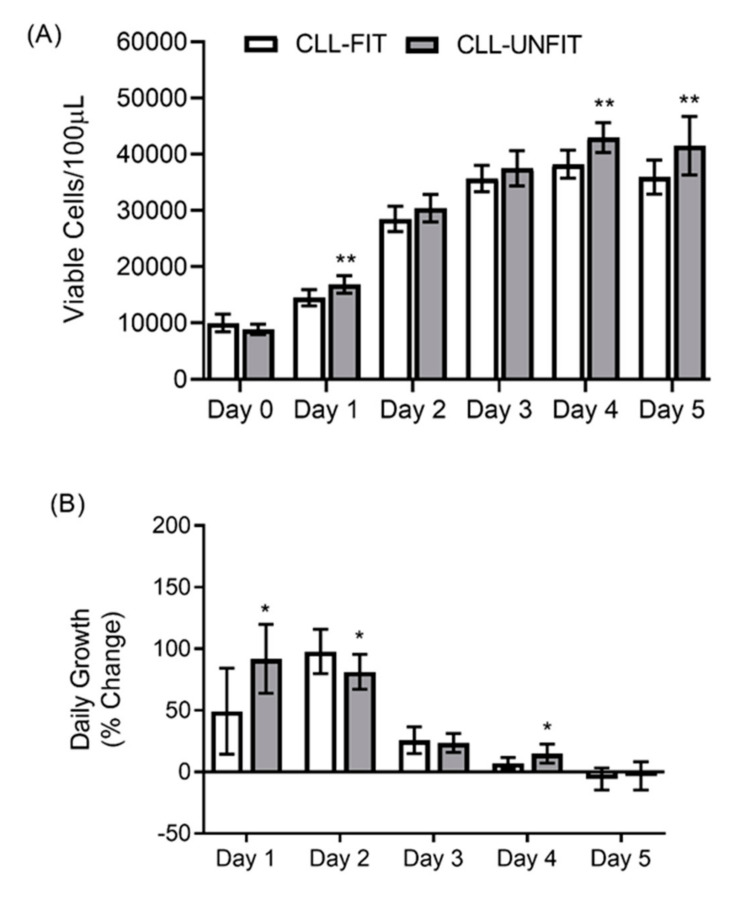
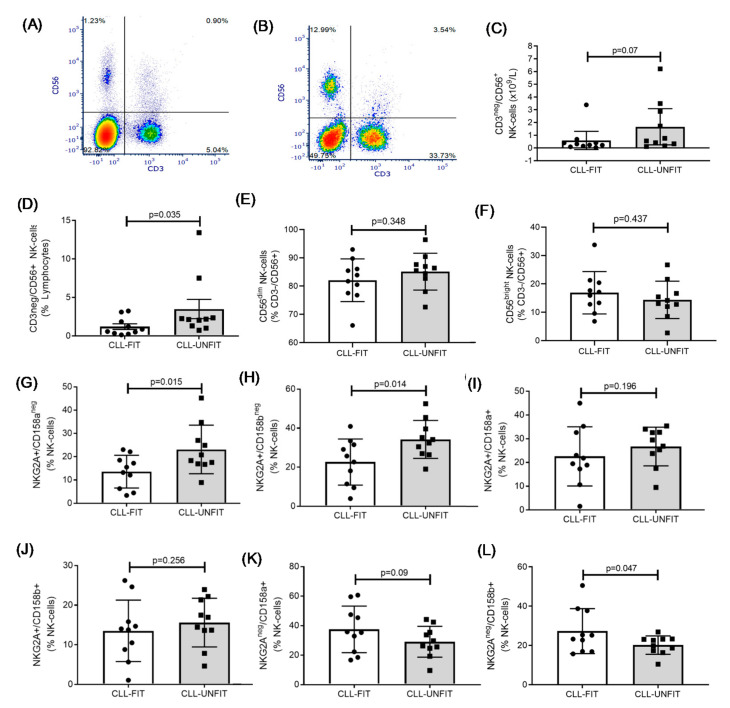
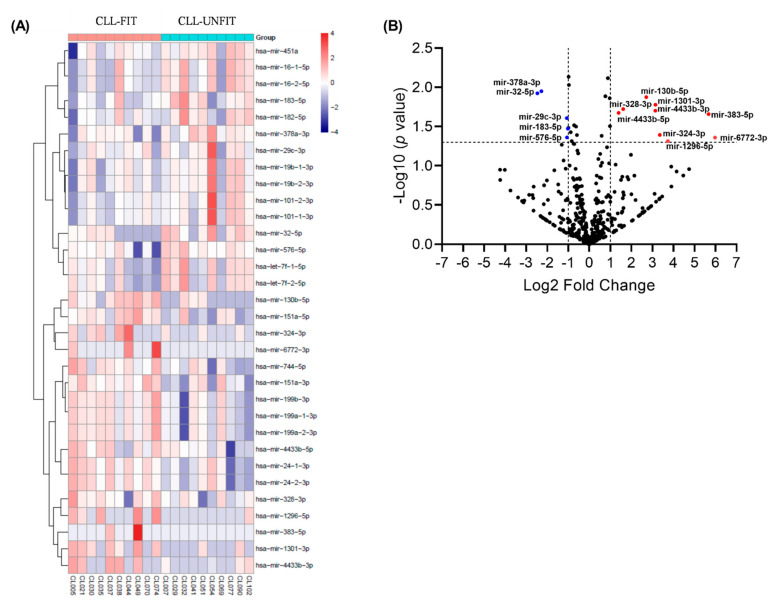
Chronic lymphocytic leukemia (CLL) is associated with physical dysfunction and low overall fitness that predicts poor survival following the commencement of treatment. However, it remains unknown whether higher fitness provides antioncogenic effects. We identified ten fit (CLL-FIT) and ten less fit (CLL-UNFIT) treatment-naïve CLL patients from 144 patients who completed a set of physical fitness and performance tests. Patient plasma was used to determine its effects on an 5-day growth/viability of three B-cell cell lines (OSU-CLL, Daudi, and Farage). Plasma exosomal miRNA profiles, circulating lipids, lipoproteins, inflammation levels, and immune cell phenotypes were also assessed. CLL-FIT was associated with fewer viable OSU-CLL cells at Day 1 ( = 0.003), Day 4 ( = 0.001), and Day 5 ( = 0.009). No differences between the groups were observed for Daudi and Farage cells. Of 455 distinct exosomal miRNAs identified, 32 miRNAs were significantly different between the groups. Of these, 14 miRNAs had ≤-1 or ≥1 log2 fold differences. CLL-FIT patients had five exosomal miRNAs with lower expression and nine miRNAs with higher expression. CLL-FIT patients had higher HDL cholesterol, lower inflammation, and lower levels of triglyceride components (all < 0.05). CLL-FIT patients had lower frequencies of low-differentiated NKG2+/CD158a/b ( = 0.015 and = 0.014) and higher frequencies of NKG2A/CD158b+ mature NK cells ( = 0.047). The absolute number of lymphocytes, including CD19+/CD5+ CLL-cells, was similar between the groups ( = 0.359). Higher physical fitness in CLL patients is associated with altered CLL-like cell line growth and with altered circulating and cellular factors indicative of better immune functions and tumor control.
慢性淋巴细胞白血病 (CLL) 与身体机能障碍和整体健康状况不佳有关,这些会预测治疗开始后患者的生存情况较差。然而,目前尚不清楚更高的健康水平是否具有抗肿瘤作用。我们从完成了一系列体能和表现测试的 144 名患者中,确定了 10 名体能良好(CLL-FIT)和 10 名体能较差(CLL-UNFIT)的初治 CLL 患者。使用患者的血浆来确定其对三种 B 细胞系(OSU-CLL、Daudi 和 Farage)为期 5 天的生长/活力的影响。还评估了血浆外泌体 miRNA 谱、循环脂质、脂蛋白、炎症水平和免疫细胞表型。CLL-FIT 与第 1 天( = 0.003)、第 4 天( = 0.001)和第 5 天( = 0.009)的 OSU-CLL 细胞的存活数较少有关。两组之间未观察到 Daudi 和 Farage 细胞的差异。在鉴定的 455 种独特的外泌体 miRNA 中,有 32 种 miRNA 在两组之间存在显著差异。其中,有 14 种 miRNA 的对数 2 倍差异≤-1 或≥1。CLL-FIT 患者有 5 种外泌体 miRNA 表达下调,9 种 miRNA 表达上调。CLL-FIT 患者的高密度脂蛋白胆固醇更高,炎症水平更低,甘油三酯成分水平更低(均 < 0.05)。CLL-FIT 患者的低分化 NKG2+/CD158a/b 频率较低( = 0.015 和 = 0.014),成熟 NK 细胞 NKG2A/CD158b+频率较高( = 0.047)。两组之间的淋巴细胞绝对值(包括 CD19+/CD5+ CLL 细胞)相似( = 0.359)。CLL 患者的身体健康水平较高与 CLL 样细胞系生长改变有关,与循环和细胞因子改变有关,这些改变表明更好的免疫功能和肿瘤控制。