Laboratory Medicine, Inje University, Ilsan Paik Hospital, Goyang 10380, Korea.
Laboratory Medicine, Inje University, Sanggye Paik Hospital, Seoul 01757, Korea.
Medicina (Kaunas). 2021 May 11;57(5):477. doi: 10.3390/medicina57050477.
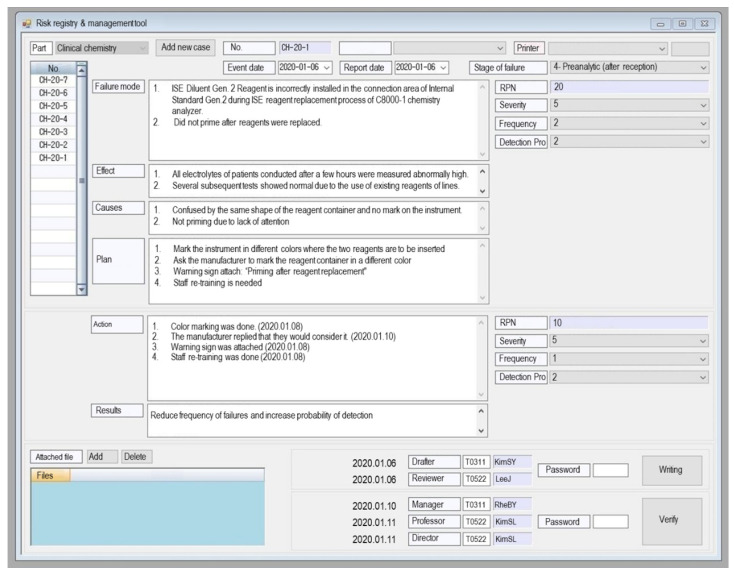
: Risk management is considered an integral part of laboratory medicine to assure laboratory quality and patient safety. However, the concept of risk management is philosophical, so actually performing risk management in a clinical laboratory can be challenging. Therefore, we would like to develop a sustainable, practical system for continuous total laboratory risk management. : This study was composed of two phases: the development phase in 2019 and the application phase in 2020. A concept flow diagram for the computerized risk registry and management tool (RRMT) was designed using the failure mode and effects analysis (FMEA) and the failure reporting, analysis, and corrective action system (FRACAS) methods. The failure stage was divided into six according to the testing sequence. We applied laboratory errors to this system over one year in 2020. The risk priority number (RPN) score was calculated by multiplying the severity of the failure mode, frequency (or probability) of occurrence, and detection difficulty. : 103 cases were reported to RRMT during one year. Among them, 32 cases (31.1%) were summarized using the FMEA method, and the remaining 71 cases (68.9%) were evaluated using the FRACAS method. There was no failure in the patient registration phase. Chemistry units accounted for the highest proportion of failure with 18 cases (17.5%), while urine test units accounted for the lowest portion of failure with two cases (1.9%). : We developed and applied a practical computerized risk-management tool based on FMEA and FRACAS methods for the entire testing process. RRMT was useful to detect, evaluate, and report failures. This system might be a great example of a risk management system optimized for clinical laboratories.
风险管理被认为是实验室医学的一个组成部分,以确保实验室质量和患者安全。然而,风险管理的概念是哲学性的,因此在临床实验室中实际执行风险管理可能具有挑战性。因此,我们希望为持续的全面实验室风险管理开发一个可持续的、实用的系统。
本研究由 2019 年的开发阶段和 2020 年的应用阶段组成。使用失效模式和影响分析 (FMEA) 和失效报告、分析和纠正措施系统 (FRACAS) 方法设计了计算机化风险登记和管理工具 (RRMT) 的概念流程图。失效阶段根据测试顺序分为六个阶段。我们在 2020 年的一年时间里将实验室误差应用于该系统。风险优先数 (RPN) 得分通过将失效模式的严重程度、发生频率 (或概率) 和检测难度相乘来计算。
在一年的时间里,有 103 例报告给 RRMT。其中,32 例(31.1%)采用 FMEA 方法进行总结,其余 71 例(68.9%)采用 FRACAS 方法进行评估。患者登记阶段没有失效。化学单位的失效比例最高,有 18 例(17.5%),而尿液检测单位的失效比例最低,有 2 例(1.9%)。
我们开发并应用了一种基于 FMEA 和 FRACAS 方法的实用计算机化风险管理工具,用于整个测试过程。RRMT 有助于检测、评估和报告失效。该系统可能是临床实验室优化风险管理系统的一个很好的例子。