• 文献检索
  • 文档翻译
  • 深度研究
  • 学术资讯
  • Suppr Zotero 插件Zotero 插件
  • 邀请有礼
  • 套餐&价格
  • 历史记录
应用&插件
Suppr Zotero 插件Zotero 插件浏览器插件Mac 客户端Windows 客户端微信小程序
定价
高级版会员购买积分包购买API积分包
服务
文献检索文档翻译深度研究API 文档MCP 服务
关于我们
关于 Suppr公司介绍联系我们用户协议隐私条款
关注我们

Suppr 超能文献

核心技术专利:CN118964589B侵权必究
粤ICP备2023148730 号-1Suppr @ 2026

文献检索

告别复杂PubMed语法,用中文像聊天一样搜索,搜遍4000万医学文献。AI智能推荐,让科研检索更轻松。

立即免费搜索

文件翻译

保留排版,准确专业,支持PDF/Word/PPT等文件格式,支持 12+语言互译。

免费翻译文档

深度研究

AI帮你快速写综述,25分钟生成高质量综述,智能提取关键信息,辅助科研写作。

立即免费体验

基于太极拳的脑卒中康复方案对症状群、躯体和认知功能及生活质量的影响:一项随机可行性研究。

Effects of a Tai Chi-Based Stroke Rehabilitation Program on Symptom Clusters, Physical and Cognitive Functions, and Quality of Life: A Randomized Feasibility Study.

机构信息

College of Nursing, Chungnam National University, Daejeon 35015, Korea.

College of Nursing, Woosuk University, Wanju 55338, Korea.

出版信息

Int J Environ Res Public Health. 2021 May 20;18(10):5453. doi: 10.3390/ijerph18105453.

DOI:10.3390/ijerph18105453
PMID:34065178
原文链接:https://pmc.ncbi.nlm.nih.gov/articles/PMC8160714/
Abstract

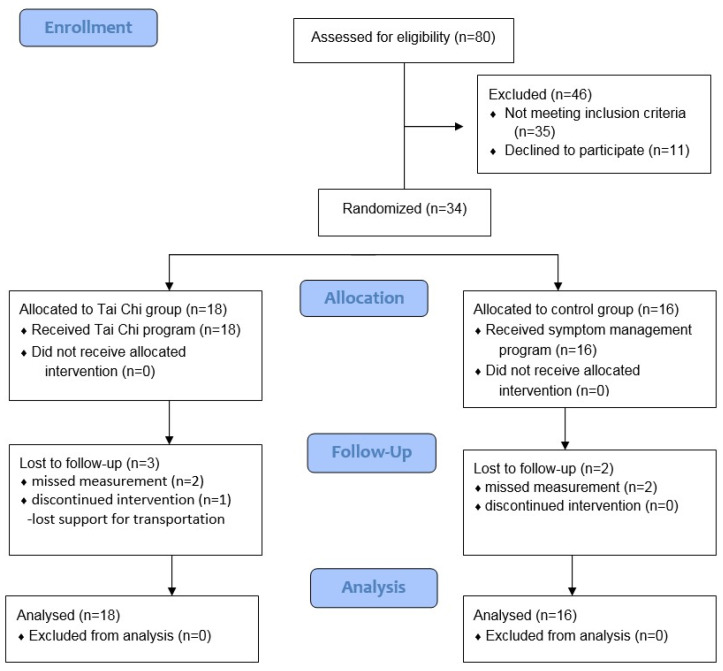
Stroke survivors suffer from disease-associated symptoms. Tai Chi can be a beneficial approach to provide an adapted form of intervention to manage their symptoms. The study aimed to determine the effects of a Tai Chi-based stroke rehabilitation program on symptom clusters, physical and cognitive functions, and stroke-specific quality of life among stroke survivors in Korea. Thirty-four stroke survivors were randomly assigned to receive either the Tai Chi-based program or the stroke-symptom management program. The feasibility of the program and its effects on the outcomes were assessed at baseline, 3 months, and 6 months. Repeated measures ANOVA showed that most symptoms improved in both groups during the 6-month period, but swallowing-related symptoms improved significantly in the Tai Chi group. Based on the interaction effect, Tai Chi was more effective on flexor muscle strength, ambulation, and activities of daily living and cognitive function over 6 months than their counterparts. Among SS-QOL dimensions, the Tai Chi group showed significant improvements in the thinking and self-care dimensions. The Tai Chi-based stroke rehabilitation program was feasible and safely applicable to stroke survivors in the community settings. This program could improve symptoms, physical and cognitive function, leading to improvements in the self-care dimension of the SS-QOL among stroke survivors.

摘要

中风幸存者会遭受与疾病相关的症状困扰。太极可以作为一种有益的方法,为他们提供一种适应的干预形式,以管理他们的症状。本研究旨在确定基于太极的中风康复计划对韩国中风幸存者的症状群、身体和认知功能以及中风特定生活质量的影响。34 名中风幸存者被随机分配接受基于太极的方案或中风症状管理方案。在基线、3 个月和 6 个月时评估了该方案的可行性及其对结果的影响。重复测量方差分析显示,在 6 个月的时间里,两组的大多数症状都有所改善,但太极组的吞咽相关症状有明显改善。基于交互效应,与对照组相比,太极在 6 个月内对屈肌力量、步行能力和日常生活活动以及认知功能更有效。在 SS-QOL 维度中,太极组在思维和自我护理维度上有显著改善。基于太极的中风康复计划在社区环境中对中风幸存者是可行且安全适用的。该方案可以改善症状、身体和认知功能,从而提高中风幸存者的 SS-QOL 的自我护理维度。
https://cdn.ncbi.nlm.nih.gov/pmc/blobs/9cb6/8160714/0f9f834c4bb2/ijerph-18-05453-g001.jpg

相似文献

1
Effects of a Tai Chi-Based Stroke Rehabilitation Program on Symptom Clusters, Physical and Cognitive Functions, and Quality of Life: A Randomized Feasibility Study.基于太极拳的脑卒中康复方案对症状群、躯体和认知功能及生活质量的影响:一项随机可行性研究。
Int J Environ Res Public Health. 2021 May 20;18(10):5453. doi: 10.3390/ijerph18105453.
2
Tailored Sitting Tai Chi Program for Subacute Stroke Survivors: A Randomized Controlled Trial.定制化坐姿太极拳方案用于亚急性脑卒中幸存者:一项随机对照试验。
Stroke. 2022 Jul;53(7):2192-2203. doi: 10.1161/STROKEAHA.121.036578. Epub 2022 Apr 7.
3
Exploring the Adaptability of Tai Chi to Stroke Rehabilitation.探索太极拳对中风康复的适应性。
Rehabil Nurs. 2019 Jul/Aug;44(4):221-229. doi: 10.1097/rnj.0000000000000110.
4
Applying Tai Chi as a rehabilitation program for stroke patients in the recovery phase: study protocol for a randomized controlled trial.将太极拳作为中风恢复期患者的康复方案应用:一项随机对照试验的研究方案。
Trials. 2014 Dec 11;15:484. doi: 10.1186/1745-6215-15-484.
5
Tai Chi for stroke rehabilitation: a focused review.太极拳在脑卒中康复中的应用:综述
Am J Phys Med Rehabil. 2012 Dec;91(12):1091-6. doi: 10.1097/PHM.0b013e31826edd21.
6
Community-based Yang-style Tai Chi is safe and feasible in chronic stroke: a pilot study.基于社区的杨式太极拳对慢性中风患者安全且可行:一项初步研究。
Clin Rehabil. 2012 Feb;26(2):121-31. doi: 10.1177/0269215511419381. Epub 2011 Sep 21.
7
Effect of Tai Chi on physical function, fall rates and quality of life among older stroke survivors.太极拳对老年中风幸存者身体功能、跌倒发生率及生活质量的影响。
Arch Phys Med Rehabil. 2014 May;95(5):816-24. doi: 10.1016/j.apmr.2014.01.001. Epub 2014 Jan 17.
8
Feasibility and effects of a tai chi self-help education program for Korean gastric cancer survivors.一项针对韩国胃癌幸存者的太极拳自助教育项目的可行性与效果
Oncol Nurs Forum. 2010 Jan;37(1):E1-6. doi: 10.1188/10.ONF.E1-E6.
9
Effects of 12-week Tai Chi program on physical function, depression, and quality of life among cognitively impaired older adults: a feasibility study.12 周太极拳方案对认知障碍老年人身体功能、抑郁和生活质量的影响:一项可行性研究。
BMC Geriatr. 2023 Mar 3;23(1):118. doi: 10.1186/s12877-023-03840-2.
10
Effects of Tai Chi and Qigong on the mobility of stroke survivors: A systematic review and meta-analysis of randomized trials.太极拳和气功对脑卒中幸存者活动能力的影响:一项随机试验的系统评价和荟萃分析。
PLoS One. 2022 Nov 17;17(11):e0277541. doi: 10.1371/journal.pone.0277541. eCollection 2022.

引用本文的文献

1
Symptom burden profiles and influencing factors in convalescent stroke patients: a latent profile analysis.恢复期脑卒中患者的症状负担概况及影响因素:一项潜在类别分析
BMC Neurol. 2025 Jul 1;25(1):266. doi: 10.1186/s12883-025-04230-4.
2
Analysis of Factors Affecting Quality of Life (QoL) in Middle-Aged Stroke Patients (Under 65 Years Old) in the Rehabilitation Phase: Multivariate Regression Analysis.康复期65岁以下中年脑卒中患者生活质量影响因素分析:多因素回归分析
J Multidiscip Healthc. 2025 Jun 15;18:3477-3491. doi: 10.2147/JMDH.S504851. eCollection 2025.
3
The effect of exercise interventions on reducing the risk of depressive and cognitive disorders in post-stroke-a systematic review and meta-analysis.

本文引用的文献

1
Effects of individualized Tai-Chi on balance and lower-limb strength in older adults.个体化太极拳对老年人平衡和下肢力量的影响。
BMC Geriatr. 2019 Aug 27;19(1):235. doi: 10.1186/s12877-019-1250-8.
2
Exploring the Adaptability of Tai Chi to Stroke Rehabilitation.探索太极拳对中风康复的适应性。
Rehabil Nurs. 2019 Jul/Aug;44(4):221-229. doi: 10.1097/rnj.0000000000000110.
3
Effects of Tai Chi Yunshou exercise on community-based stroke patients: a cluster randomized controlled trial.太极云手运动对社区中风患者的影响:一项整群随机对照试验
运动干预对降低中风后抑郁和认知障碍风险的影响——一项系统综述和荟萃分析
Front Neurol. 2025 Mar 24;16:1564347. doi: 10.3389/fneur.2025.1564347. eCollection 2025.
4
Network Meta-Analysis on the Effects of Traditional Chinese Exercise on Stroke Patients.关于传统中医运动对中风患者影响的网状Meta分析
Rev Cardiovasc Med. 2025 Mar 24;26(3):27104. doi: 10.31083/RCM27104. eCollection 2025 Mar.
5
Effects of mind-body exercise on physical ability, mental health and quality of life in stroke patients: a systematic review and meta-analysis.身心锻炼对中风患者身体能力、心理健康和生活质量的影响:一项系统综述和荟萃分析。
Front Public Health. 2024 Dec 20;12:1432510. doi: 10.3389/fpubh.2024.1432510. eCollection 2024.
6
The effectiveness of Tai Chi for patients with mild cognitive impairment: a systematic review and meta-analysis.太极拳对轻度认知障碍患者的有效性:一项系统评价和荟萃分析。
Front Neurosci. 2024 Nov 25;18:1467595. doi: 10.3389/fnins.2024.1467595. eCollection 2024.
7
Duration and Efficiency of Combined versus Isolated Aerobic Training Interventions in Post-Stroke Cognition: A Systematic Review.中风后认知中联合与单独有氧训练干预的持续时间和效率:一项系统综述。
Port J Public Health. 2024 Jan 8;42(1):43-62. doi: 10.1159/000535272. eCollection 2024 Apr.
8
Bibliometric analysis of traditional Chinese exercises in stroke rehabilitation from 2003 to 2022 using CiteSpace.使用CiteSpace对2003年至2022年期间中风康复领域的中医传统功法进行文献计量分析。
Front Neurol. 2024 Feb 1;15:1260643. doi: 10.3389/fneur.2024.1260643. eCollection 2024.
9
Identifying Non-Traditional Approaches to Swallowing Rehabilitation: A Scoping Review.识别非传统吞咽康复方法:范围综述。
Dysphagia. 2024 Jun;39(3):321-347. doi: 10.1007/s00455-023-10622-w. Epub 2023 Oct 18.
10
Concepts and Application of Tai Ji in Stroke Rehabilitation: A Narrative Review.太极拳在中风康复中的概念与应用:一项叙述性综述
Iran J Public Health. 2022 Nov;51(11):2449-2457. doi: 10.18502/ijph.v51i11.11162.
Eur Rev Aging Phys Act. 2018 Dec 12;15:17. doi: 10.1186/s11556-018-0206-x. eCollection 2018.
4
The effect of Tai Chi training on the dual-tasking performance of stroke survivors: a randomized controlled trial.太极拳训练对脑卒中幸存者双重任务表现的影响:一项随机对照试验。
Clin Rehabil. 2018 Aug;32(8):1076-1085. doi: 10.1177/0269215518777872. Epub 2018 May 21.
5
Evaluation of the Stroke-Specific Quality-of-Life (SSQOL) Scale in Mexico: A Preliminary Approach.墨西哥卒中特异性生活质量(SSQOL)量表的评估:初步探讨。
Value Health Reg Issues. 2013 Dec;2(3):392-397. doi: 10.1016/j.vhri.2013.04.002. Epub 2013 Jun 21.
6
Correlation Between Montreal Cognitive Assessment and Functional Outcome in Subacute Stroke Patients With Cognitive Dysfunction.蒙特利尔认知评估与亚急性卒中认知功能障碍患者功能转归的相关性
Ann Rehabil Med. 2018 Feb;42(1):26-34. doi: 10.5535/arm.2018.42.1.26. Epub 2018 Feb 28.
7
Seated Tai Chi to alleviate pain and improve quality of life in individuals with spinal cord disorder.坐式太极拳可减轻脊髓疾病患者的疼痛并改善其生活质量。
J Spinal Cord Med. 2016 May;39(3):353-8. doi: 10.1080/10790268.2016.1148895. Epub 2016 Mar 4.
8
Seated Tai Chi versus usual activities in older people using wheelchairs: A randomized controlled trial.坐式太极拳与使用轮椅的老年人日常活动对比:一项随机对照试验。
Complement Ther Med. 2016 Feb;24:1-6. doi: 10.1016/j.ctim.2015.11.006. Epub 2015 Dec 2.
9
Executive Summary: Heart Disease and Stroke Statistics--2016 Update: A Report From the American Heart Association.执行摘要:《2016年心脏病和中风统计数据更新:美国心脏协会报告》
Circulation. 2016 Jan 26;133(4):447-54. doi: 10.1161/CIR.0000000000000366.
10
Effect of Traditional Chinese Exercise on Gait and Balance for Stroke: A Systematic Review and Meta-Analysis.传统中式运动对中风患者步态和平衡的影响:一项系统评价与荟萃分析
PLoS One. 2015 Aug 20;10(8):e0135932. doi: 10.1371/journal.pone.0135932. eCollection 2015.