Department of Mechanical Engineering, Polytechnique Montréal, Montréal, QC H3T 1J4, Canada.
Marie-Enfant Rehabilitation Center, Research Center of Ste-Justine University Hospital Center, Montreal, QC H1T 1C9, Canada.
Sensors (Basel). 2021 May 20;21(10):3561. doi: 10.3390/s21103561.
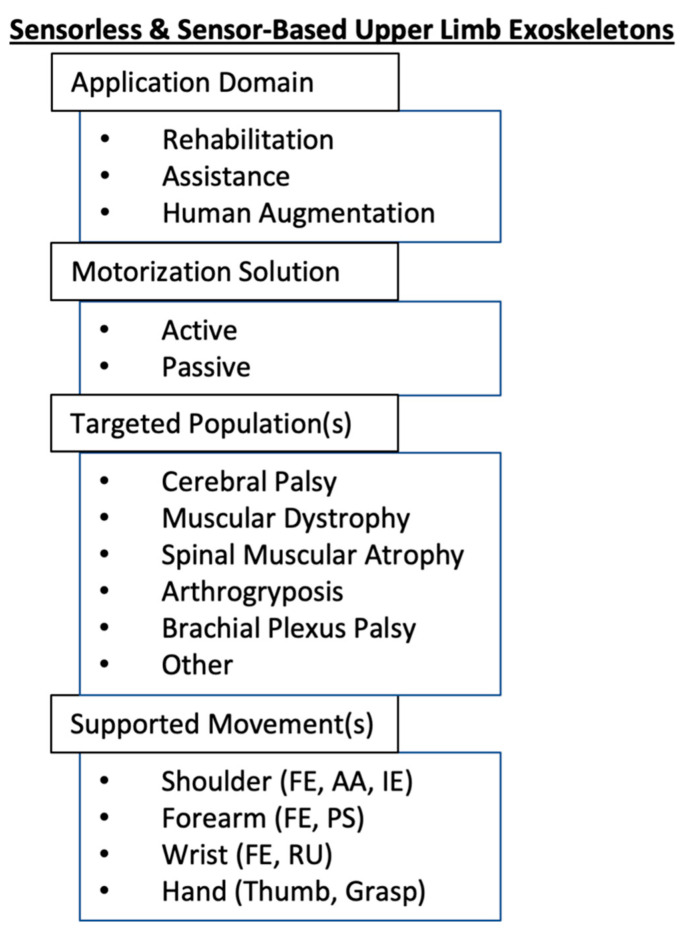
Sensorless and sensor-based upper limb exoskeletons that enhance or support daily motor function are limited for children. This review presents the different needs in pediatrics and the latest trends when developing an upper limb exoskeleton and discusses future prospects to improve accessibility. First, the principal diagnoses in pediatrics and their respective challenge are presented. A total of 14 upper limb exoskeletons aimed for pediatric use were identified in the literature. The exoskeletons were then classified as sensorless or sensor-based, and categorized with respect to the application domain, the motorization solution, the targeted population(s), and the supported movement(s). The relative absence of upper limb exoskeleton in pediatrics is mainly due to the additional complexity required in order to adapt to children's growth and answer their specific needs and usage. This review highlights that research should focus on sensor-based exoskeletons, which would benefit the majority of children by allowing easier adjustment to the children's needs. Sensor-based exoskeletons are often the best solution for children to improve their participation in activities of daily living and limit cognitive, social, and motor impairments during their development.
用于增强或辅助日常运动功能的无传感器和基于传感器的上肢外骨骼在儿童中应用有限。本综述介绍了儿科的不同需求以及开发上肢外骨骼的最新趋势,并讨论了提高可及性的未来前景。首先,介绍了儿科的主要诊断及其各自的挑战。在文献中总共确定了 14 种旨在用于儿科的上肢外骨骼。然后,根据无传感器或基于传感器、应用领域、驱动解决方案、目标人群和支持运动对这些外骨骼进行分类。上肢外骨骼在儿科中的相对缺失主要是由于需要额外的复杂性,以便适应儿童的生长并满足他们的特定需求和使用方式。本综述强调,研究应集中在基于传感器的外骨骼上,这将通过更容易地调整到儿童的需求而使大多数儿童受益。基于传感器的外骨骼通常是改善儿童日常生活活动参与度并限制其在发育过程中认知、社交和运动障碍的最佳解决方案。