López-Viñau Teresa, Peñalva Germán, García-Martínez Lucrecia, Castón Juan José, Muñoz-Rosa Montserrat, Cano Ángela, Recio Manuel, Cisneros José Miguel, Pérez-Nadales Elena, Rumbao Aguirre José, García-Martínez Elena, Salcedo Inmaculada, Del Prado José Ramón, de la Fuente Carmen, Martínez-Martínez Luis, Gracia-Ahufinger Irene, Torre-Cisneros Julián
Pharmacy Unit, Reina Sofia University Hospital, 14004 Cordoba, Spain.
Infectious Diseases Unit, Reina Sofia University Hospital, Maimonides, Biomedical Research Institute of Cordoba (IMIBIC), University of Cordoba (UCO), 14004 Cordoba, Spain.
Antibiotics (Basel). 2021 May 16;10(5):586. doi: 10.3390/antibiotics10050586.
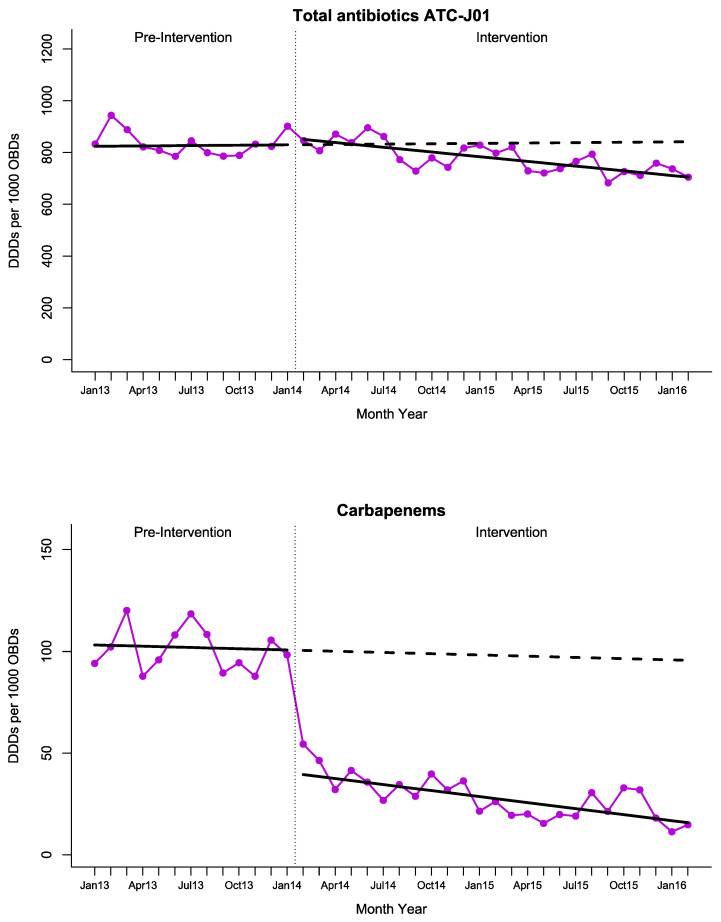
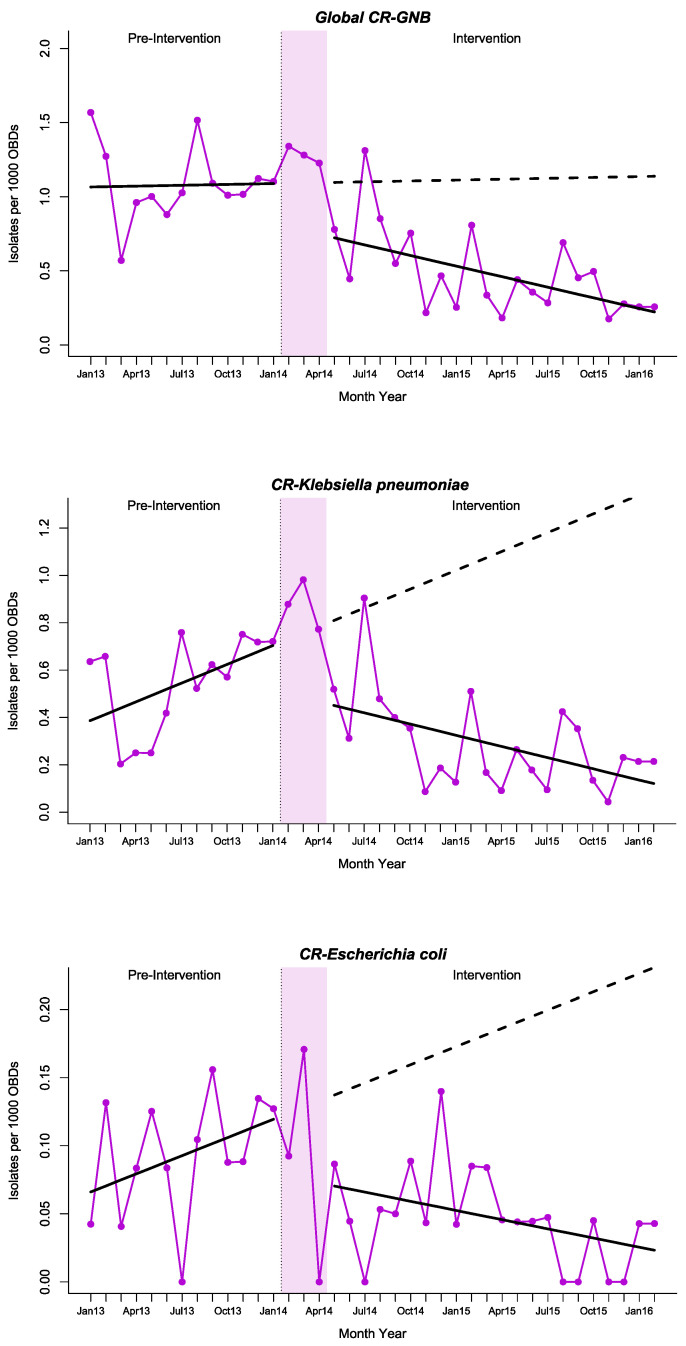
Carbapenem-resistant Gram-negative bacilli (CR-GNB) are a critical public health threat, and carbapenem use contributes to their spread. Antimicrobial stewardship programs (ASPs) have proven successful in reducing antimicrobial use. However, evidence on the impact of carbapenem resistance remains unclear. We evaluated the impact of a multifaceted ASP on carbapenem use and incidence of CR-GNB in a high-endemic hospital. An interrupted time-series analysis was conducted one year before and two years after starting the ASP to assess carbapenem consumption, CR-GNB incidence, death rates of sentinel events, and other variables potentially related to CR-GNB incidence. An intense reduction in carbapenem consumption occurred after starting the intervention and was sustained two years later (relative effect -83.51%; 95% CI -87.23 to -79.79). The incidence density of CR-GNB decreased by -0.915 cases per 1000 occupied bed days (95% CI -1.743 to -0.087). This effect was especially marked in CR- and CR-, reversing the pre-intervention upward trend and leading to a relative reduction of -91.15% (95% CI -105.53 to -76.76) and -89.93% (95% CI -107.03 to -72.83), respectively, two years after starting the program. Death rates did not change. This ASP contributed to decreasing CR-GNB incidence through a sustained reduction in antibiotic use without increasing mortality rates.
耐碳青霉烯革兰氏阴性杆菌(CR-GNB)是对公共卫生的重大威胁,而碳青霉烯类药物的使用助长了它们的传播。抗菌药物管理计划(ASP)已被证明在减少抗菌药物使用方面是成功的。然而,关于碳青霉烯耐药性影响的证据仍不明确。我们评估了一项多方面的ASP对一家高流行医院碳青霉烯类药物使用和CR-GNB发病率的影响。在启动ASP之前一年和之后两年进行了中断时间序列分析,以评估碳青霉烯类药物的消耗量、CR-GNB发病率、哨点事件死亡率以及其他可能与CR-GNB发病率相关的变量。干预开始后,碳青霉烯类药物的消耗量大幅下降,并在两年后持续保持(相对效应-83.51%;95%置信区间-87.23至-79.79)。CR-GNB的发病密度每1000个占用床日减少了-0.915例(95%置信区间-1.743至-0.087)。这种效应在CR-和CR-中尤为明显,扭转了干预前的上升趋势,在项目启动两年后分别导致相对降低-91.15%(95%置信区间-105.53至-76.76)和-89.93%(95%置信区间-107.03至-72.83)。死亡率没有变化。该ASP通过持续减少抗生素使用且不增加死亡率,有助于降低CR-GNB的发病率。