López-Viñau Teresa, Muñoz-Rosa Montserrat, Ruiz-Lara Lidia Mª, García-Martínez Lucrecia, Machuca Isabel, Gracia-Ahufinger Irene, Montero Rafael Ruiz, Castón Juan José, Cano Ángela, Ruiz-Arabi Elisa, Del Prado José Ramón, Salcedo Inmaculada, Martínez-Martínez Luis, Torre-Cisneros Julián
Pharmacy Unit, Reina Sofia University Hospital, 14004 Cordoba, Spain.
Infectious Diseases Unit, Reina Sofia University Hospital, Maimonides. Biomedical Research Institute of Cordoba (IMIBIC), University of Cordoba (UCO), 14004 Cordoba, Spain.
Antibiotics (Basel). 2024 Aug 23;13(9):792. doi: 10.3390/antibiotics13090792.
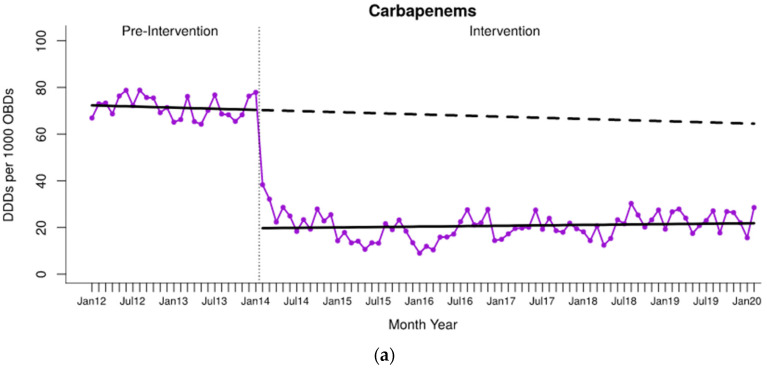
Carbapenem-resistant (CR-Kp) is currently a serious global concern. Antimicrobial stewardship programs (ASPs) are one of the key strategies to overcome this resistance. However, evidence about the long-term clinical and ecological impacts of ASPs is scarce. A multidisciplinary team conducted a multifaceted intervention in a CR-Kp endemic hospital over a 6-year period. We assessed the monthly long-term impacts of ASPs on carbapenem use, incidence density (ID), and crude death rates of hospital-acquired CR-Kp infections. Other variables potentially related to CR-Kp incidence and healthcare activity indicators were monitored. Carbapenem use showed a sustained reduction over the long term, with a difference of -66.19% (95% CI -87.03 to -45.34) between the expected pre-intervention trend consumption value and that obtained six years after starting the program. The ID of CR-Kp also decreased significantly and was maintained over the long term, with a relative reduction of -88.14% (95% CI; -100.4 to -75.85) at the end of the study period. The crude death rate of CR-Kp at 14 and 28 days decreased significantly after the intervention and remained steady after six years. Infection control indicator trends remained stable. This mixed ASP contributed to reducing the high incidence of infections and mortality rates of CR-Kp, achieving a sustained ecological and clinical effect.
耐碳青霉烯类(CR-Kp)目前是一个严重的全球问题。抗菌药物管理计划(ASPs)是克服这种耐药性的关键策略之一。然而,关于ASPs长期临床和生态影响的证据很少。一个多学科团队在一家CR-Kp流行医院进行了为期6年的多方面干预。我们评估了ASPs对碳青霉烯类药物使用、发病率密度(ID)和医院获得性CR-Kp感染粗死亡率的长期月度影响。监测了其他可能与CR-Kp发病率和医疗活动指标相关的变量。碳青霉烯类药物的使用长期持续减少,干预前预期趋势消费值与项目启动六年后获得的值之间的差异为-66.19%(95%CI -87.03至-45.34)。CR-Kp的ID也显著下降并长期维持,在研究期末相对降低了-88.14%(95%CI;-100.4至-75.85)。干预后,CR-Kp在14天和28天的粗死亡率显著下降,并在六年后保持稳定。感染控制指标趋势保持稳定。这种综合的ASPs有助于降低CR-Kp的高感染率和死亡率,实现持续的生态和临床效果。