Elliott Rory, Ryan Aoife A, Aggarwal Aviral, Zhu Nianyong, Steuber Friedrich W, Senge Mathias O, Schmitt Wolfgang
School of Chemistry & AMBER Centre, Trinity College, University of Dublin, Dublin, Ireland.
School of Chemistry, Chair of Organic Chemistry, Trinity Biomedical Science Institute, 152-160 Pearse Street, Trinity College, The University of Dublin, Dublin, Ireland.
Molecules. 2021 May 16;26(10):2955. doi: 10.3390/molecules26102955.
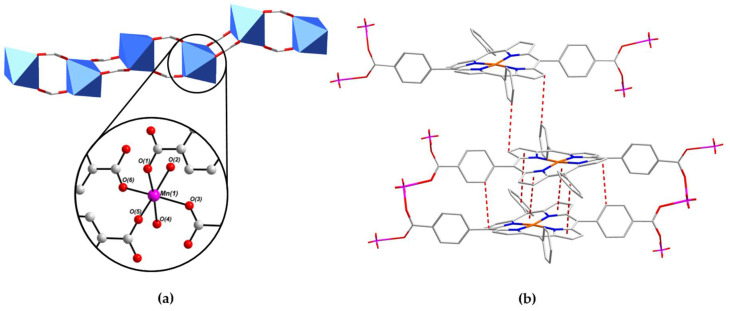
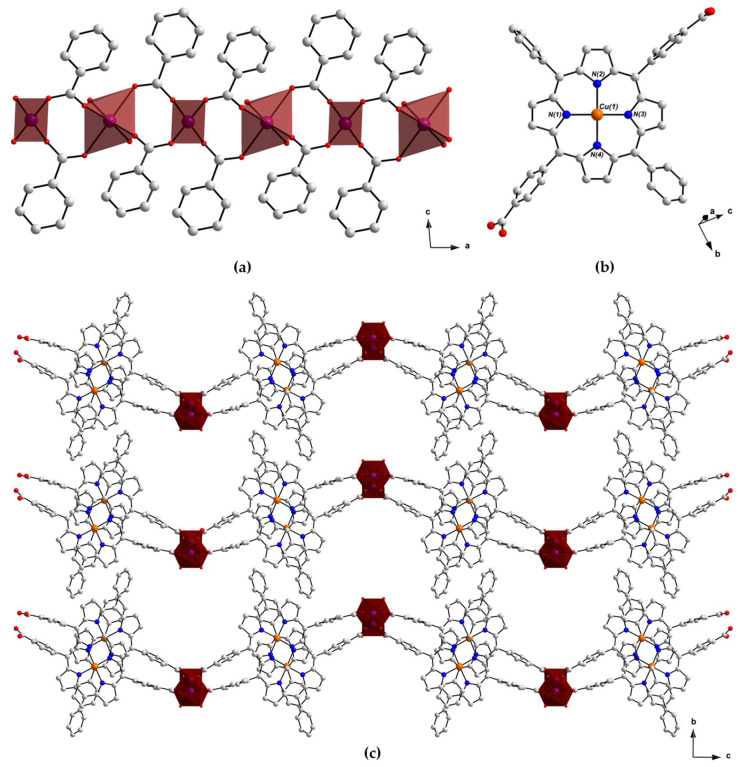
Metal-organic frameworks (MOFs) encompass a rapidly expanding class of materials with diverse potential applications including gas storage, molecular separation, sensing and catalysis. So-called 'rod MOFs', which comprise infinitely extended 1D secondary building units (SBUs), represent an underexplored subclass of MOF. Further, porphyrins are considered privileged ligands for MOF synthesis due to their tunable redox and photophysical properties. In this study, the Cu complex of 5,15-bis(4-carboxyphenyl)-10,20-diphenylporphyrin (H-Cu, where H refers to the ligand's carboxyl H atoms) is used to prepare two new 2D porphyrinic rod MOFs PROD-1 and PROD-2. Single-crystal X-ray analysis reveals that these frameworks feature 1D Mn- or Co-based rod-like SBUs that are coordinated by labile solvent molecules and photoactive porphyrin moieties. Both materials were characterised using infrared (IR) spectroscopy, powder X-ray diffraction (PXRD) spectroscopy and thermogravimetric analysis (TGA). The structural attributes of PROD-1 and PROD-2 render them promising materials for future photocatalytic investigations.
金属有机框架材料(MOFs)是一类迅速发展的材料,具有多种潜在应用,包括气体储存、分子分离、传感和催化。所谓的“棒状MOFs”,由无限延伸的一维二级结构单元(SBUs)组成,是MOF中一个尚未充分探索的子类。此外,卟啉因其可调谐的氧化还原和光物理性质,被认为是MOF合成中的特权配体。在本研究中,5,15-双(4-羧基苯基)-10,20-二苯基卟啉的铜配合物(H-Cu,其中H指配体的羧基氢原子)用于制备两种新的二维卟啉棒状MOFs PROD-1和PROD-2。单晶X射线分析表明,这些框架具有一维基于锰或钴的棒状SBUs,它们由不稳定的溶剂分子和光活性卟啉部分配位。两种材料都使用红外(IR)光谱、粉末X射线衍射(PXRD)光谱和热重分析(TGA)进行了表征。PROD-1和PROD-2的结构特性使其成为未来光催化研究的有前景的材料。