Campbell Jiovan, Sarkhosh Ali, Habibi Fariborz, Gajjar Pranavkumar, Ismail Ahmed, Tsolova Violeta, El-Sharkawy Islam
Center for Viticulture and Small Fruit Research, College of Agriculture and Food Sciences, Florida A&M University, Tallahassee, FL 32308, USA.
Horticultural Sciences Department, University of Florida, Gainesville, FL 32611, USA.
Foods. 2021 May 16;10(5):1101. doi: 10.3390/foods10051101.
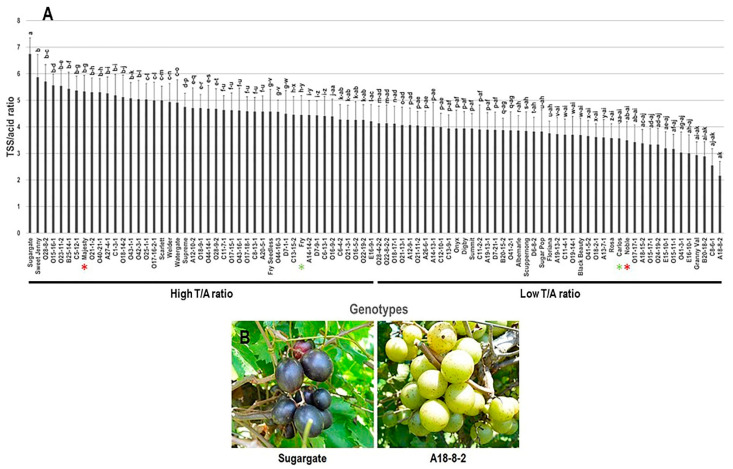
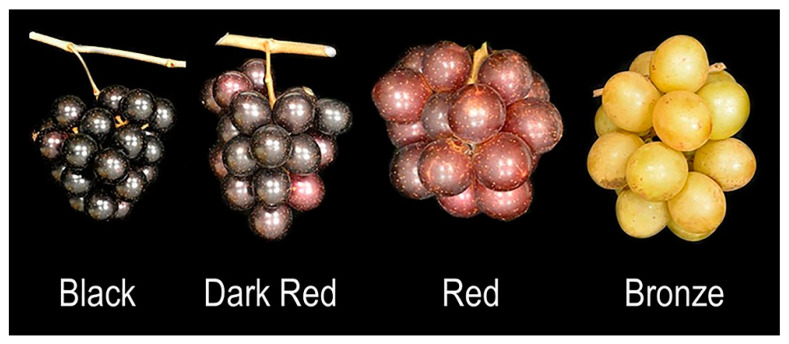
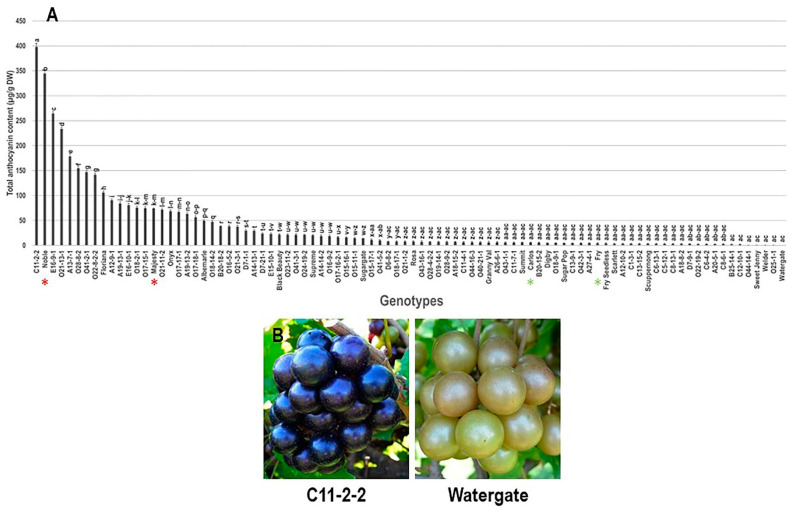
Biochemical juice attributes and color-related traits of muscadine grape genotypes have been investigated. For this study, 90 muscadine genotypes, including 21 standard cultivars, 60 breeding lines, and 9 hybrids (VM), were evaluated. The biochemical properties of total soluble solids (TSS), titratable acidity, and TSS/Acid (T/A) ratio showed modest diversity among genotypes with a range of 10.3 °Brix, 2.1 mg tartaric acid/L, and 4.6, respectively. Nonetheless, the pH trait exhibited a tight range of 0.74 among the population with a minimum and maximum pH of 3.11 ± 0.12 and 3.85 ± 0.12. Color-related traits showed more deviation between individuals. Total anthocyanin content (TAC), luminosity index (L*), hue angle (°), and chroma index (C*) displayed a range of 398 µg/g DW, 33.2, 352.1, and 24, respectively. The hierarchical clustering map classified the population into two large groups of colored and non-colored grapes based on L* and °, suggesting the predominance of these two characters among the population. The colored berries genotypes clade was further divided into several sub-clades depending on C*, TAC, and TSS levels. The principal component analysis (PCA) separated the four-color characteristics into two groups with a negative correlation between them, L* and C* versus TAC and °. Further, PCA suggested the positive influence of acidity in enhancing the different nutraceutical components. Despite the nature of anthocyanins as a member of phenolic compounds, a lack of significant correlation between TAC and nutraceutical-related traits was detected. The dissimilatory matrix analysis highlighted the muscadine individuals C11-2-2, E16-9-1, O21-13-1, and Noble as particular genotypes among the population due to enhanced color characteristics.
已对圆叶葡萄基因型的生化汁液特性和颜色相关性状进行了研究。在本研究中,对90个圆叶葡萄基因型进行了评估,其中包括21个标准品种、60个育种系和9个杂交种(VM)。总可溶性固形物(TSS)、可滴定酸度和TSS/酸(T/A)比的生化特性在基因型之间表现出适度的差异,范围分别为10.3°Brix、2.1毫克酒石酸/升和4.6。尽管如此,pH值性状在群体中的范围很窄,为0.74,最低和最高pH值分别为3.11±0.12和3.85±0.12。颜色相关性状在个体之间表现出更大的差异。总花青素含量(TAC)、亮度指数(L*)、色调角(°)和色度指数(C*)的范围分别为398微克/克干重、33.2、352.1和24。层次聚类图根据L和°将群体分为有色和无色葡萄两大组,表明这两个性状在群体中占主导地位。有色浆果基因型分支根据C、TAC和TSS水平进一步分为几个子分支。主成分分析(PCA)将四种颜色特征分为两组,它们之间呈负相关,即L和C与TAC和°。此外,PCA表明酸度对增强不同营养成分有积极影响。尽管花青素是酚类化合物的一员,但未检测到TAC与营养相关性状之间存在显著相关性。异化矩阵分析突出了圆叶葡萄个体C11-2-2、E16-9-1、O21-13-1和诺布尔是群体中具有增强颜色特征的特殊基因型。