
壳聚糖涂覆光纤布拉格光栅(FBG)湿度传感。
Humidity Sensing by Chitosan-Coated Fibre Bragg Gratings (FBG).
机构信息
Photonics Micro and Nanostructures Laboratory, Fusion and Technologies for Nuclear Safety and Security Department, FSN-TECFIS-MNF, ENEA C.R. Frascati, Via E. Fermi, 45, 00044 Frascati, RM, Italy.
出版信息
Sensors (Basel). 2021 May 12;21(10):3348. doi: 10.3390/s21103348.
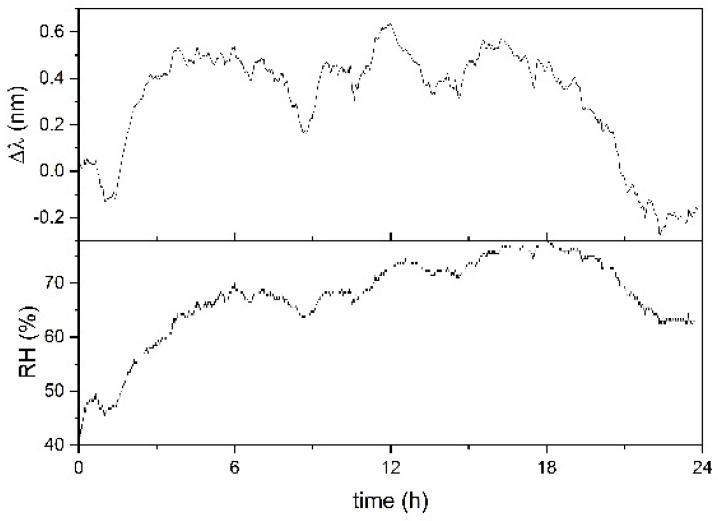
In this work, we report novel relative humidity sensors realized by functionalising fibre Bragg gratings with chitosan, a moisture-sensitive biopolymer never used before for this kind of fibre optic sensor. The swelling capacity of chitosan is fundamental to the sensing mechanism. Different samples were fabricated, testing the influence of coating design and deposition procedure on sensor performance. The sensitivity of the sensors was measured in an airtight humidity-controlled chamber using saturated chemical salt solutions. The best result in terms of sensitivity was obtained for a sensor produced on filter paper substrate. Tests for each design were performed in the environment, lasted several days, and all designs were independently re-tested at different seasons of the year. The produced sensors closely followed the ambient humidity variation common to the 24-h circadian cycle.
在这项工作中,我们报告了一种新型的相对湿度传感器,该传感器通过壳聚糖功能化光纤布拉格光栅实现,壳聚糖是一种以前从未用于这种光纤传感器的水分敏感生物聚合物。壳聚糖的溶胀能力是传感机制的基础。制备了不同的样品,测试了涂层设计和沉积过程对传感器性能的影响。使用密闭湿度控制腔室中的饱和化学盐溶液测量传感器的灵敏度。在滤纸衬底上制备的传感器获得了最佳灵敏度。对每种设计进行了环境测试,持续了数天,并且对不同季节的每种设计都进行了独立的重新测试。所制备的传感器紧密跟踪了常见的 24 小时昼夜节律的环境湿度变化。




 Zotero 插件