Gholizadeh Pouya, Onuchukwu Ikechukwu S, Esmaeili Behzad
Sid and Reva Dewberry Department of Civil, Environmental and Infrastructure Engineering, Volgenau School of Engineering, George Mason University, Fairfax, VA 22030, USA.
Int J Environ Res Public Health. 2021 May 12;18(10):5126. doi: 10.3390/ijerph18105126.
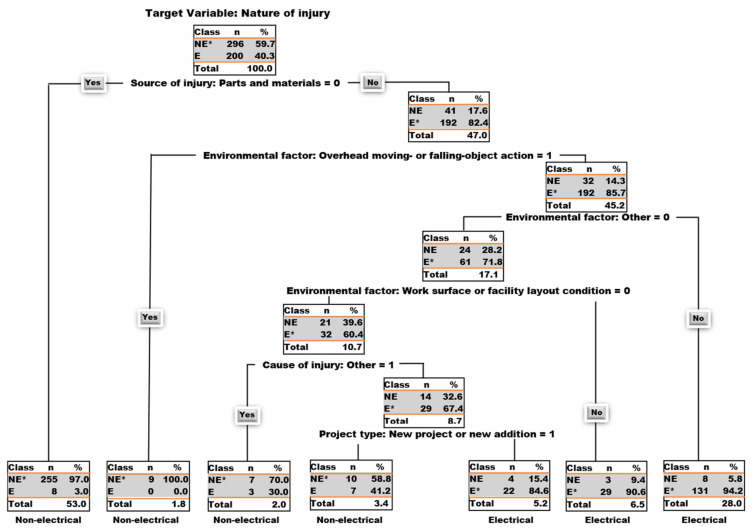
This study used methodologies of descriptive and quantitative statistics to identify the contributing factors most affecting occupational accident outcomes among electrical contracting enterprises, given an accident occurred. Accident reports were collected from the Occupational Safety and Health Administration's fatality and catastrophe database. To ensure the reliability of the data, the team manually codified more than 600 incidents through a comprehensive content analysis using injury-classification standards. Inclusive of both fatal and non-fatal injuries, the results showed that most accidents happened in , , and (i.e., $50,000 or less). The main source of injuries manifested in (46%), followed by (19%), and (16%). The most frequent types of injuries were (31%), (27%), and (14%); the main injured body parts were (25%), (23%), and (18%). Among non-fatal cases, (37%), (36%), and (19%) caused most injuries; among fatal cases, was the leading cause of death (50%), followed by (28%) and (19%). The analysis also investigated the impact of several accident factors on the degree of injuries and found significant effects from such factors such as , , , , , and . In other words, the statistical probability of a fatal accident-given an accident occurrence-changes significantly based on the degree of these factors. The results of this study, as depicted in the proposed decision tree model, revealed that the most important factor for predicting the nature of injury (electrical or non-electrical) is: whether the source of injury is ; followed by whether the source of injury is . In other words, in predicting (with a 94.31% accuracy) the nature of injury as electrical or non-electrical, whether the source of injury is and whether the source of injury is are very important. Seven decision rules were derived from the proposed decision tree model. Beyond these outcomes, the described methodology contributes to the accident-analysis body of knowledge by providing a framework for codifying data from accident reports to facilitate future analysis and modeling attempts to subsequently mitigate more injuries in other fields.
本研究采用描述性和定量统计方法,以确定在发生事故的情况下,对电气承包企业职业事故结果影响最大的因素。事故报告取自职业安全与健康管理局的死亡和灾难数据库。为确保数据的可靠性,研究团队通过使用伤害分类标准进行全面的内容分析,对600多起事故进行了人工编码。包括致命伤和非致命伤在内,结果显示,大多数事故发生在 、 和 (即5万美元或以下)。受伤的主要来源表现为 (46%),其次是 (19%)和 (16%)。最常见的伤害类型是 (31%)、 (27%)和 (14%);主要受伤身体部位是 (25%)、 (23%)和 (18%)。在非致命案例中, (37%)、 (36%)和 (19%)造成的伤害最多;在致命案例中, 是主要死因(50%),其次是 (28%)和 (19%)。分析还调查了几个事故因素对伤害程度的影响,发现 、 、 、 、 和 等因素有显著影响。换句话说,给定事故发生的情况下,致命事故的统计概率会根据这些因素的程度而显著变化。本研究结果如所提出的决策树模型所示,表明预测伤害性质(电气或非电气)的最重要因素是:伤害源是否为 ;其次是伤害源是否为 。换句话说,在预测(准确率为94.31%)伤害性质是电气还是非电气时,伤害源是否为 和伤害源是否为 非常重要。从所提出的决策树模型中得出了七条决策规则。除了这些结果外,所描述的方法通过提供一个对事故报告数据进行编码的框架,为事故分析知识体系做出了贡献,以促进未来的分析和建模尝试,从而在其他领域减少更多伤害。