Jabaudon Matthieu, Pereira Bruno, Laroche Erwan, Roszyk Laurence, Blondonnet Raiko, Audard Jules, Godet Thomas, Futier Emmanuel, Bazin Jean-Etienne, Sapin Vincent, Bastarache Julie A, Ware Lorraine B, Constantin Jean-Michel
Department of Perioperative Medicine, CHU Clermont-Ferrand, 63000 Clermont-Ferrand, France.
GReD, CNRS, INSERM, Université Clermont Auvergne, 63000 Clermont-Ferrand, France.
J Clin Med. 2021 May 12;10(10):2076. doi: 10.3390/jcm10102076.
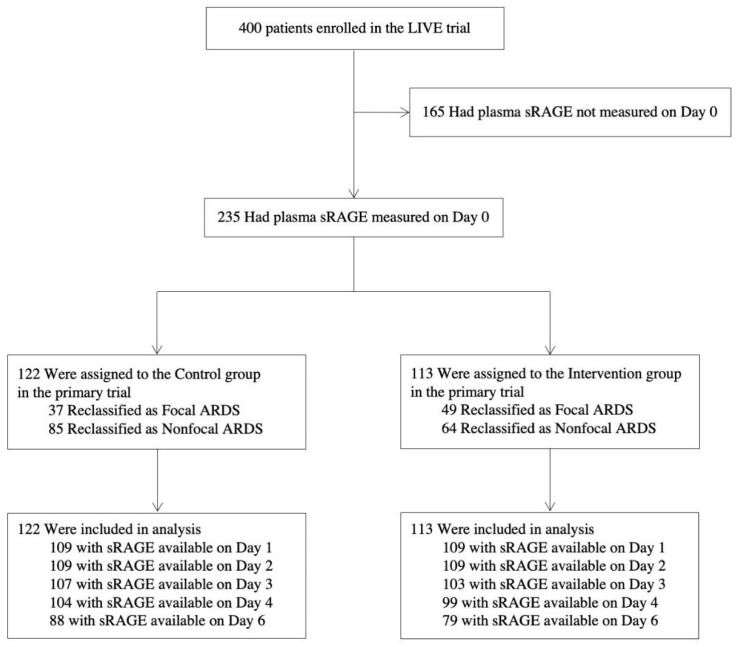
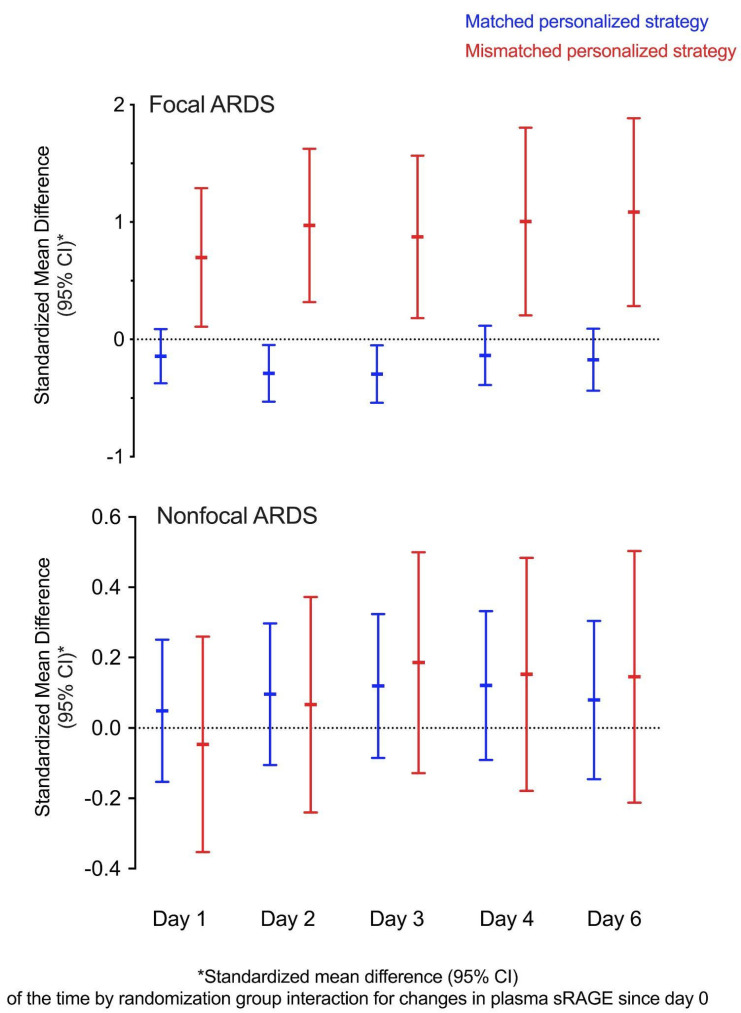
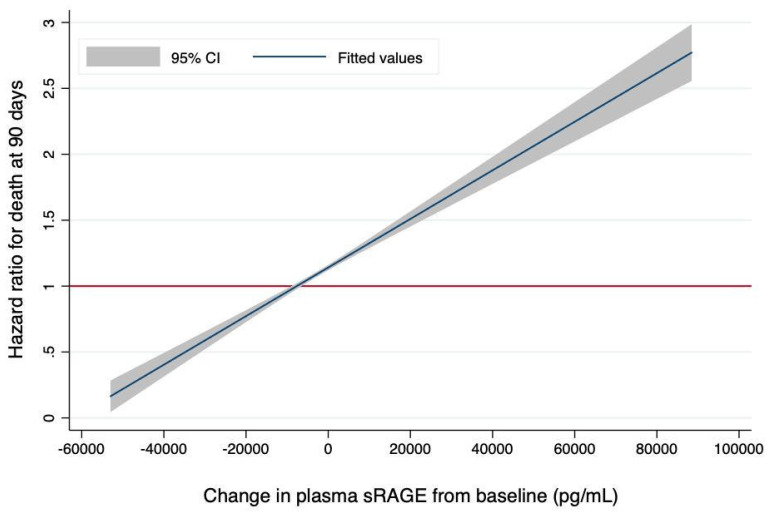
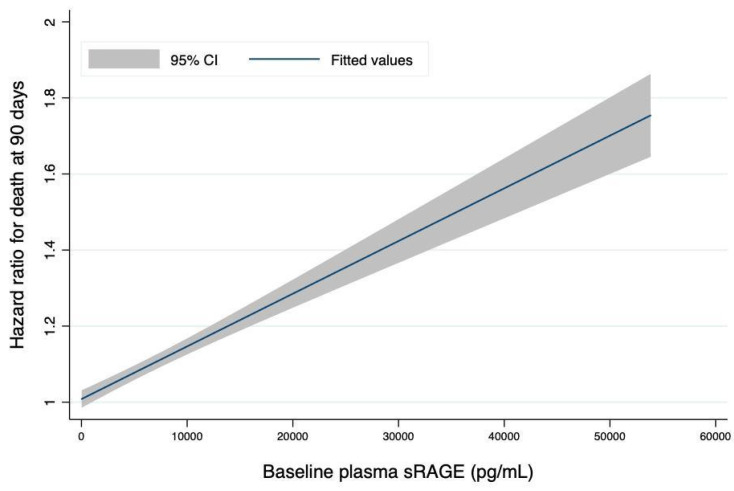
The plasma soluble receptor for advanced glycation end-products (sRAGE) is a marker of lung epithelial injury with prognostic value when measured at baseline in acute respiratory distress syndrome (ARDS). However, whether changes in plasma sRAGE could inform prognosis in ARDS remains unknown. In this secondary analysis of the Lung Imaging for Ventilator Setting in ARDS (LIVE) multicenter randomized controlled trial, which evaluated a personalized ventilation strategy tailored to lung morphology, plasma sRAGE was measured upon study entry (baseline) and on days one, two, three, four and six. The association between changes in plasma sRAGE over time and 90-day survival was evaluated. Higher baseline plasma sRAGE (HR per-one log increment, 1.53; 95% CI, 1.16-2.03; = 0.003) and an increase in sRAGE over time (HR for each one-log increment in plasma sRAGE per time unit, 1.01; 95% CI, 1.01-1.02; < 10) were both associated with increased 90-day mortality. Each 100-unit increase in the plasma sRAGE level per unit of time increased the risk of death at day 90 by 1% in joint modeling. Plasma sRAGE increased over time when a strategy of maximal alveolar recruitment was applied in patients with focal ARDS. Current findings suggest that the rate of change in plasma sRAGE over time is associated with 90-day survival and could be helpful as a surrogate outcome in ARDS.
血浆晚期糖基化终产物可溶性受体(sRAGE)是肺上皮损伤的标志物,在急性呼吸窘迫综合征(ARDS)患者基线时进行检测具有预后价值。然而,血浆sRAGE的变化是否能为ARDS的预后提供信息仍不清楚。在这项针对ARDS患者通气设置的肺部成像(LIVE)多中心随机对照试验的二次分析中,该试验评估了一种根据肺形态量身定制的个性化通气策略,在研究入组时(基线)以及第1、2、3、4和6天测量血浆sRAGE。评估了血浆sRAGE随时间的变化与90天生存率之间的关联。较高的基线血浆sRAGE(每增加一个对数单位的风险比,1.53;95%置信区间,1.16 - 2.03;P = 0.003)以及sRAGE随时间增加(每单位时间血浆sRAGE每增加一个对数单位的风险比,1.01;95%置信区间,1.01 - 1.02;P < 0.001)均与90天死亡率增加相关。在联合模型中,每单位时间血浆sRAGE水平每增加100个单位,90天时的死亡风险增加1%。在局灶性ARDS患者中应用最大肺泡复张策略时,血浆sRAGE随时间增加。目前的研究结果表明,血浆sRAGE随时间的变化率与90天生存率相关,并且在ARDS中作为替代结局可能会有所帮助。