Wohlt Daria, Schwarz Elena, Schieber Andreas, Bader-Mittermaier Stephanie
Department of Food Process Development, Fraunhofer Institute for Process Engineering and Packaging IVV, 85354 Freising, Germany.
Institute of Nutritional and Food Sciences, Molecular Food Technology, University of Bonn, 53115 Bonn, Germany.
Foods. 2021 May 8;10(5):1022. doi: 10.3390/foods10051022.
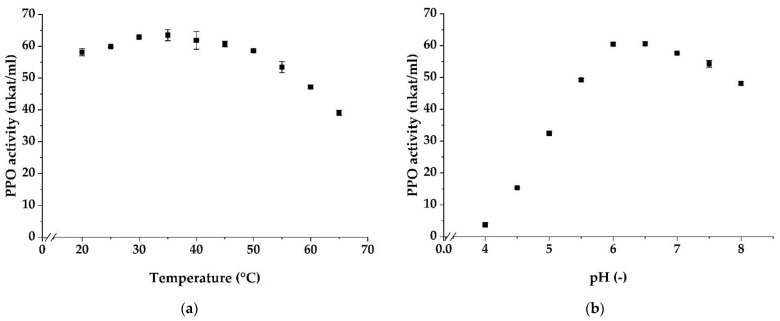
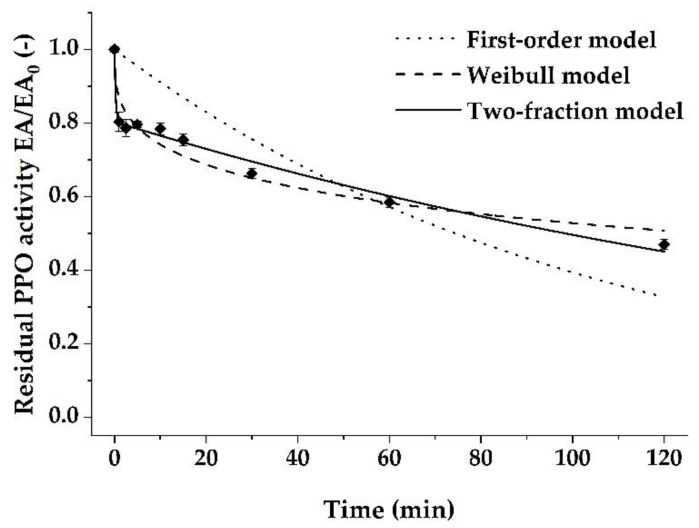
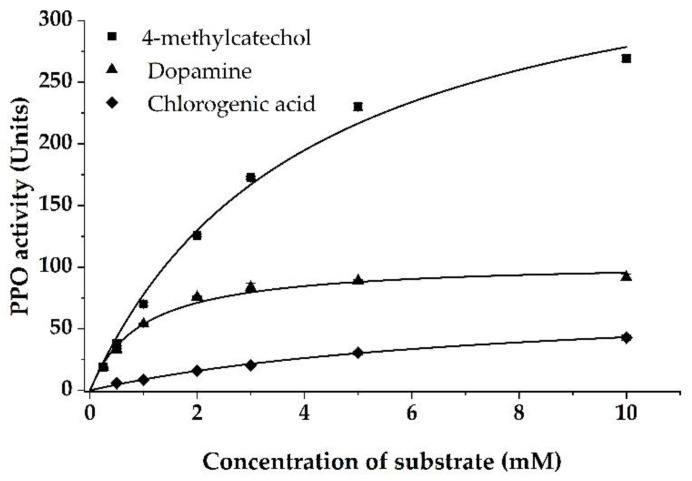
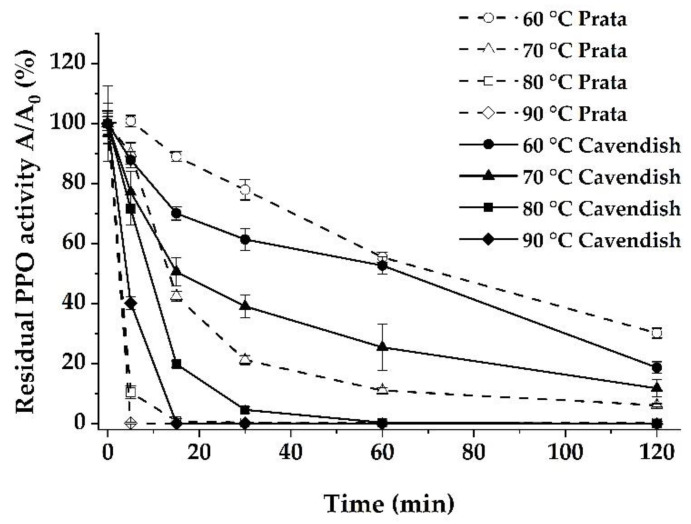
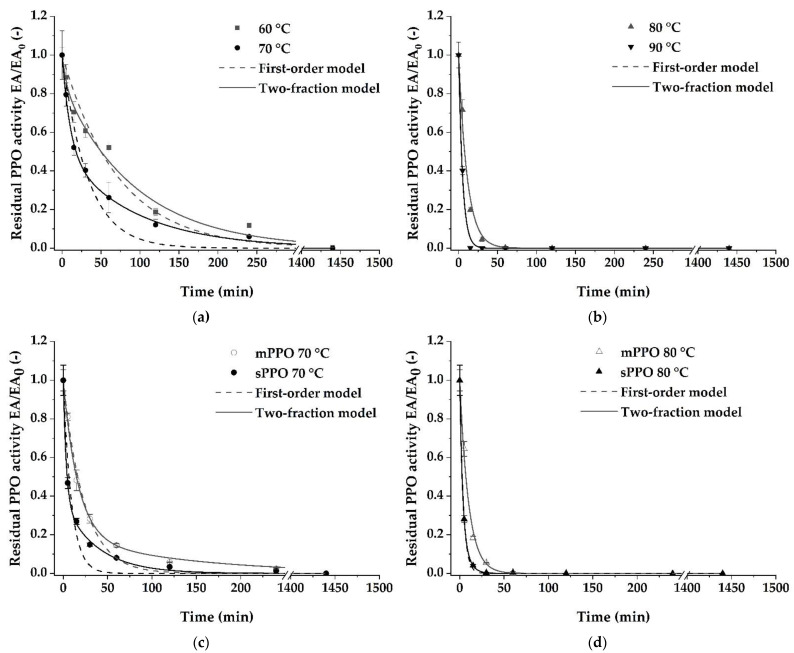
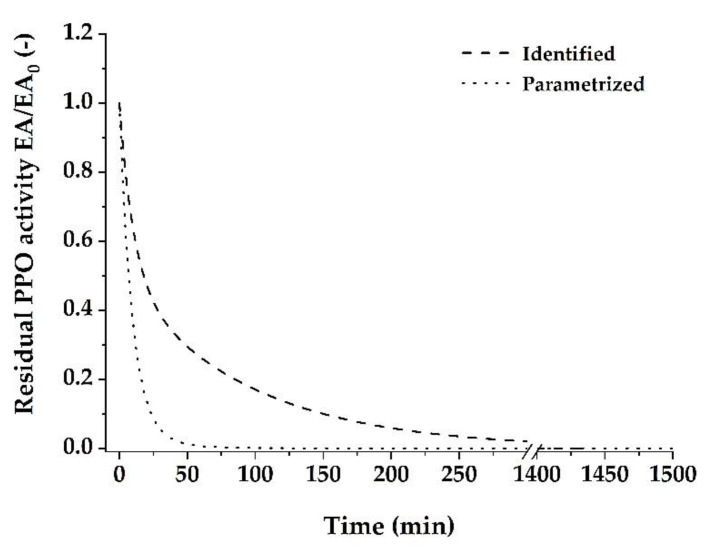
The objective of this work was to characterize banana peel polyphenol oxidase (PPO) and to study the inactivation kinetics during thermal and cold atmospheric pressure plasma treatment. Since varietal differences in enzyme characteristics are a well-known phenomenon, 'Prata' banana peel PPO was characterized, and PPO activity and thermal stability of the peel PPO of the two dessert banana cultivars 'Cavendish' and 'Prata' were compared to identify the cultivar better suited for industrial food applications. A crude extract obtained from the peels of the Brazilian banana variety 'Prata' revealed highest PPO activities (46.0-55.2 nkat/mL) at 30-40 °C in a range of pH 6.0-6.5 after addition of 0.5 g/g polyvinylpyrrolidone and 0.5% (/) Triton X-100 during extraction. 'Cavendish' PPO activity was four times higher. Banana peel PPO exhibited the highest affinity towards dopamine ( = 0.94 mM). Thermal inactivation of 'Prata' and 'Cavendish' PPO was achieved at 90 °C after 5 and 15 min, respectively, whereas cold plasma treatment did not decrease PPO activity below 46% of the initial enzyme activity. The inactivation behavior of PPO could successfully be described by a two-fraction model indicating at least two types of isoenzymes with different thermal stability. The overall high thermal stability was mainly attributed to membrane-bound PPO. The results may help to prevent enzymatic browning of banana peels and thereby facilitate their valorization as food ingredients.
这项工作的目的是对香蕉皮多酚氧化酶(PPO)进行表征,并研究其在热和冷大气压等离子体处理过程中的失活动力学。由于酶特性的品种差异是一个众所周知的现象,因此对‘Prata’香蕉皮PPO进行了表征,并比较了两个甜点香蕉品种‘Cavendish’和‘Prata’的皮PPO的活性和热稳定性,以确定更适合工业食品应用的品种。从巴西香蕉品种‘Prata’的果皮中获得的粗提物在提取过程中添加0.5 g/g聚乙烯吡咯烷酮和0.5%(/) Triton X-100后,在pH 6.0 - 6.5范围内,于30 - 40 °C时显示出最高的PPO活性(46.0 - 55.2 nkat/mL)。‘Cavendish’的PPO活性高四倍。香蕉皮PPO对多巴胺表现出最高亲和力( = 0.94 mM)。‘Prata’和‘Cavendish’PPO的热失活分别在90 °C下5分钟和15分钟后实现,而冷等离子体处理并未使PPO活性降低至初始酶活性的46%以下。PPO的失活行为可以成功地用双组分模型描述,表明至少有两种具有不同热稳定性的同工酶。整体较高的热稳定性主要归因于膜结合的PPO。这些结果可能有助于防止香蕉皮的酶促褐变,从而促进其作为食品成分的价值提升。