O'Dwyer Joanne, Murphy Robert, González-Vázquez Arlyng, Kovarova Lenka, Pravda Martin, Velebny Vladimir, Heise Andreas, Duffy Garry P, Cryan Sally Ann
Drug Delivery & Advanced Materials Team, School of Pharmacy & Biomolecular Sciences, Royal College of Surgeons in Ireland (RCSI), Dublin 2, Ireland.
Tissue Engineering Research Group, Department of Anatomy & Regenerative Medicine, Royal College of Surgeons in Ireland (RCSI), Dublin 2, Ireland.
Pharmaceutics. 2021 May 22;13(6):779. doi: 10.3390/pharmaceutics13060779.
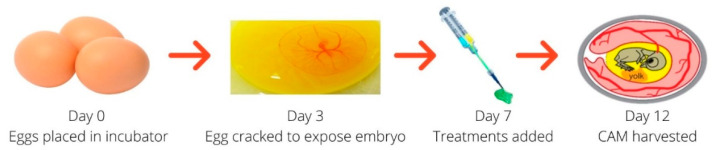
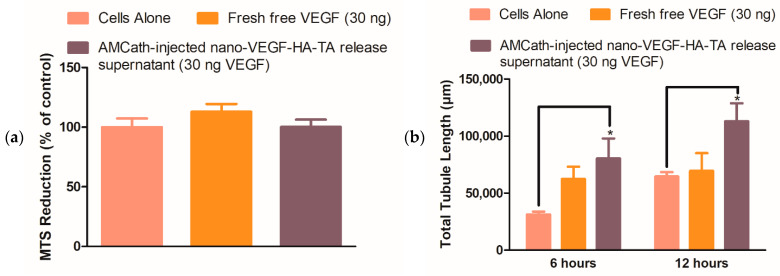
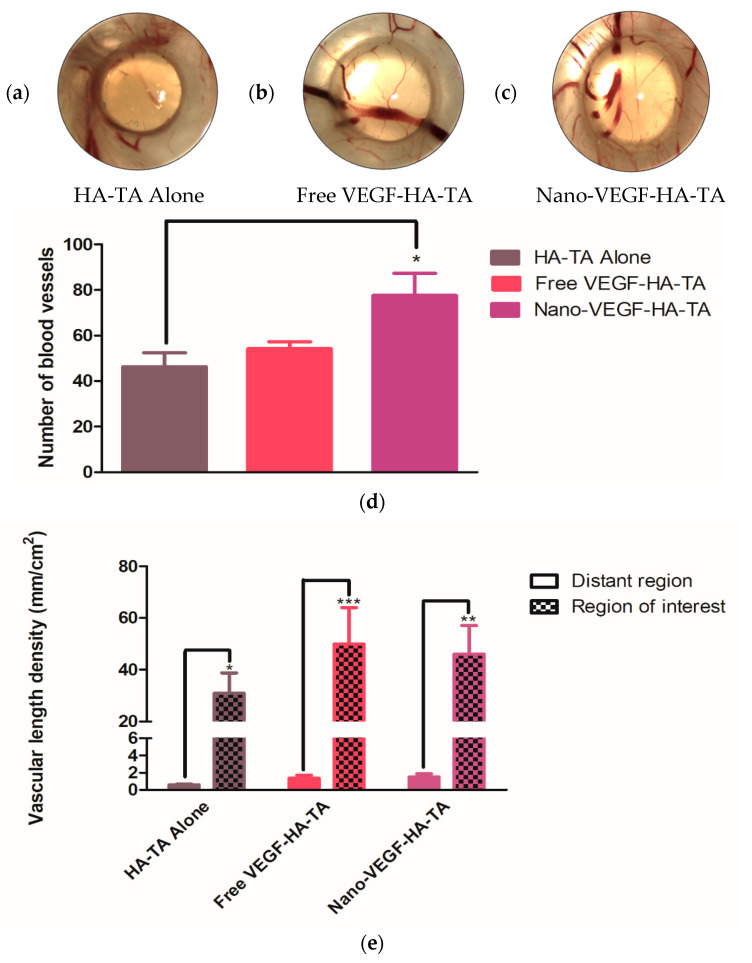
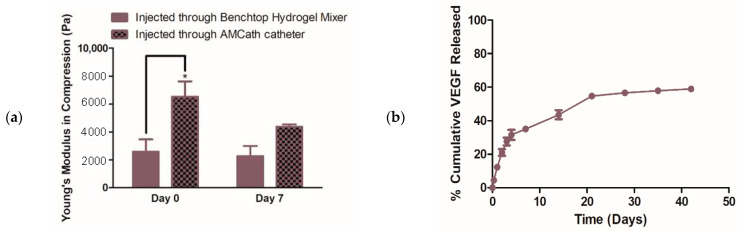
Heart failure has a five-year mortality rate approaching 50%. Inducing angiogenesis following a myocardial infarction is hypothesized to reduce cardiomyocyte death and tissue damage, thereby preventing heart failure. Herein, a novel nano-in-gel delivery system for vascular endothelial growth factor (VEGF), composed of star-shaped polyglutamic acid-VEGF nanoparticles in a tyramine-modified hyaluronic acid hydrogel (nano-VEGF-HA-TA), is investigated. The ability of the nano-VEGF-HA-TA system to induce angiogenesis is assessed in vivo using a chick chorioallantoic membrane model (CAM). The formulation is then integrated with a custom-made, clinically relevant catheter suitable for minimally invasive endocardial delivery and the effect of injection on hydrogel properties is examined. Nano-VEGF-HA-TA is biocompatible on a CAM assay and significantly improves blood vessel branching ( < 0.05) and number ( < 0.05) compared to a HA-TA hydrogel without VEGF. Nano-VEGF-HA-TA is successfully injected through a 1.2 m catheter, without blocking or breaking the catheter and releases VEGF for 42 days following injection in vitro. The released VEGF retains its bioactivity, significantly improving total tubule length on a Matrigel assay and human umbilical vein endothelial cell migration on a Transwell migration assay. This VEGF-nano in a HA-TA hydrogel delivery system is successfully integrated with an appropriate device for clinical use, demonstrates promising angiogenic properties in vivo and is suitable for further clinical translation.
心力衰竭的五年死亡率接近50%。据推测,心肌梗死后诱导血管生成可减少心肌细胞死亡和组织损伤,从而预防心力衰竭。在此,研究了一种用于血管内皮生长因子(VEGF)的新型凝胶内纳米递送系统,其由酪胺修饰的透明质酸水凝胶(纳米VEGF-HA-TA)中的星形聚谷氨酸-VEGF纳米颗粒组成。使用鸡胚绒毛尿囊膜模型(CAM)在体内评估纳米VEGF-HA-TA系统诱导血管生成的能力。然后将该制剂与适合微创心内膜递送的定制临床相关导管整合,并检查注射对水凝胶性质的影响。在CAM试验中,纳米VEGF-HA-TA具有生物相容性,与不含VEGF的HA-TA水凝胶相比,可显著改善血管分支(<0.05)和数量(<0.05)。纳米VEGF-HA-TA成功通过1.2米长的导管注射,未堵塞或折断导管,且在体外注射后可释放VEGF达42天。释放的VEGF保留其生物活性,在基质胶试验中显著改善总小管长度,在Transwell迁移试验中显著改善人脐静脉内皮细胞迁移。这种HA-TA水凝胶递送系统中的VEGF纳米制剂成功地与适合临床使用的装置整合,在体内显示出有前景的血管生成特性,适合进一步的临床转化。