Niggli Cédric, Pape Hans-Christoph, Niggli Philipp, Mica Ladislav
Department of Trauma Surgery, University Hospital Zurich, 8091 Zurich, Switzerland.
Department of Mathematics, ETH Zurich, 8092 Zurich, Switzerland.
J Clin Med. 2021 May 14;10(10):2115. doi: 10.3390/jcm10102115.
Big data-based artificial intelligence (AI) has become increasingly important in medicine and may be helpful in the future to predict diseases and outcomes. For severely injured patients, a new analytics tool has recently been developed (WATSON Trauma Pathway Explorer) to assess individual risk profiles early after trauma. We performed a validation of this tool and a comparison with the Trauma and Injury Severity Score (TRISS), an established trauma survival estimation score. Prospective data collection, level I trauma centre, 1 January 2018-31 December 2019.
Primary admission for trauma, injury severity score (ISS) ≥ 16, age ≥ 16.
Age, ISS, temperature, presence of head injury by the Glasgow Coma Scale (GCS).
SIRS and sepsis within 21 days and early death within 72 h after hospitalisation.
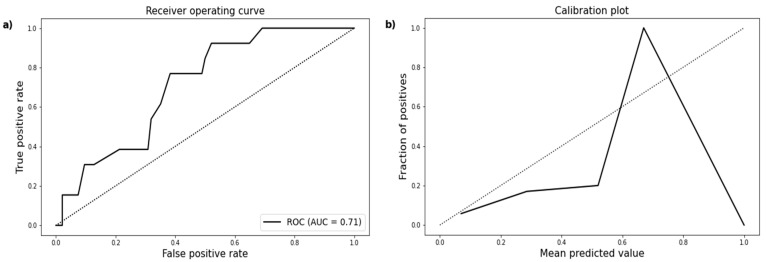
Area under the receiver operating characteristic (ROC) curve for predictive quality, calibration plots for graphical goodness of fit, Brier score for overall performance of WATSON and TRISS. Between 2018 and 2019, 107 patients were included (33 female, 74 male; mean age 48.3 ± 19.7; mean temperature 35.9 ± 1.3; median ISS 30, IQR 23-36). The area under the curve (AUC) is 0.77 (95% CI 0.68-0.85) for SIRS and 0.71 (95% CI 0.58-0.83) for sepsis. WATSON and TRISS showed similar AUCs to predict early death (AUC 0.90, 95% CI 0.79-0.99 vs. AUC 0.88, 95% CI 0.77-0.97; = 0.75). The goodness of fit of WATSON ( = 8.19, Hosmer-Lemeshow = 0.42) was superior to that of TRISS ( = 31.93, Hosmer-Lemeshow < 0.05), as was the overall performance based on Brier score (0.06 vs. 0.11 points). The validation supports previous reports in terms of feasibility of the WATSON Trauma Pathway Explorer and emphasises its relevance to predict SIRS, sepsis, and early death when compared with the TRISS method.
基于大数据的人工智能(AI)在医学领域变得越来越重要,未来可能有助于预测疾病和预后。对于重伤患者,最近开发了一种新的分析工具(沃森创伤路径探索器),用于在创伤后早期评估个体风险概况。我们对该工具进行了验证,并与创伤和损伤严重程度评分(TRISS)进行了比较,TRISS是一种既定的创伤生存估计评分。前瞻性数据收集,一级创伤中心,2018年1月1日至2019年12月31日。
因创伤首次入院,损伤严重程度评分(ISS)≥16,年龄≥16岁。
年龄、ISS、体温、格拉斯哥昏迷量表(GCS)评定的头部损伤情况。
住院后21天内发生全身炎症反应综合征(SIRS)和脓毒症,以及72小时内早期死亡。
预测质量的受试者操作特征(ROC)曲线下面积、拟合优度的校准图、沃森和TRISS整体性能的Brier评分。2018年至2019年期间,共纳入107例患者(女性33例,男性74例;平均年龄48.3±19.7岁;平均体温35.9±1.3℃;ISS中位数30,四分位数间距23 - 36)。SIRS的曲线下面积(AUC)为0.77(95%可信区间0.68 - 0.85),脓毒症的AUC为0.71(95%可信区间0.58 - 0.83)。沃森和TRISS预测早期死亡的AUC相似(AUC 0.90,95%可信区间0.79 - 0.99 vs. AUC 0.88,95%可信区间0.77 - 0.97;P = 0.75)。沃森的拟合优度(χ² = 8.19,Hosmer - Lemeshow检验P = 0.42)优于TRISS(χ² = 31.93,Hosmer - Lemeshow检验P < 0.05),基于Brier评分的整体性能也是如此(0.06分对0.11分)。该验证在沃森创伤路径探索器的可行性方面支持了先前的报告,并强调了与TRISS方法相比,其在预测SIRS、脓毒症和早期死亡方面的相关性。