Ma Tian, Li Lei, Zhao Yang, Hua Chen, Sun Zhengxi, Li Tao
Key Laboratory of Plant Functional Genomics of the Ministry of Education, Jiangsu Key Laboratory of Crop Genomics and Molecular Breeding, Collaborative Innovation of Modern Crops and Food Crops in Jiangsu, Jiangsu Key Laboratory of Crop Genetics and Physiology, College of Agriculture, Yangzhou University, Yangzhou 225009, China.
Biology (Basel). 2021 May 14;10(5):437. doi: 10.3390/biology10050437.
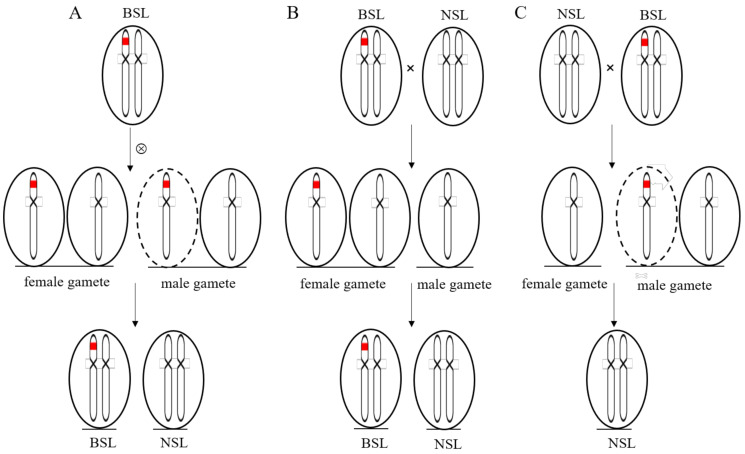
Wheat ( L.) spike architecture is an important trait associated with spike development and grain yield. Here, we report a naturally occurring wheat mutant with branched spikelets (BSL) from its wild-type YD-16, which has a normal spike trait and confers a moderate level of resistance to wheat Fusarium head blight (FHB). The lateral meristems positioned at the basal parts of the rachis node of the BSL mutant develop into ramified spikelets characterized as multiple spikelets. The BSL mutant shows three to four-day longer growth period but less 1000-grain weight than the wild type, and it becomes highly susceptible to FHB infection, indicating that the locus controlling the BSL trait may have undergone an intensively artificial and/or natural selection in modern breeding process. The self-pollinated descendants of the lines with the BSL trait consistently segregated with an equal ratio of branched and normal spikelets (NSL) wheat, and homozygotes with the BSL trait could not be achieved even after nine cycles of self-pollination. Distinct segregation patterns both from the self-pollinated progenies of the BSL plants and from the reciprocal crosses between the BSL plants with their sister NSL plants suggested that gametophytic male sterility was probably associated with the heterozygosity for the BSL trait. Transcriptome sequencing of the RNA bulks contrasting in the two types of spike trait at the heading stage indicated that the genes on chromosome 2D may be critical for the BSL trait formation since 329 out of 2540 differentially expressed genes (DEGs) were located on that chromosome, and most of them were down-regulated. Kyoto Encyclopedia of Genes and Genomes (KEGG) analysis showed that carbohydrate metabolism may be involved in the BSL trait expression. This work provides valuable clues into understanding development and domestication of wheat spike as well as the association of the BSL trait with FHB susceptibility.
小麦(L.)的穗型结构是与穗发育和籽粒产量相关的重要性状。在此,我们报道了一种从小麦野生型YD - 16中自然产生的具有分枝小穗(BSL)的小麦突变体,野生型YD - 16具有正常的穗型性状,并对小麦赤霉病(FHB)具有中等抗性水平。位于BSL突变体穗轴节基部的侧生分生组织发育成具有多个小穗特征的分枝小穗。与野生型相比,BSL突变体的生育期长3至4天,但千粒重较低,并且它对FHB感染高度敏感,这表明控制BSL性状的基因座在现代育种过程中可能经历了强烈的人工和/或自然选择。具有BSL性状的株系自花授粉后代始终以分枝小穗小麦和正常小穗(NSL)小麦1:1的比例分离,即使经过9代自花授粉也无法获得具有BSL性状的纯合子。BSL植株自花授粉后代以及BSL植株与其姊妹NSL植株之间正反交的明显分离模式表明,配子体雄性不育可能与BSL性状的杂合性有关。在抽穗期对两种穗型性状进行对比的RNA混合样本进行转录组测序表明,2D染色体上的基因可能对BSL性状形成至关重要,因为在2540个差异表达基因(DEG)中有329个位于该染色体上,并且它们中的大多数表达下调。京都基因与基因组百科全书(KEGG)分析表明,碳水化合物代谢可能参与了BSL性状的表达。这项工作为理解小麦穗的发育和驯化以及BSL性状与FHB易感性之间关系提供有价值的线索。