Clinical Research Centre, Hospital Seberang Jaya, Ministry of Health Malaysia, Seberang Jaya 13700, Malaysia.
Department of Internal Medicine, Hospital Seberang Jaya, Ministry of Health Malaysia, Seberang Jaya 13700, Malaysia.
Medicina (Kaunas). 2021 May 19;57(5):507. doi: 10.3390/medicina57050507.
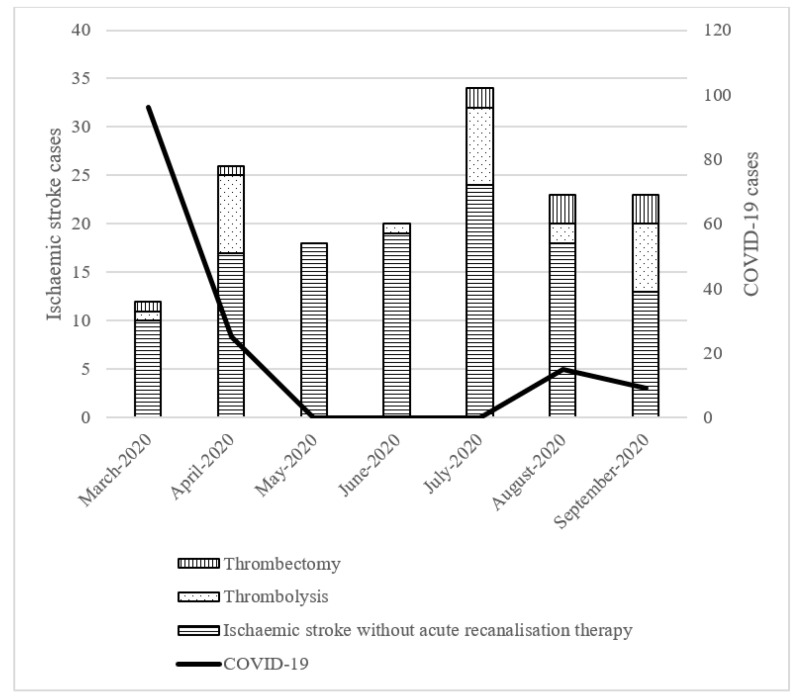
: The Coronavirus disease 2019 (COVID-19) pandemic caused significant disruption to established medical care systems globally. Thus, this study was aimed to compare the admission and outcome variables such as number of patient and its severity, acute recanalisation therapy given pre-post COVID-19 at a primary stroke centre located in Malaysia. : This cross-sectional hospital-based study included adult ischaemic stroke patients. Variables of the study included the number of ischaemic stroke patients, the proportions of recanalisation therapies, stroke severity during admission based on the National Institutes of Health Stroke Scale, functional outcome at discharge based on the modified Rankin Scale, and relevant workflow metrics. We compared the outcome between two six-month periods, namely the pre-COVID-19 period (March 2019 to September 2019) and the COVID-19 period (March 2020 to September 2020). : There were 131 and 156 patients, respectively, from the pre-COVID-19 period and the COVID-19 period. The median door-to-scan time and the median door-to-reperfusion time were both significantly shorter in the COVID-19 period (24.5 min versus 12.0 min, = 0.047) and (93.5 min versus 60.0 min, = 0.015), respectively. There were also significantly more patients who received intravenous thrombolysis (7.6% versus 17.3%, = 0.015) and mechanical thrombectomy (0.8% versus 6.4%, = 0.013) in the COVID-19 period, respectively. : The COVID-19 pandemic may not have caused disruptions of acute stroke care in our primary stroke centre. Our data indicated that the number of ischaemic stroke events remained stable, with a significant increase of recanalisation therapies and better in-hospital workflow metrics during the COVID-19 pandemic period. However, we would like to highlight that the burden of COVID-19 cases in the study area was very low. Therefore, the study may not have captured the true burden (and relevant delays in stroke patient management) during the COVID-19 pandemic. The effect of the pandemic crisis is ongoing and both pre-hospital and in-hospital care systems must continue to provide optimal, highly time-dependent stroke care services.
新型冠状病毒肺炎(COVID-19)大流行在全球范围内对既定的医疗保健系统造成了重大干扰。因此,本研究旨在比较位于马来西亚的初级卒中中心在 COVID-19 前后的入院和结局变量,如患者数量及其严重程度、急性再通治疗等。
这项基于医院的横断面研究纳入了成年缺血性脑卒中患者。研究变量包括缺血性脑卒中患者数量、再通治疗比例、入院时根据国立卫生研究院卒中量表(NIHSS)评估的卒中严重程度、出院时根据改良 Rankin 量表(mRS)评估的功能结局,以及相关工作流程指标。我们比较了两个 6 个月时间段的结局,即 COVID-19 前时期(2019 年 3 月至 2019 年 9 月)和 COVID-19 时期(2020 年 3 月至 2020 年 9 月)。
COVID-19 前时期和 COVID-19 时期分别有 131 例和 156 例患者。COVID-19 时期的中位门到扫描时间和中位门到再灌注时间均显著缩短(24.5 分钟比 12.0 分钟, = 0.047)和(93.5 分钟比 60.0 分钟, = 0.015)。COVID-19 时期分别也有更多的患者接受了静脉溶栓(7.6%比 17.3%, = 0.015)和机械取栓(0.8%比 6.4%, = 0.013)。
COVID-19 大流行可能并未对我们的初级卒中中心的急性卒中治疗造成干扰。我们的数据表明,缺血性脑卒中事件的数量保持稳定,再通治疗的数量显著增加,COVID-19 大流行期间院内工作流程指标也有所改善。然而,我们想强调的是,研究地区的 COVID-19 病例负担非常低。因此,该研究可能没有捕捉到 COVID-19 大流行期间的真实负担(以及相关的卒中患者管理延迟)。大流行的影响仍在继续,院前和院内护理系统必须继续提供最佳的、高度依赖时间的卒中护理服务。