School of Information and Electronics, Beijing Institute of Technology, Beijing 100081, China.
Sensors (Basel). 2021 May 18;21(10):3505. doi: 10.3390/s21103505.
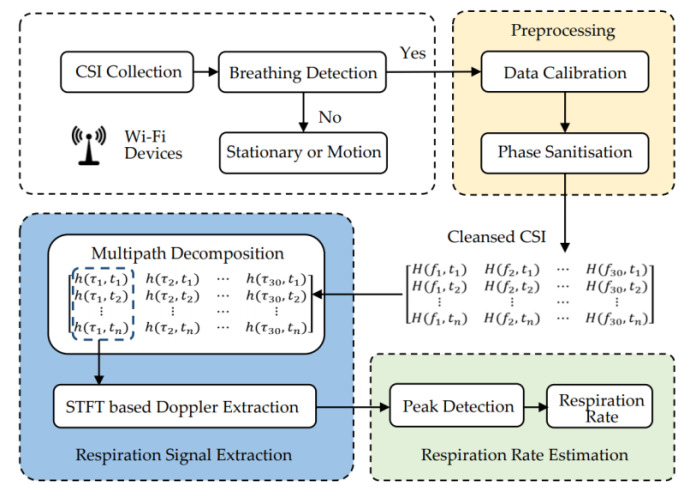
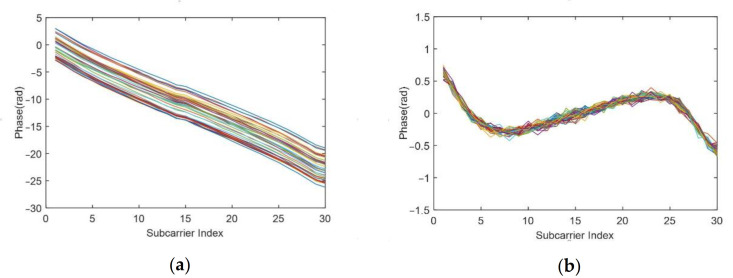
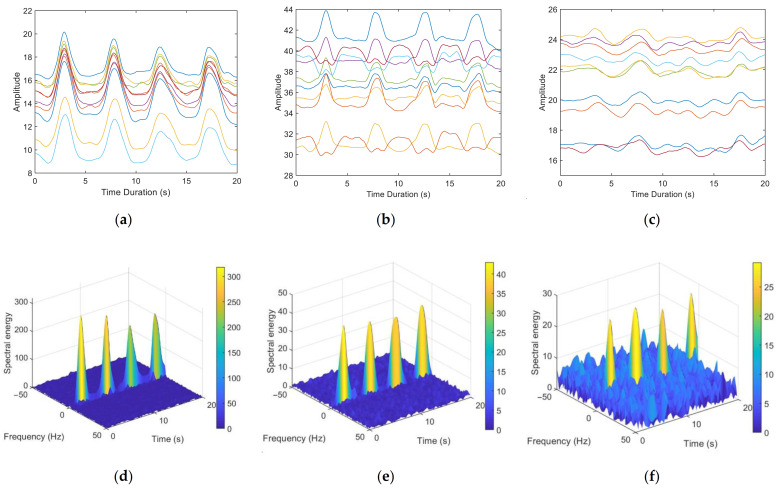
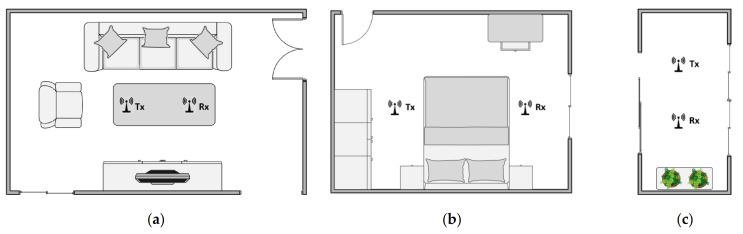
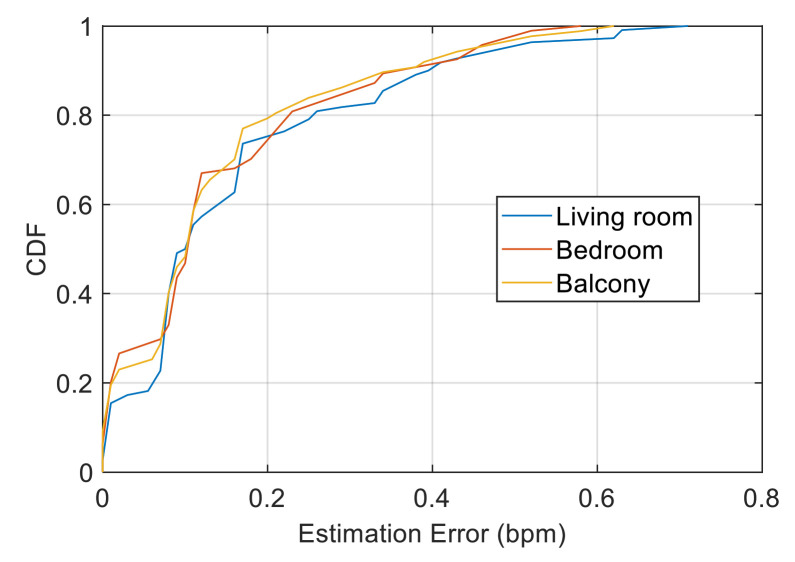
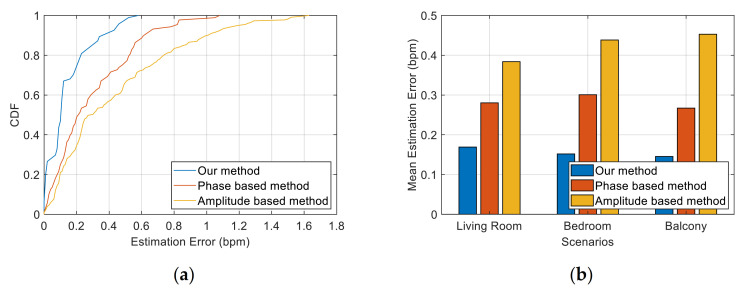
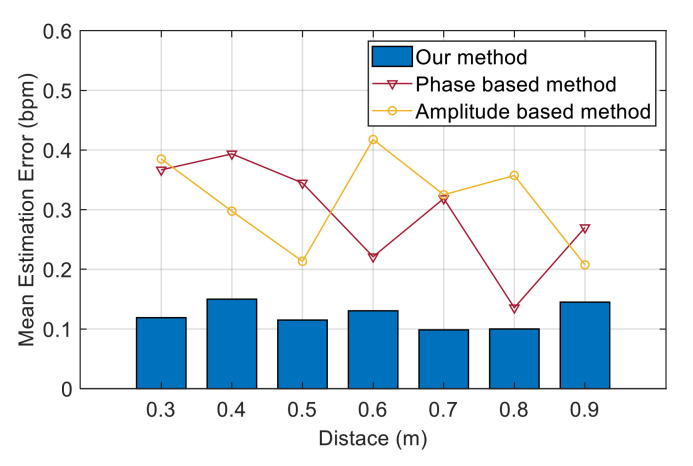
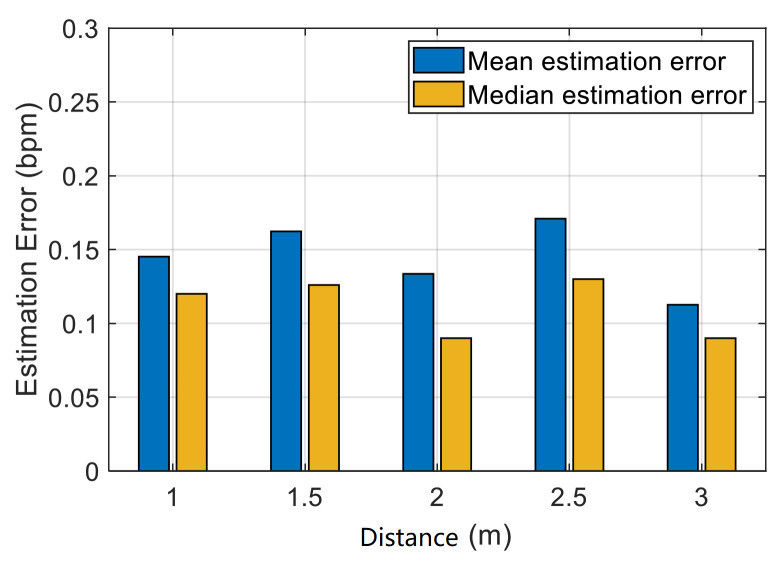
Respiration rate is an essential indicator of vital signs, which can demonstrate the physiological condition of the human body and provide clues to some diseases. Commercial Wi-Fi devices can provide a non-invasive, cost-effective and long-term respiration rate-monitoring scheme for home scenarios. However, previous studies show that the breathing depth and location may affect the detectability of respiratory signals. In this study, we leverage the variation of the Doppler spectral energy extracted from the channel state information (CSI) collected by Wi-Fi devices to track the chest displacement induced by respiration. First, the random phase is eliminated by phase-fitting method to obtain the complex CSI containing the Doppler shift. Then, the multipath decomposition of CSI is carried out to obtain the channel impulse response, which eliminates the interference phase of the time delay and retains the Doppler shift. The dynamic path units are also separate from the multipath, which overcomes the indoor multipath effect. Finally, we conduct a time-frequency analysis to dynamic units to accumulate Doppler spectral energy. Based on these ideas, we design a complete respiration rate-monitoring system to obtain the respiration rate by using the consistency between the Doppler energy change period and the respiratory cycle. We evaluate our system through extensive experiments in several typical home environments filled with multipath. Experimental results show that the errors of the three scenarios are approximate, the maximum error is less than 0.7 bpm, and the average errors are approximately 0.15 bpm. This result indicates that our scheme can achieve high precision respiration monitoring and has good anti-multipath ability compared with existing methods.
呼吸率是生命体征的一个重要指标,可以反映人体的生理状况,并为某些疾病提供线索。商用 Wi-Fi 设备可为家庭场景提供一种非侵入性、经济高效且长期的呼吸率监测方案。然而,先前的研究表明,呼吸深度和位置可能会影响呼吸信号的可检测性。在本研究中,我们利用 Wi-Fi 设备采集的信道状态信息(CSI)中提取的多普勒频谱能量变化来跟踪呼吸引起的胸部位移。首先,通过相位拟合方法消除随机相位,以获得包含多普勒频移的复 CSI。然后,对 CSI 进行多径分解,以获得信道冲激响应,从而消除时延的干扰相位并保留多普勒频移。动态路径单元也与多径分离,克服了室内多径效应。最后,我们对动态路径单元进行时频分析,以累积多普勒频谱能量。基于这些思路,我们设计了一个完整的呼吸率监测系统,通过多普勒能量变化周期与呼吸周期之间的一致性来获得呼吸率。我们在充满多径的几个典型家庭环境中进行了广泛的实验来评估我们的系统。实验结果表明,三种场景的误差相近,最大误差小于 0.7 bpm,平均误差约为 0.15 bpm。这一结果表明,与现有方法相比,我们的方案可以实现高精度的呼吸监测,并具有良好的抗多径能力。