Department of Kinesiology and Sport Sciences, University of Miami, Coral Gables, FL 33146, USA.
Department of Sport Science, College of Sport Science, Sungkyunkwan University, Suwon-si 16419, Korea.
Int J Environ Res Public Health. 2021 May 18;18(10):5364. doi: 10.3390/ijerph18105364.
Chronic Ankle Instability (CAI) is one of the most common musculoskeletal dysfunctions. Stroboscopic vision (SV) training has been deemed to enhance somatosensorial pathways in this population group; nevertheless, until recently no studies have addressed the additional effects of this treatment option to the traditional therapeutic approach.
To evaluate the effectiveness of a partial visual deprivation training protocol in patients with CAI, a randomized controlled trial was carried out. Patients with CAI ( = 73) were randomized into either a balance training, SV training, or a control (no training) group. For participants assigned into training groups, they received 18 training sessions over 6 weeks. The primary outcome was dynamic balance as measured by the Star Excursion Balance Test assessed at baseline and after 6 weeks of intervention. Secondary outcome measures included ankle dorsiflexion range of motion, self-reported instability feeling, and ankle functional status.
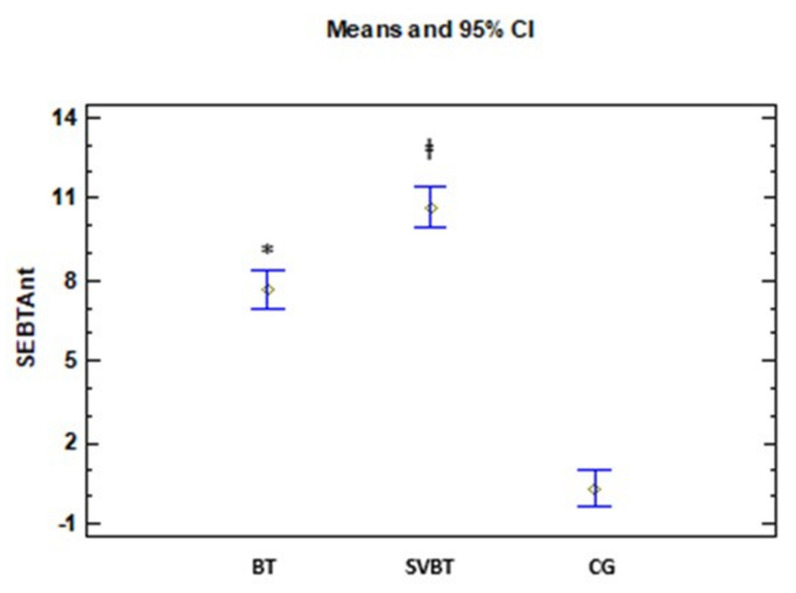
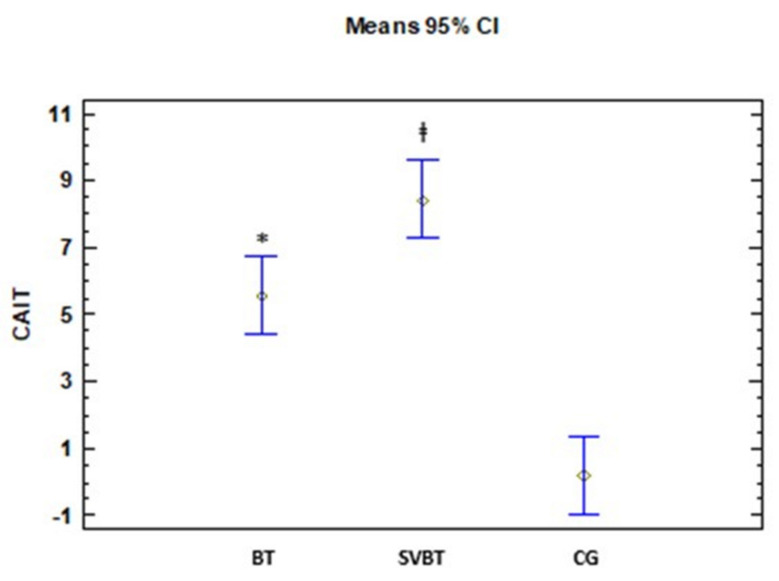
Better scores in stroboscopic training and balance training groups in all outcome measures were observed in comparison with the control group with moderate to large effect sizes. Stroboscopic training was more effective than neuromuscular training in self-reported instability feeling (cohen's d = 0.71; = 0.042) and anterior reach distance of the star excursion balance test (cohen's d = 1.23; = 0.001).
Preliminary findings from the effects of SV Stroboscopic training in patients with CAI, suggest that SV may be beneficial in CAI rehabilitation.
慢性踝关节不稳定(CAI)是最常见的肌肉骨骼功能障碍之一。频闪视觉(SV)训练被认为可以增强该人群的体感通路;然而,直到最近,尚无研究探讨这种治疗选择对传统治疗方法的额外影响。
为了评估部分视觉剥夺训练方案对 CAI 患者的有效性,进行了一项随机对照试验。将 CAI 患者(n=73)随机分为平衡训练组、SV 训练组或对照组(无训练)。对于分配到训练组的参与者,他们在 6 周内接受了 18 次训练。主要结局指标是通过星型偏移平衡测试(Star Excursion Balance Test)评估的动态平衡,在基线和 6 周干预后进行评估。次要结局指标包括踝关节背屈活动范围、自我报告的不稳定感和踝关节功能状态。
与对照组相比,频闪训练和平衡训练组在所有结局指标上的得分均有所提高,具有中到大的效应量。频闪训练在自我报告的不稳定感(cohen's d=0.71; = 0.042)和星型偏移平衡测试的前伸距离(cohen's d=1.23; = 0.001)方面比神经肌肉训练更有效。
CAI 患者接受频闪视觉训练的初步效果表明,频闪视觉可能有益于 CAI 的康复。