Gulde Philipp, Hermsdörfer Joachim, Rieckmann Peter
Center for Clinical Neuroplasticity Medical Park Loipl, Medical Park SE, Thanngasse 15, 83483 Bischofswiesen, Germany.
Department for Sports and Health Sciences, Technical University of Munich, 80992 Munich, Germany.
J Clin Med. 2021 May 18;10(10):2177. doi: 10.3390/jcm10102177.
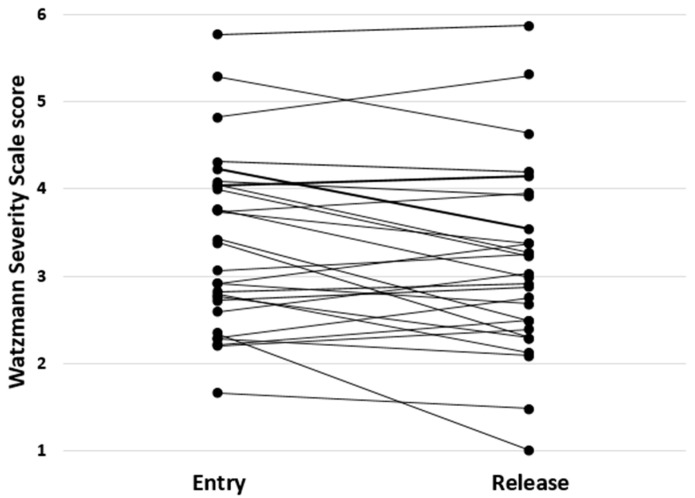
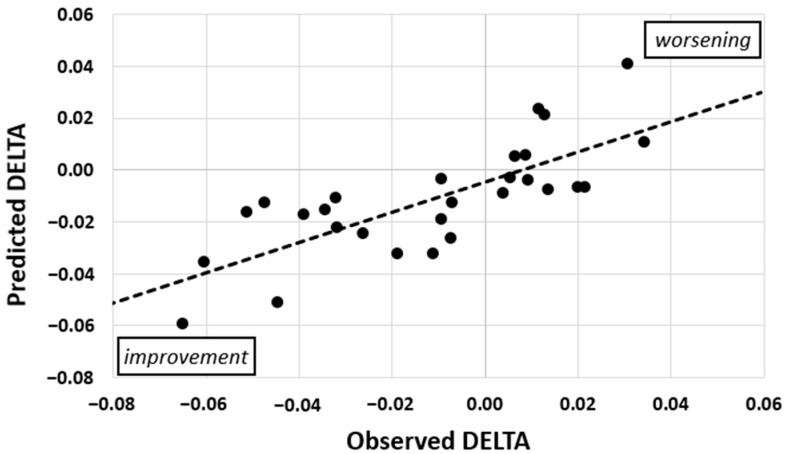
Inpatient rehabilitation has been shown to be an effective intervention for sensorimotor performance in multiple sclerosis (MS) patients. So far, predictions of the rehabilitation outcomes are limited. The objective was to predict inpatient rehabilitation outcomes by changes in the Watzmann Severity Scale (WSS), a statistical estimation of the EDSS by sensorimotor capacity. Sensorimotor performance and physical activity during rehabilitation (by actigraphy) were assessed in a sample of 28 MS patients at a facility for neurorehabilitation. Daily changes in the WSS were predicted by a model of multiple linear regression. The resulting model had an R of 0.48 ( < 0.01) and revealed five impacting factors (a reduction in the WSS represents an improvement): the number of steps (β-weight = 0.52, < 0.01), the duration of nocturnal rest time (β-weight = 0.46, = 0.01), the EDSS at entry (β-weight = 0.38, = 0.03), a relapsing-remitting MS (β-weight = 0.37, = 0.03), and the performance in a visuomotor pursuit task with time pressure (β-weight = -0.35, = 0.04). One standard deviation improvement was predicted when the patient at admission yielded 6600 fewer steps per day, 94 min less rest per night, -2.7 points in the EDSS at entry, a relapsing-remitting MS, and a pursuit task performance that decreased by 2.2 standard deviations. Overall, the patients improved by -0.22 ± 0.51 WSS points during 19.3 ± 4.5 d of inpatient rehabilitation. Different potential explanations of the findings are discussed, one of which proposes that the results reflect an unhealthy lifestyle which, in addition to MS, would explain the higher predicted improvements by rehabilitation tackling both MS and the patients' lifestyle.
住院康复已被证明是对多发性硬化症(MS)患者感觉运动功能有效的干预措施。到目前为止,康复结果的预测很有限。目的是通过瓦茨曼严重程度量表(WSS)的变化来预测住院康复结果,WSS是根据感觉运动能力对扩展残疾状态量表(EDSS)的一种统计估计。在一家神经康复机构对28名MS患者进行了康复期间感觉运动功能和身体活动(通过活动记录仪)的评估。通过多元线性回归模型预测WSS的每日变化。所得模型的R值为0.48(P<0.01),并揭示了五个影响因素(WSS降低表示改善):步数(β权重=0.52,P<0.01)、夜间休息时间(β权重=0.46,P=0.01)、入院时的EDSS(β权重=0.38,P=0.03)、复发缓解型MS(β权重=0.37,P=0.03)以及有时间压力的视觉运动追踪任务中的表现(β权重=-0.35,P=0.04)。预测当入院患者每天少走6600步、每晚少休息94分钟、入院时EDSS降低2.7分、为复发缓解型MS且追踪任务表现降低2.2个标准差时,会有一个标准差的改善。总体而言,患者在19.3±4.5天的住院康复期间WSS改善了-0.22±0.51分。讨论了对这些发现的不同潜在解释,其中之一提出结果反映了不健康的生活方式,除MS外,这也可以解释通过针对MS和患者生活方式进行康复治疗所预测的更高改善效果。