
糖尿病肾病中的胰岛素撤退:我们还在等什么?
Insulin Withdrawal in Diabetic Kidney Disease: What Are We Waiting for?
机构信息
Endocrinology Department, Hospital Doctor Peset, 46020 Valencia, Spain.
Nephrology Department, Hospital Clínico Universitario, INCLIVA, Universidad de Valencia, 46010 Valencia, Spain.
出版信息
Int J Environ Res Public Health. 2021 May 18;18(10):5388. doi: 10.3390/ijerph18105388.
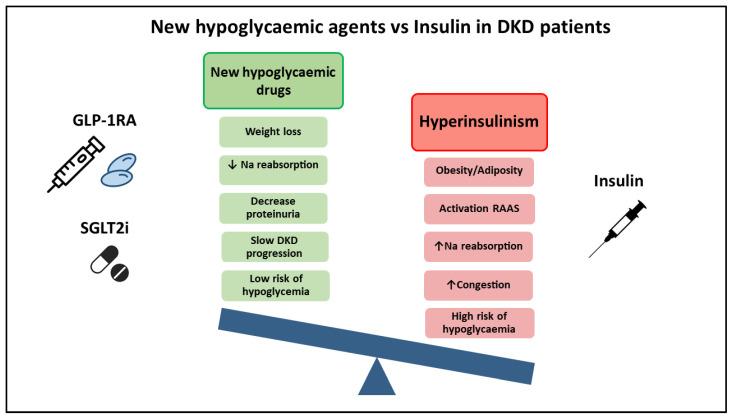
The prevalence of type 2 diabetes mellitus worldwide stands at nearly 9.3% and it is estimated that 20-40% of these patients will develop diabetic kidney disease (DKD). DKD is the leading cause of chronic kidney disease (CKD), and these patients often present high morbidity and mortality rates, particularly in those patients with poorly controlled risk factors. Furthermore, many are overweight or obese, due primarily to insulin compensation resulting from insulin resistance. In the last decade, treatment with sodium-glucose cotransporter 2 inhibitors (SGLT2i) and glucagon-like peptide-1 receptor agonists (GLP1-RA) have been shown to be beneficial in renal and cardiovascular targets; however, in patients with CKD, the previous guidelines recommended the use of drugs such as repaglinide or dipeptidyl peptidase-4 inhibitors (DPP-4 inhibitors), plus insulin therapy. However, new guidelines have paved the way for new treatments, such as SGLT2i or GLP1-RA in patients with CKD. Currently, the new evidence supports the use of GLP1-RA in patients with an estimated glomerular filtration rate (eGFR) of up to 15 mL/min/1.73 m and an SGLT2i should be started with an eGFR > 60 mL/min/1.73 m. Regarding those patients in advanced stages of CKD, the usual approach is to switch to insulin. Thus, the add-on of GLP1-RA and/or SGLT2i to insulin therapy can reduce the dose of insulin, or even allow for its withdrawal, as well as achieve a good glycaemic control with no weight gain and reduced risk of hypoglycaemia, with the added advantage of cardiorenal benefits.
全球 2 型糖尿病的患病率接近 9.3%,据估计,其中 20-40%的患者将发展为糖尿病肾病(DKD)。DKD 是慢性肾脏病(CKD)的主要原因,这些患者的发病率和死亡率往往较高,尤其是那些风险因素控制不佳的患者。此外,许多患者超重或肥胖,主要是由于胰岛素抵抗导致胰岛素代偿。在过去十年中,钠-葡萄糖共转运蛋白 2 抑制剂(SGLT2i)和胰高血糖素样肽-1 受体激动剂(GLP1-RA)的治疗已被证明对肾脏和心血管靶标有益;然而,在 CKD 患者中,以前的指南建议使用瑞格列奈或二肽基肽酶-4 抑制剂(DPP-4 抑制剂)等药物加胰岛素治疗。然而,新的指南为新的治疗方法铺平了道路,如 SGLT2i 或 GLP1-RA 在 CKD 患者中的应用。目前,新的证据支持在肾小球滤过率(eGFR)估计值高达 15 mL/min/1.73 m 的患者中使用 GLP1-RA,并且应该在 eGFR > 60 mL/min/1.73 m 时开始使用 SGLT2i。对于那些处于 CKD 晚期的患者,通常的方法是转为胰岛素治疗。因此,GLP1-RA 和/或 SGLT2i 与胰岛素治疗联合应用可以减少胰岛素剂量,甚至可以停用胰岛素,同时实现良好的血糖控制,不会增加体重,低血糖风险降低,并且具有心脏和肾脏益处的额外优势。
 Zotero 插件