Laboratory of Cellular and Molecular Neuroscience (LCMN), School of Life Sciences, Faculty of Science, University of Technology Sydney, Sydney, NSW 2007, Australia.
Respiratory Bioinformatics and Molecular Biology (RBMB) Group, School of Life Sciences, Faculty of Science, University of Technology Sydney, Sydney, NSW 2007, Australia.
Cells. 2021 May 25;10(6):1312. doi: 10.3390/cells10061312.
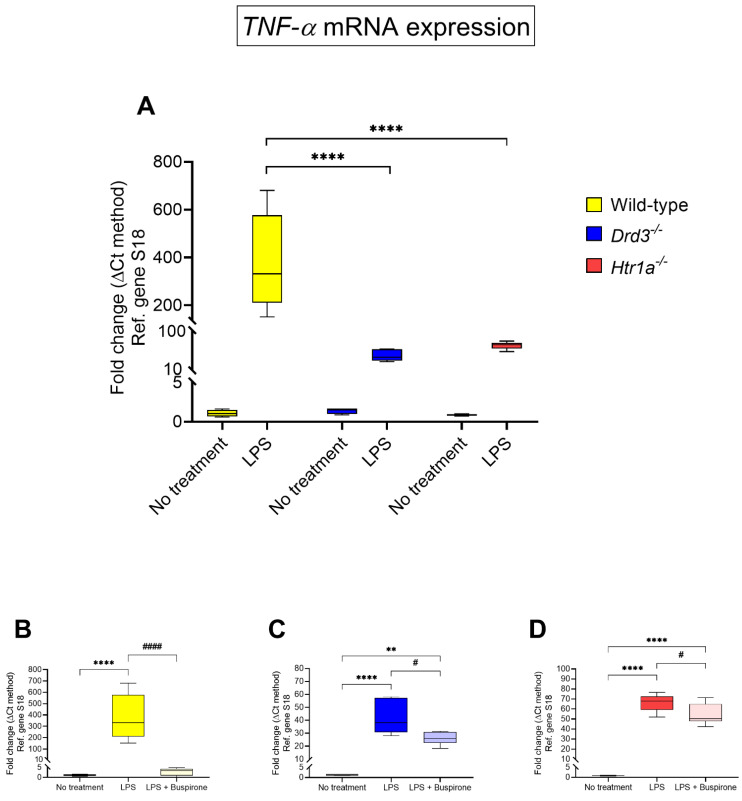
Buspirone is an anxiolytic drug with robust serotonin receptor 1A (Htr1a) agonist activities. However, evidence has demonstrated that this drug also targets the dopamine D3 receptor (Drd3), where it acts as a potent antagonist. In vivo, Drd3 blockade is neuroprotective and reduces inflammation in models of Parkinson's disease. To test if buspirone also elicited anti-inflammatory activities in vitro, we generated stable Drd3 and Htr1a BV2 microglial cell lines using CRISPR-Cas9 technology and then tested the effects of buspirone after lipopolysaccharide (LPS) challenge. We found that LPS exposure had no effect on cell viability, except in Htr1a cells, where viability was reduced ( < 0.001). Drug treatment reduced viability in Drd3 cells, but not in WT or Htr1a cells. Buspirone counteracted LPS-induced NO release, NOS2, IL-1β and TNF-α gene expression in WT cells, whereas it exerted limited effects in Drd3 or Htr1a microglia. In summary, our findings indicate that buspirone attenuates microglial polarization after LPS challenge. These results also highlight some major effects of Drd3 or Htr1a genetic ablation on microglial biology, raising important questions on the complex role of neurotransmitters in regulating microglia functions.
丁螺环酮是一种具有强大血清素受体 1A(Htr1a)激动活性的抗焦虑药物。然而,有证据表明,该药物还靶向多巴胺 D3 受体(Drd3),在那里它作为一种有效的拮抗剂。在体内,Drd3 阻断具有神经保护作用,并减少帕金森病模型中的炎症。为了测试丁螺环酮是否在体外也具有抗炎活性,我们使用 CRISPR-Cas9 技术生成了稳定的 Drd3 和 Htr1a BV2 小胶质细胞系,然后在脂多糖(LPS)挑战后测试了丁螺环酮的作用。我们发现 LPS 暴露除了在 Htr1a 细胞中降低细胞活力(<0.001)外,对细胞活力没有影响。药物处理降低了 Drd3 细胞的活力,但在 WT 或 Htr1a 细胞中没有。丁螺环酮拮抗 LPS 诱导的 WT 细胞中 NO 释放、NOS2、IL-1β 和 TNF-α 基因表达,但在 Drd3 或 Htr1a 小胶质细胞中仅发挥有限作用。总之,我们的研究结果表明,丁螺环酮在 LPS 挑战后减轻小胶质细胞极化。这些结果还强调了 Drd3 或 Htr1a 基因缺失对小胶质细胞生物学的一些主要影响,提出了关于神经递质在调节小胶质细胞功能中的复杂作用的重要问题。