Thomas Broome Sarah, Louangaphay Krystal, Keay Kevin A, Leggio Gian Marco, Musumeci Giuseppe, Castorina Alessandro
Laboratory of Cellular and Molecular Neuroscience (LCMN), School of Life Science, Faculty of Science, University of Technology Sydney, Sydney, Australia.
Laboratory of Neural Structure and Function (LNSF), School of Medical Sciences, (Anatomy and Histology), Faculty of Medicine and Health, University of Sydney, Sydney, Australia.
Neural Regen Res. 2020 Dec;15(12):2173-2185. doi: 10.4103/1673-5374.284976.
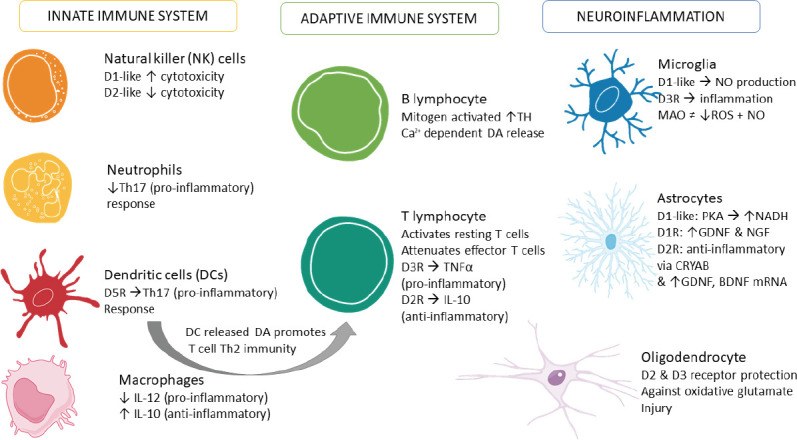
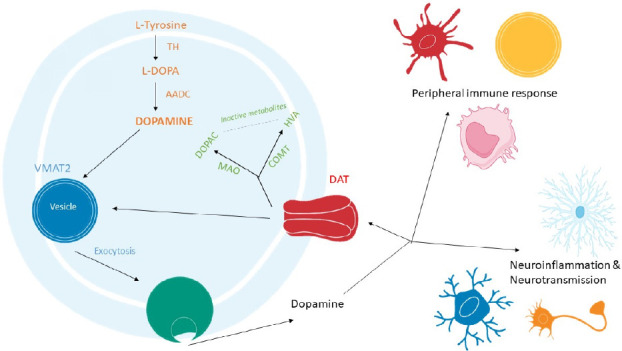
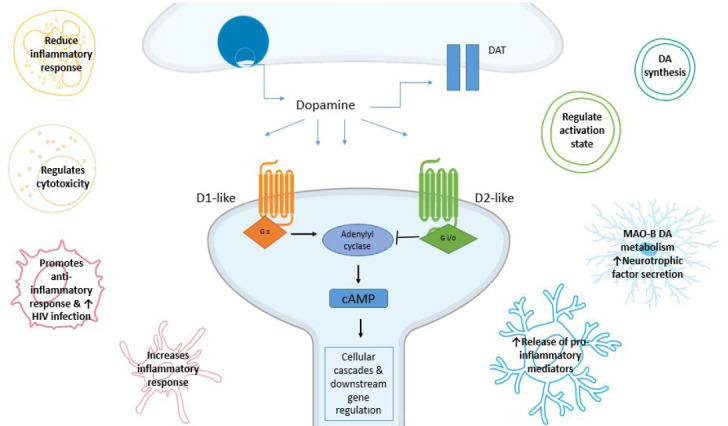
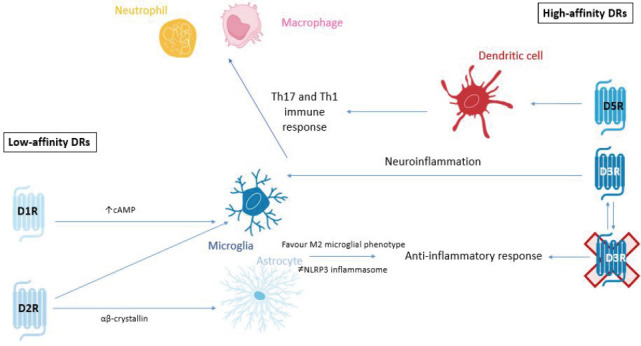
The dopaminergic system controls several vital central nervous system functions, including the control of movement, reward behaviors and cognition. Alterations of dopaminergic signaling are involved in the pathogenesis of neurodegenerative and psychiatric disorders, in particular Parkinson's disease, which are associated with a subtle and chronic inflammatory response. A substantial body of evidence has demonstrated the non-neuronal expression of dopamine, its receptors and of the machinery that governs synthesis, secretion and storage of dopamine across several immune cell types. This review aims to summarize current knowledge on the role and expression of dopamine in immune cells. One of the goals is to decipher the complex mechanisms through which these cell types respond to dopamine, in order to address the impact this has on neurodegenerative and psychiatric pathologies such as Parkinson's disease. A further aim is to illustrate the gaps in our understanding of the physiological roles of dopamine to encourage more targeted research focused on understanding the consequences of aberrant dopamine production on immune regulation. These highlights may prompt scientists in the field to consider alternative functions of this important neurotransmitter when targeting neuroinflammatory/neurodegenerative pathologies.
多巴胺能系统控制着中枢神经系统的多种重要功能,包括运动控制、奖赏行为和认知。多巴胺能信号的改变参与神经退行性疾病和精神疾病的发病机制,尤其是帕金森病,这些疾病与微妙的慢性炎症反应有关。大量证据表明,多巴胺、其受体以及控制多巴胺在多种免疫细胞类型中合成、分泌和储存的机制存在非神经元表达。本综述旨在总结目前关于多巴胺在免疫细胞中的作用和表达的知识。目标之一是解读这些细胞类型对多巴胺作出反应的复杂机制,以探讨这对帕金森病等神经退行性和精神疾病的影响。另一个目标是阐明我们对多巴胺生理作用理解上的空白,以鼓励开展更具针对性的研究,专注于了解多巴胺异常产生对免疫调节的影响。这些要点可能促使该领域的科学家在针对神经炎症/神经退行性疾病时考虑这种重要神经递质的其他功能。