Kim Hye-Rim, Jin Hyun-Seok, Eom Yong-Bin
Department of Medical Sciences, Graduate School, Soonchunhyang University, Asan 31538, Chungnam, Korea.
Department of Biomedical Laboratory Science, College of Life and Health Sciences, Hoseo University, Asan 31499, Chungnam, Korea.
J Clin Med. 2021 May 23;10(11):2255. doi: 10.3390/jcm10112255.
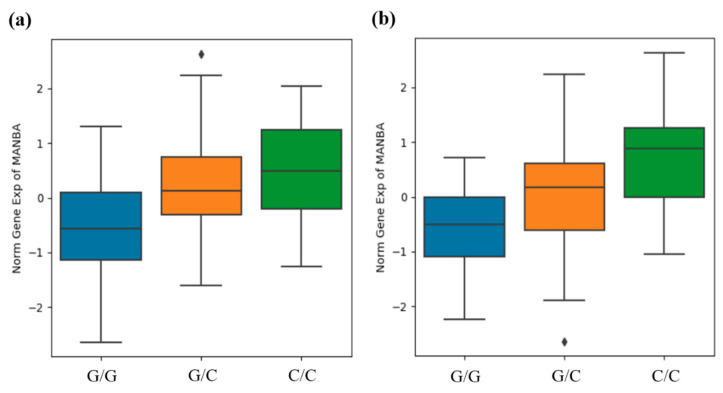
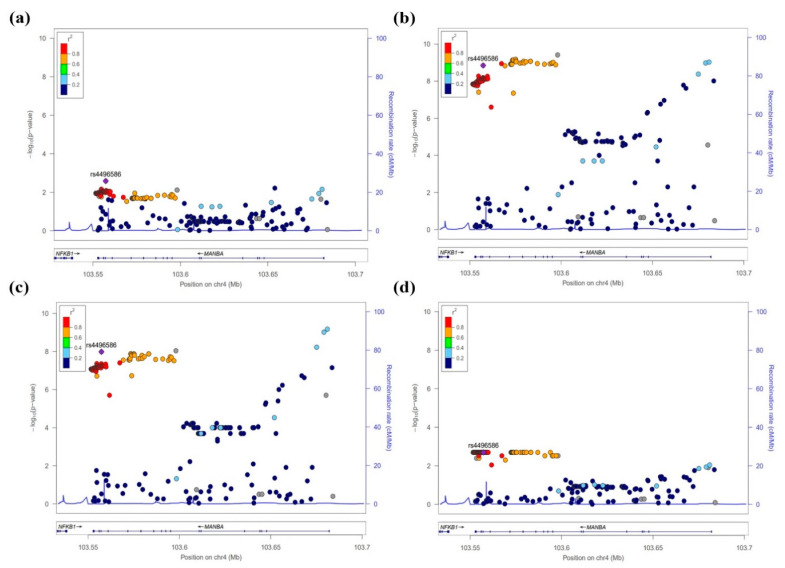
Chronic kidney disease (CKD), a damaged condition of the kidneys, is a global public health problem that can be caused by diabetes, hypertension, and other disorders. Recently, the gene was identified in CKD by integrating CKD-related variants and kidney expression quantitative trait loci (eQTL) data. This study evaluated the effects of gene variants on CKD and kidney function-related traits using a Korean cohort. We also analyzed the association of gene variants with kidney-related traits such as the estimated glomerular filtration rate (eGFR), and blood urea nitrogen (BUN), creatinine, and uric acid levels using linear regression analysis. As a result, 14 single nucleotide polymorphisms (SNPs) were replicated in CKD ( < 0.05), consistent with previous studies. Among them, rs4496586, which was the most significant for CKD and kidney function-related traits, was associated with a decreased CKD risk in participants with the homozygous minor allele (CC), increased eGFR, and decreased creatinine and uric acid concentrations. Furthermore, the association analysis between the rs4496586 genotype and gene expression in human tubules and glomeruli showed high gene expression in the minor allele carriers. In conclusion, this study demonstrated that gene variants were associated with CKD and kidney function-related traits in a Korean cohort.
慢性肾脏病(CKD)是一种肾脏受损的病症,是一个全球性的公共卫生问题,可由糖尿病、高血压及其他疾病引起。最近,通过整合CKD相关变异和肾脏表达定量性状位点(eQTL)数据,在CKD中鉴定出了该基因。本研究使用韩国队列评估了该基因变异对CKD和肾功能相关性状的影响。我们还使用线性回归分析分析了该基因变异与肾脏相关性状的关联,如估计肾小球滤过率(eGFR)、血尿素氮(BUN)、肌酐和尿酸水平。结果,14个单核苷酸多态性(SNP)在CKD中得到重复验证(<0.05),与先前的研究一致。其中,rs4496586对CKD和肾功能相关性状最为显著,与纯合次要等位基因(CC)参与者的CKD风险降低、eGFR升高以及肌酐和尿酸浓度降低有关。此外,rs4496586基因型与人类肾小管和肾小球中该基因表达之间的关联分析显示,次要等位基因携带者中该基因表达较高。总之,本研究表明该基因变异与韩国队列中的CKD和肾功能相关性状有关。