Institute of New Frontier Research Team, Hallym University College of Medicine, Chuncheon 24253, Korea.
Department of Otorhinolaryngology-Head and Neck Surgery, Chuncheon Sacred Heart Hospital, Hallym University College of Medicine, Chuncheon 24253, Korea.
Int J Mol Sci. 2021 May 28;22(11):5772. doi: 10.3390/ijms22115772.
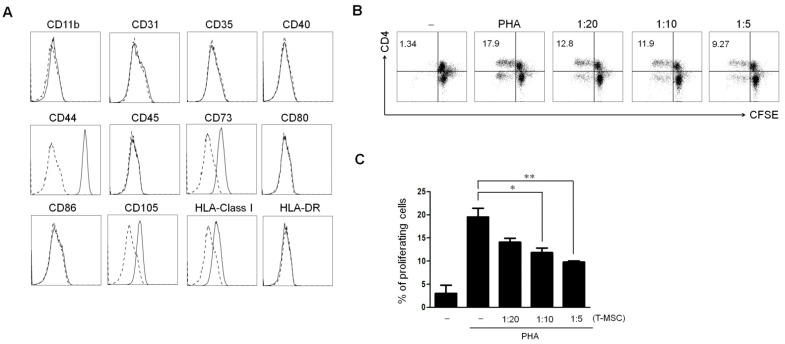
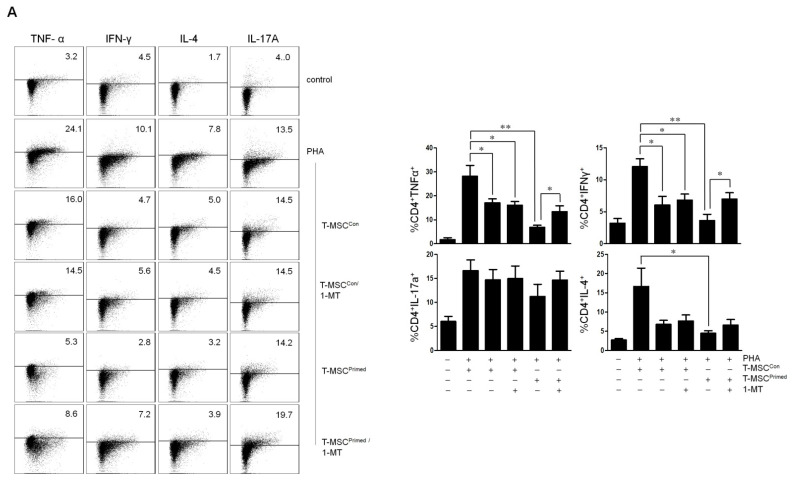
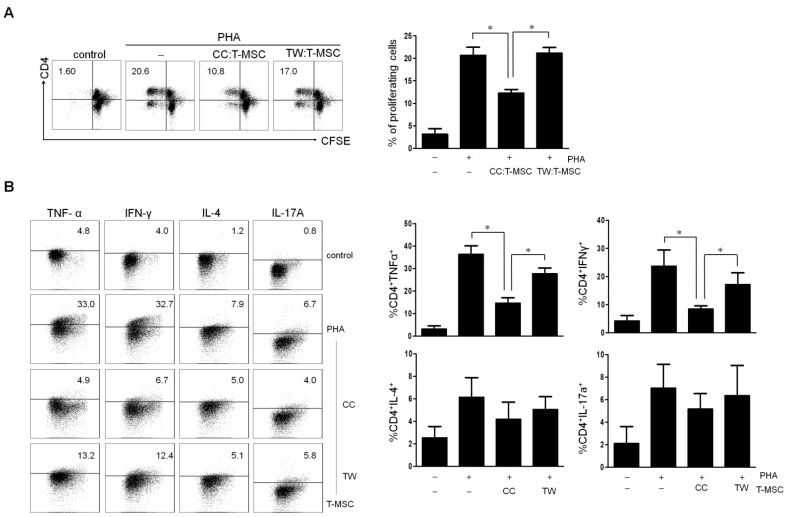
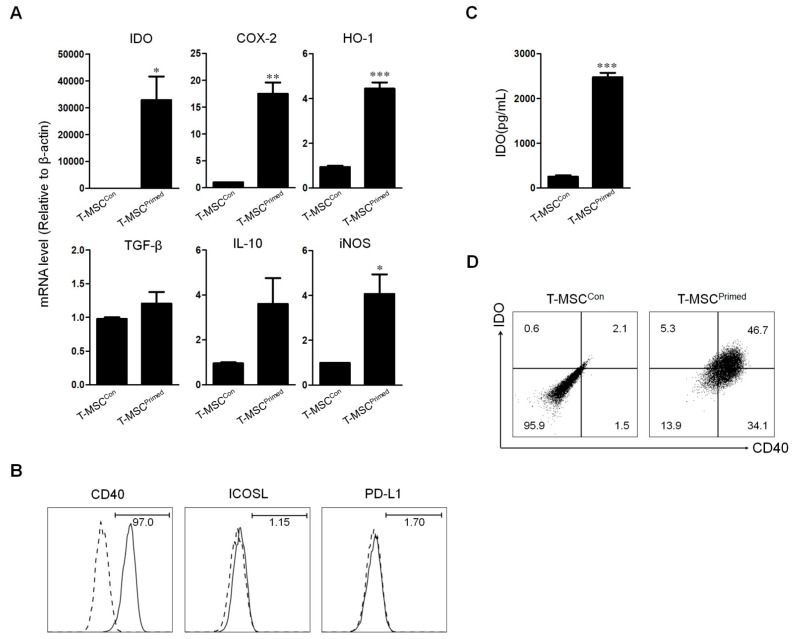
Tonsil-derived mesenchymal stem cells (T-MSCs) were reported to have suppressive effect on T cells, yet much remains unknown about the underlying mechanisms supporting this effect. We investigated the underlying mechanism of the immunomodulatory effect of T-MSCs on immune cell proliferation and cytokine production. We isolated T-MSCs from human palatine tonsil and evaluated the immunomodulatory capacity using RT-PCR, ELISA, and flow cytometry. Additionally, we assessed the expression of various soluble factors and several costimulatory molecules to detect the priming effect on T-MSCs. T-MSCs significantly inhibited the immune cell proliferation and cytokine expression (TNF-α and IFN-γ) in the direct co-culture, but there was no suppressive effect in indirect co-culture. Additionally, we detected a remarkably higher expression of indoleamine 2,3-dioxygenase (IDO) in the primed T-MSCs having co-expression CD40. Moreover, immune cells or CD4 T cells showed lower TNF-α, IFN-γ, and IL-4 expression when the primed T-MSC were added; whereas those findings were reversed when the inhibitor for IDO (not IL-4) or CD40 were added. Furthermore, T-bet and GATA3 levels were significantly decreased in the co-cultures of the primed T-MSCs and CD4 T cells; whereas those findings were reversed when we added the neutralizing anti-CD40 antibody. Primed T-MSCs expressing IDO and CD40 may have immunomodulatory capacity via Th1-mediated and Th2-mediated immune response.
扁桃体间充质干细胞(T-MSCs)被报道具有抑制 T 细胞的作用,但对于支持这种作用的潜在机制仍知之甚少。我们研究了 T-MSCs 对免疫细胞增殖和细胞因子产生的免疫调节作用的潜在机制。我们从人腭扁桃体中分离出 T-MSCs,并通过 RT-PCR、ELISA 和流式细胞术评估其免疫调节能力。此外,我们评估了各种可溶性因子和几种共刺激分子的表达,以检测 T-MSCs 的启动作用。T-MSCs 在直接共培养中显著抑制免疫细胞增殖和细胞因子表达(TNF-α和 IFN-γ),但在间接共培养中没有抑制作用。此外,我们在共表达 CD40 的被激活的 T-MSCs 中检测到吲哚胺 2,3-双加氧酶(IDO)的表达显著升高。此外,当加入被激活的 T-MSC 时,免疫细胞或 CD4 T 细胞的 TNF-α、IFN-γ 和 IL-4 表达降低;而当加入 IDO 的抑制剂(非 IL-4)或 CD40 时,这些发现则相反。此外,在被激活的 T-MSCs 和 CD4 T 细胞的共培养物中,T-bet 和 GATA3 水平显著降低;而当我们加入中和抗 CD40 抗体时,这些发现则相反。表达 IDO 和 CD40 的被激活的 T-MSCs 可能通过 Th1 介导和 Th2 介导的免疫反应具有免疫调节能力。