Ambrosino Pasquale, Molino Antonio, Calcaterra Ilenia, Formisano Roberto, Stufano Silvia, Spedicato Giorgio Alfredo, Motta Andrea, Papa Antimo, Di Minno Matteo Nicola Dario, Maniscalco Mauro
Istituti Clinici Scientifici Maugeri IRCCS, 27100 Pavia, Italy.
Department of Respiratory Medicine, Federico II University, 80131 Naples, Italy.
Biomedicines. 2021 May 28;9(6):614. doi: 10.3390/biomedicines9060614.
Growing evidence points to a key role of endothelial dysfunction in the pathogenesis of COVID-19. In this study, we evaluated changes in endothelium-dependent flow-mediated dilation (FMD) in a cohort of convalescent COVID-19 patients undergoing pulmonary rehabilitation (PR).
After swab test negativization, convalescent COVID-19 patients referring to a post-acute care facility for PR were consecutively screened for inclusion. Study procedures were performed at the time of hospitalization and discharge.
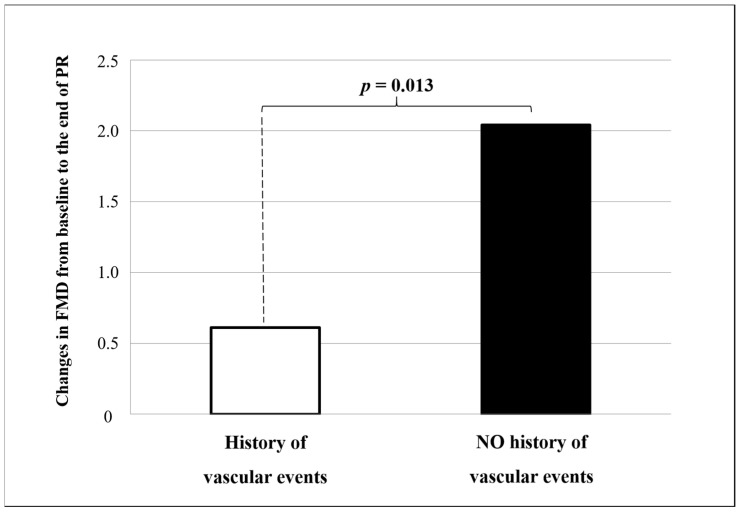
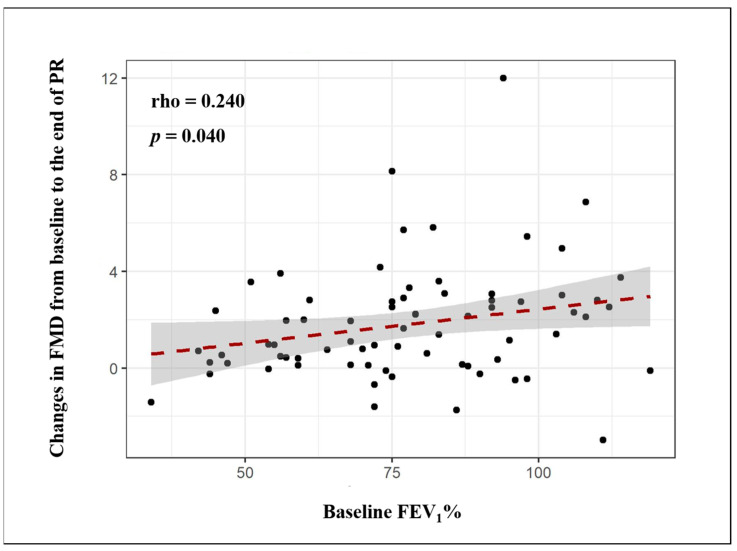
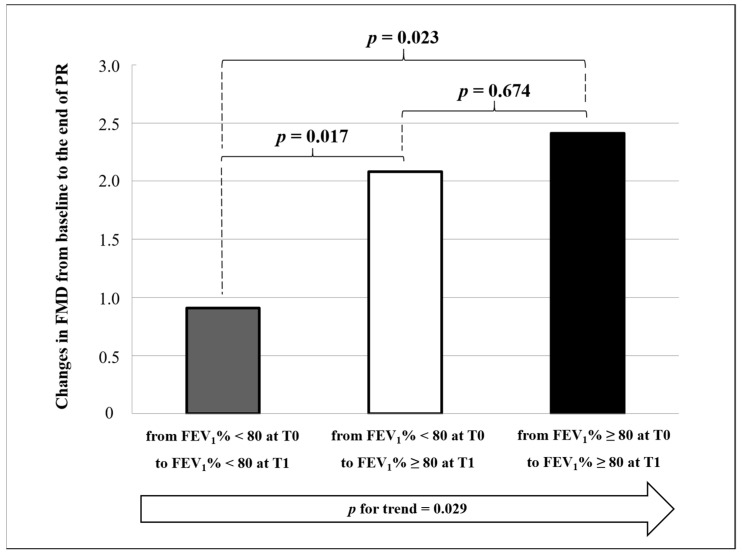
We enrolled 82 convalescent COVID-19 patients (85.4% males, mean age 60.4 years). After PR, a significant improvement in most pulmonary function tests and exercise capacity was documented. FMD changed from 2.48% ± 2.01 to 4.24% ± 2.81 ( < 0.001), corresponding to a 70.9% increase. Significantly higher changes in FMD were found in patients without a history of vascular events as compared to those with (+2.04% ± 2.30 vs. +0.61% ± 1.83, = 0.013). Values of forced expiratory volume in 1 s (FEV%), forced vital capacity (FVC%) and diffusion capacity for carbon monoxide (DLCO%) significantly and directly correlated with FMD both at baseline and after PR. Patients with normal FEV% (≥80% predicted) during the overall study period or those normalizing FEV% after PR showed a more significant FMD change as compared to patients with persistently impaired FEV% (<80% predicted) ( for trend = 0.029). This finding was confirmed in a multivariate analysis.
Clinically evaluated endothelial function improves after PR in convalescent COVID-19 patients. A direct and persistent association between the severity of pulmonary and vascular disease can be hypothesized. Endothelial function testing may be useful in the follow-up of convalescent COVID-19 patients.
越来越多的证据表明内皮功能障碍在新型冠状病毒肺炎(COVID-19)发病机制中起关键作用。在本研究中,我们评估了一组正在接受肺康复(PR)的COVID-19康复患者内皮依赖性血流介导的血管舒张(FMD)的变化。
在咽拭子检测转阴后,连续筛查转诊至急性后护理机构接受PR的COVID-19康复患者以纳入研究。研究程序在住院时和出院时进行。
我们纳入了82例COVID-19康复患者(男性占85.4%,平均年龄60.4岁)。PR后,多数肺功能检查和运动能力有显著改善。FMD从2.48%±2.01变为4.24%±2.81(<0.001),相当于增加了70.9%。与有血管事件病史的患者相比,无血管事件病史的患者FMD变化显著更高(分别为+2.04%±2.30和+0.61%±1.83,P = 0.013)。1秒用力呼气量(FEV%)、用力肺活量(FVC%)和一氧化碳弥散量(DLCO%)在基线和PR后的值均与FMD显著且直接相关。在整个研究期间FEV%正常(≥预测值的80%)或PR后FEV%恢复正常的患者,与FEV%持续受损(<预测值的80%)的患者相比,FMD变化更显著(趋势P = 0.029)。这一发现在多变量分析中得到证实。
经临床评估,COVID-19康复患者在PR后内皮功能得到改善。可以推测肺部和血管疾病严重程度之间存在直接且持续的关联。内皮功能检测可能对COVID-19康复患者的随访有用。