Santoro Luca, Falsetti Lorenzo, Zaccone Vincenzo, Nesci Antonio, Tosato Matteo, Giupponi Bianca, Savastano Maria Cristina, Moroncini Gianluca, Gasbarrini Antonio, Landi Francesco, Santoliquido Angelo
Department of Cardiovascular and Thoracic Sciences, Fondazione Policlinico Universitario Agostino Gemelli IRCCS, 00168 Rome, Italy.
Department of Emergency Medicine, Internal and Sub-Intensive Medicine, Azienda Ospedaliero-Universitaria "Ospedali Riuniti", 60166 Ancona, Italy.
J Clin Med. 2022 Mar 23;11(7):1774. doi: 10.3390/jcm11071774.
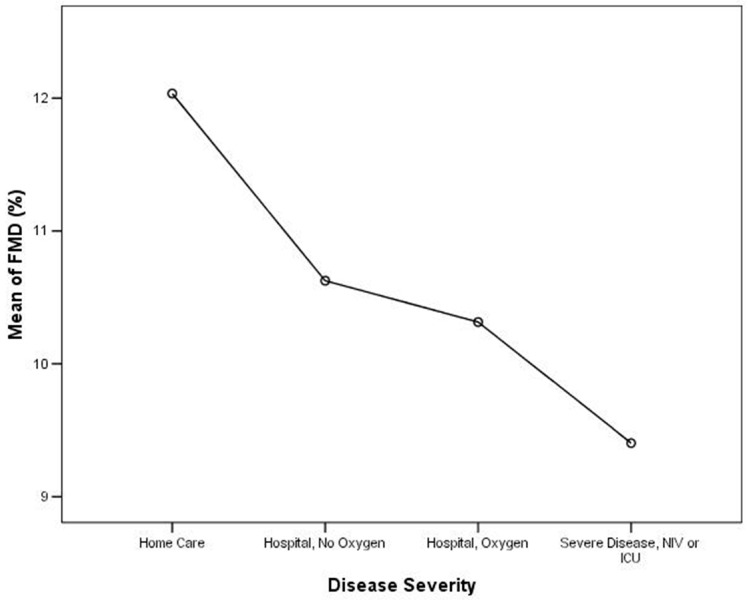
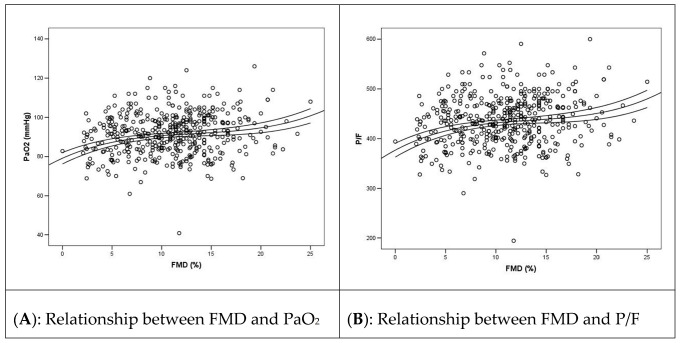
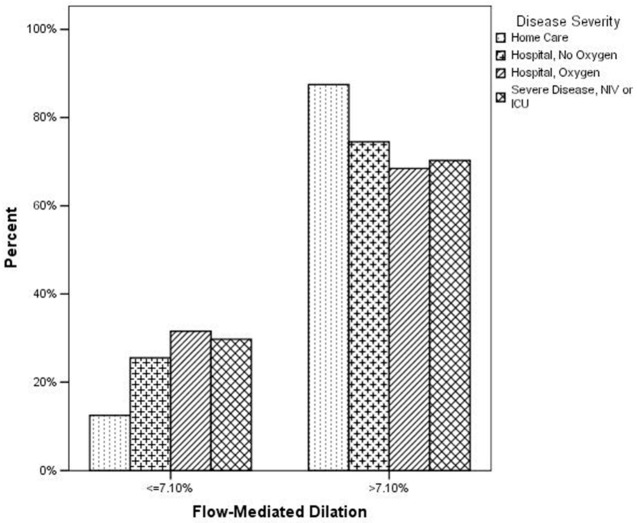
Background: Endothelial dysfunction has a role in acute COVID-19, contributing to systemic inflammatory syndrome, acute respiratory distress syndrome, and vascular events. Evidence regarding COVID-19 middle- and long-term consequences on endothelium are still lacking. Our study aimed to evaluate if COVID-19 severity could significantly affect the endothelial function after three months from the acute phase. Methods: We assessed endothelial function in outpatients with previous COVID-19 three months after negative SARS-CoV-2 molecular test by measuring flow-mediated dilation (FMD) in patients categorized according to a four-variable COVID-19 severity scale (“home care”; “hospital, no oxygen”; “hospital, oxygen”; “hospital requiring high-flow nasal canula, non-invasive ventilation, invasive mechanical ventilation, or extracorporeal membrane oxygenation”). FMD difference among COVID-19 severity categories was assessed with analysis of variance; we further clarified the relationship between FMD and previous COVID-19 severity with multivariate logistic models. Results: Among 658 consecutive COVID-19 subjects, we observed a significant linear trend of FMD reduction with the increase of the COVID-19 category (p < 0.0001). The presence of endothelial dysfunction was more frequent among hospitalized patients (78.3%) with respect to home-care patients (21.7%; p < 0.0001). COVID-19 severity was associated with increased endothelial dysfunction risk (OR: 1.354; 95% CI: 1.06−1.71; p = 0.011) at multivariate binary logistic analysis. FMD showed a significant direct correlation with PaO2 (p = 0.004), P/F ratio (p = 0.004), FEV1 (p = 0.008), and 6MWT (p = 0.0001). Conclusions: Hospitalized COVID-19 subjects showed an impaired endothelial function three months after the acute phase that correlated with pulmonary function impairment. Further studies are needed to evaluate if these subjects are at higher risk of developing pulmonary disease or future cardiovascular events.
内皮功能障碍在急性新冠病毒病(COVID-19)中起作用,可导致全身炎症综合征、急性呼吸窘迫综合征和血管事件。关于COVID-19对内皮的中长期影响的证据仍然缺乏。我们的研究旨在评估COVID-19的严重程度在急性期三个月后是否会显著影响内皮功能。方法:我们在SARS-CoV-2分子检测呈阴性的三个月后,对既往感染过COVID-19的门诊患者进行了内皮功能评估,通过测量根据四变量COVID-19严重程度量表分类的患者的血流介导的血管舒张(FMD)来评估内皮功能(“居家护理”;“住院,未吸氧”;“住院,吸氧”;“住院需要高流量鼻导管、无创通气、有创机械通气或体外膜肺氧合”)。通过方差分析评估COVID-19严重程度类别之间的FMD差异;我们通过多变量逻辑模型进一步阐明了FMD与既往COVID-19严重程度之间的关系。结果:在658例连续的COVID-19患者中,我们观察到随着COVID-19类别增加,FMD降低存在显著的线性趋势(p<0.0001)。住院患者(78.3%)内皮功能障碍的发生率高于居家护理患者(21.7%;p<0.0001)。在多变量二元逻辑分析中,COVID-19严重程度与内皮功能障碍风险增加相关(比值比:1.354;95%置信区间:1.06-1.71;p=0.011)。FMD与动脉血氧分压(p=0.004)、P/F比值(p=0.004)、第一秒用力呼气容积(p=0.008)和6分钟步行试验(p=0.0001)呈显著正相关。结论:住院的COVID-19患者在急性期三个月后内皮功能受损,这与肺功能损害相关。需要进一步研究来评估这些患者是否有更高的发生肺部疾病或未来心血管事件的风险。