Weale Cecil J, Matshazi Don M, Davids Saarah F G, Raghubeer Shanel, Erasmus Rajiv T, Kengne Andre P, Davison Glenda M, Matsha Tandi E
SAMRC/CPUT/ Cardiometabolic Health Research Unit, Department of Biomedical Sciences, Faculty of Health and Wellness Sciences, Cape Peninsula University of Technology, Cape Town 7530, South Africa.
Division of Chemical Pathology, Faculty of Health Sciences, National Health Laboratory Service (NHLS) and University of Stellenbosch, Cape Town 8000, South Africa.
Diagnostics (Basel). 2021 May 26;11(6):949. doi: 10.3390/diagnostics11060949.
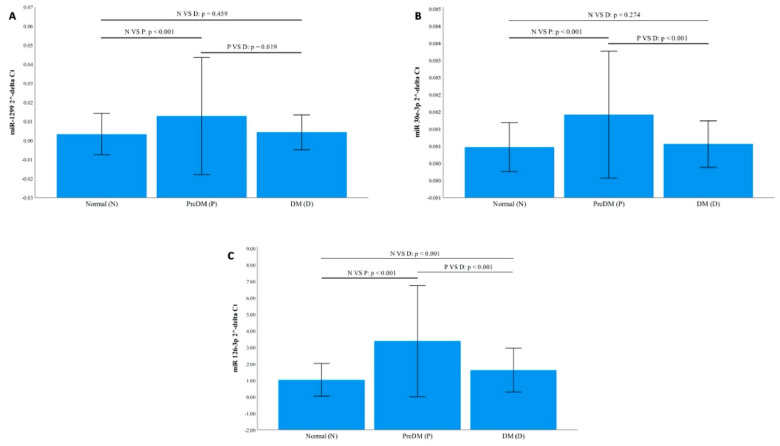
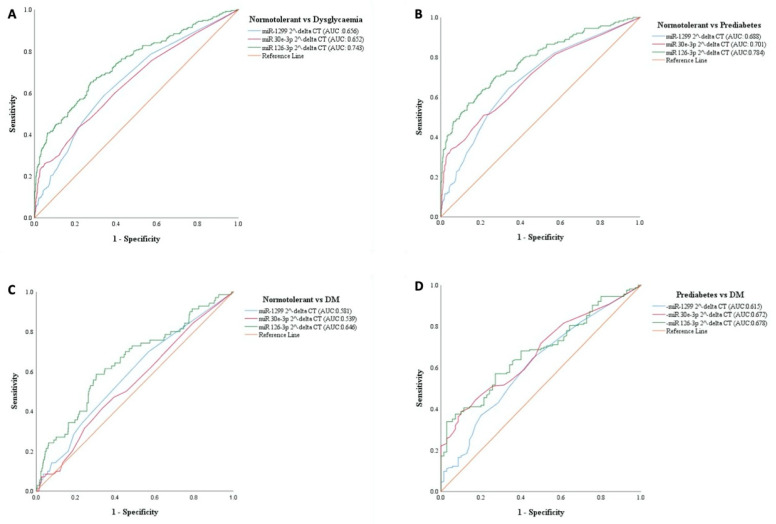
This cross-sectional study investigated the association of miR-1299, -126-3p and -30e-3p with and their diagnostic capability for dysglycaemia in 1273 (men, = 345) South Africans, aged >20 years. Glycaemic status was assessed by oral glucose tolerance test (OGTT). Whole blood microRNA (miRNA) expressions were assessed using TaqMan-based reverse transcription quantitative-PCR (RT-qPCR). Receiver operating characteristic (ROC) curves assessed the ability of each miRNA to discriminate dysglycaemia, while multivariable logistic regression analyses linked expression with dysglycaemia. In all, 207 (16.2%) and 94 (7.4%) participants had prediabetes and type 2 diabetes mellitus (T2DM), respectively. All three miRNAs were significantly highly expressed in individuals with prediabetes compared to normotolerant patients, < 0.001. miR-30e-3p and miR-126-3p were also significantly more expressed in T2DM versus normotolerant patients, < 0.001. In multivariable logistic regressions, the three miRNAs were consistently and continuously associated with prediabetes, while only miR-126-3p was associated with T2DM. The ROC analysis indicated all three miRNAs had a significant overall predictive ability to diagnose prediabetes, diabetes and the combination of both (dysglycaemia), with the area under the receiver operating characteristic curve (AUC) being significantly higher for miR-126-3p in prediabetes. For prediabetes diagnosis, miR-126-3p (AUC = 0.760) outperformed HbA1c (AUC = 0.695), = 0.042. These results suggest that miR-1299, -126-3p and -30e-3p are associated with prediabetes, and measuring miR-126-3p could potentially contribute to diabetes risk screening strategies.
这项横断面研究调查了1273名年龄大于20岁的南非人(男性345名)中miR-1299、-126-3p和-30e-3p与血糖异常的关联及其诊断能力。通过口服葡萄糖耐量试验(OGTT)评估血糖状态。使用基于TaqMan的逆转录定量聚合酶链反应(RT-qPCR)评估全血微小RNA(miRNA)表达。受试者工作特征(ROC)曲线评估每个miRNA区分血糖异常的能力,而多变量逻辑回归分析将表达与血糖异常联系起来。共有207名(16.2%)和94名(7.4%)参与者分别患有糖尿病前期和2型糖尿病(T2DM)。与糖耐量正常的患者相比,所有三种miRNA在糖尿病前期个体中均显著高表达,P<0.001。与糖耐量正常的患者相比,miR-30e-3p和miR-126-3p在T2DM患者中也显著表达更高,P<0.001。在多变量逻辑回归中,这三种miRNA与糖尿病前期持续且连续相关,而只有miR-126-3p与T2DM相关。ROC分析表明,所有三种miRNA对糖尿病前期、糖尿病以及两者的组合(血糖异常)均具有显著的总体预测能力,miR-126-3p在糖尿病前期的受试者工作特征曲线下面积(AUC)显著更高。对于糖尿病前期诊断,miR-126-3p(AUC = 0.760)优于糖化血红蛋白(AUC = 0.695),P = 0.042。这些结果表明,miR-1299、-126-3p和-30e-3p与糖尿病前期相关,检测miR-126-3p可能有助于糖尿病风险筛查策略。