Franieck Erick, Fleischmann Martin, Hölck Ole, Kutuzova Larysa, Kandelbauer Andreas
Automotive Electronics, Engineering Technology Polymer & Packaging, Robert Bosch GmbH, 72770 Reutlingen, Germany.
Faculty of Electrical Engineering and Computer Science, Technical University of Berlin, 13355 Berlin, Germany.
Polymers (Basel). 2021 May 26;13(11):1734. doi: 10.3390/polym13111734.
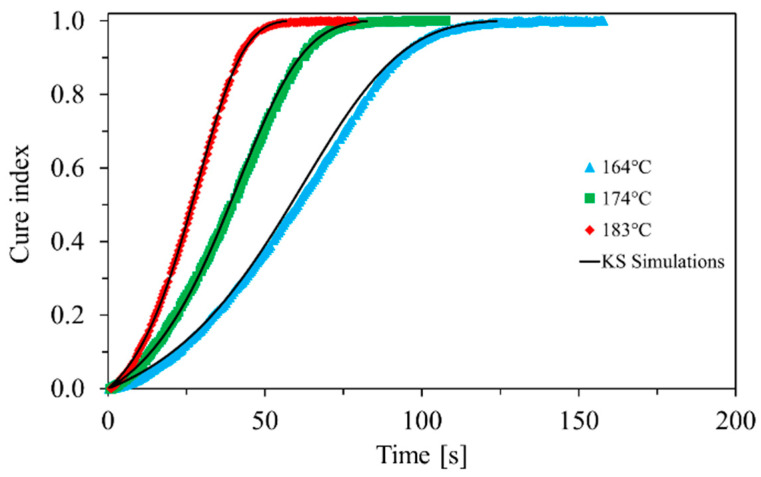
We report on the cure characterization, based on inline monitoring of the dielectric parameters, of a commercially available epoxy phenol resin molding compound with a high glass transition temperature (>195 °C), which is suitable for the direct packaging of electronic components. The resin was cured under isothermal temperatures close to general process conditions (165-185 °C). The material conversion was determined by measuring the ion viscosity. The change of the ion viscosity as a function of time and temperature was used to characterize the cross-linking behavior, following two separate approaches (model based and isoconversional). The determined kinetic parameters are in good agreement with those reported in the literature for EMCs and lead to accurate cure predictions under process-near conditions. Furthermore, the kinetic models based on dielectric analysis (DEA) were compared with standard offline differential scanning calorimetry (DSC) models, which were based on dynamic measurements. Many of the determined kinetic parameters had similar values for the different approaches. Major deviations were found for the parameters linked to the end of the reaction where vitrification phenomena occur under process-related conditions. The glass transition temperature of the inline molded parts was determined via thermomechanical analysis (TMA) to confirm the vitrification effect. The similarities and differences between the resulting kinetics models of the two different measurement techniques are presented and it is shown how dielectric analysis can be of high relevance for the characterization of the curing reaction under conditions close to series production.
我们报告了基于介电参数在线监测对一种市售环氧酚醛树脂模塑料进行固化表征的情况,该模塑料具有较高的玻璃化转变温度(>195°C),适用于电子元件的直接封装。该树脂在接近一般工艺条件(165 - 185°C)的等温温度下固化。通过测量离子粘度来确定材料转化率。离子粘度随时间和温度的变化被用于表征交联行为,采用了两种不同的方法(基于模型和等转化率)。所确定的动力学参数与文献中报道的用于模塑料的参数高度一致,并能在接近实际工艺的条件下实现准确的固化预测。此外,将基于介电分析(DEA)的动力学模型与基于动态测量的标准离线差示扫描量热法(DSC)模型进行了比较。对于不同的方法,许多所确定的动力学参数具有相似的值。在与工艺相关的条件下发生玻璃化现象时,发现与反应结束相关的参数存在较大偏差。通过热机械分析(TMA)确定在线模塑部件的玻璃化转变温度,以确认玻璃化效应。本文展示了两种不同测量技术所得动力学模型之间的异同,并说明了介电分析在接近批量生产条件下对固化反应表征的高度相关性。