Laboratory of Epidemiology and Population Sciences, Intramural Research Program, National Institute on Aging, Baltimore, MD 21224, USA.
Department of Behavioral Health and Nutrition, University of Delaware, Newark, DE 19716, USA.
Nutrients. 2021 May 26;13(6):1803. doi: 10.3390/nu13061803.
We investigated cross-sectional and longitudinal associations of diet quality with middle-aged caregiver status.
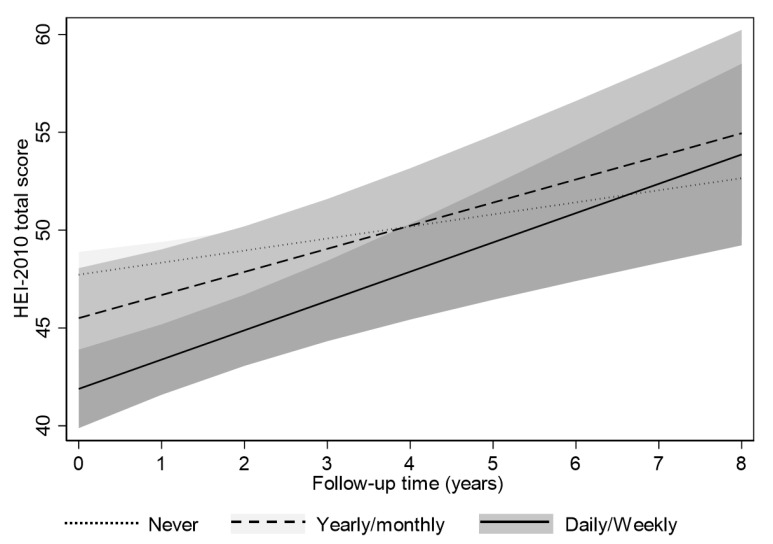
Caregiving in the Healthy Aging in Neighborhoods of Diversity across the Life Span (HANDLS) study (57.7% women, 62% African American (AA)) was measured at waves 3 (2009-2013) and 4 (2013-2017) (mean follow-up time 4.1 years). Diet quality was assessed by the Healthy Eating Index 2010 (HEI-2010) derived from two separate 24 h diet recalls. Multivariable ordinary least square regression was performed for cross-sectional analyses of the association of wave 4 caregiving with wave 4 HEI-2010. Wave 3 caregiving was examined both cross-sectionally and with annual rate of change in HEI using mixed-effects linear regression Models. Multivariable models were adjusted for age, sex, and poverty status.
Cross-sectional analyses at wave 4 demonstrate an inverse association of frequent caregiving ("Daily or Weekly" vs. "Never") for grandchildren with HEI-2010 total score (i.e., lower diet quality) among Whites (β = -2.83 ± 1.19, = 0.03, Model 2) and AAs (β = -1.84 ± 0.79, = 0.02,). The "cross-sectional" analysis pertaining to grandchildren caregiving frequency suggested that frequent caregiving (i.e., "Daily or Weekly" vs. "Never" (β = -2.90 ± 1.17, = 0.04)) only among Whites was inversely related to HEI-2010 total score. Total HEI-2010 score was also related to caring (Model 1), for the elderly over "5 years vs. Never" among Whites (-7.31 ± 3.54, = 0.04, Model 2). Longitudinally, we found slight potential improvement in diet quality over time ("Daily or Weekly" vs. Never by TIME interaction: +0.88 ± 0.38, = 0.02) with frequent caregiving among Whites, but not so among AAs.
Frequent caring for grandchildren had an inverse relationship with the diet quality of White and AA urban middle-aged caregivers, while caring for elderly was inversely linked to diet quality among Whites only. Longitudinal studies should address the paucity of research on caregivers' nutritional quality.
我们研究了饮食质量与中年照顾者身份的横断面和纵向关联。
在跨生命跨度多样性社区中的健康老龄化研究(HANDLS)中(57.7%为女性,62%为非裔美国人(AA)),在第 3 波(2009-2013 年)和第 4 波(2013-2017 年)进行了照顾者的测量(平均随访时间为 4.1 年)。通过来自两个单独的 24 小时饮食回忆的健康饮食指数 2010(HEI-2010)评估饮食质量。使用混合效应线性回归模型对第 4 波的照顾者与第 4 波的 HEI-2010 之间的横断面分析进行了多变量普通最小二乘回归。使用多变量模型调整了年龄、性别和贫困状况。
第 4 波的横断面分析表明,与孙子孙女的频繁照顾(“每天或每周”与“从不”)与白人(β=-2.83±1.19,p=0.03,模型 2)和非裔美国人(β=-1.84±0.79,p=0.02)的 HEI-2010 总分(即较差的饮食质量)呈负相关。有关孙辈照顾频率的“横断面”分析表明,只有白人的频繁照顾(即“每天或每周”与“从不”(β=-2.90±1.17,p=0.04))与 HEI-2010 总分呈负相关。HEI-2010 总分也与照顾有关(模型 1),对于白人,照顾老年人超过“5 年”与从不照顾(β=-7.31±3.54,p=0.04,模型 2)有关。纵向来看,我们发现白人中,随着时间的推移,频繁照顾者的饮食质量略有改善(“每天或每周”与“从不”的时间交互作用:+0.88±0.38,p=0.02),而非裔美国人则不然。
频繁照顾孙子孙女与白人和非裔美国城市中年照顾者的饮食质量呈负相关,而照顾老年人与白人的饮食质量呈负相关。纵向研究应该解决照顾者营养质量研究不足的问题。