Department of Orthopaedic Surgery, Kobe University Graduate School of Medicine, 7-5-1 Kusunoki-cho, Chuo-ku, Kobe 650-0017, Japan.
Int J Mol Sci. 2021 May 26;22(11):5648. doi: 10.3390/ijms22115648.
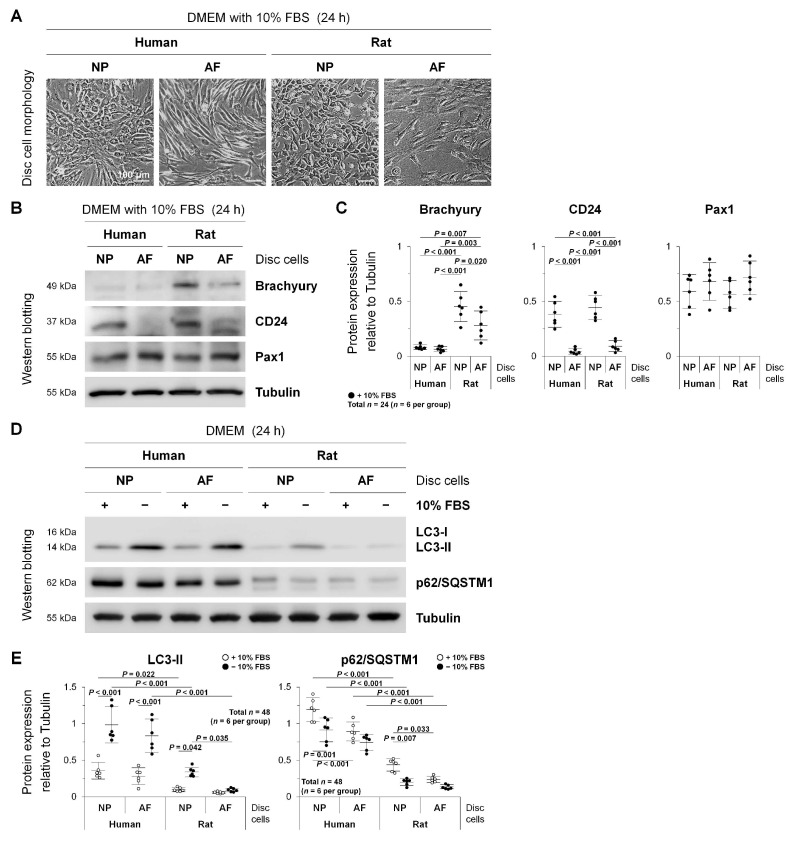
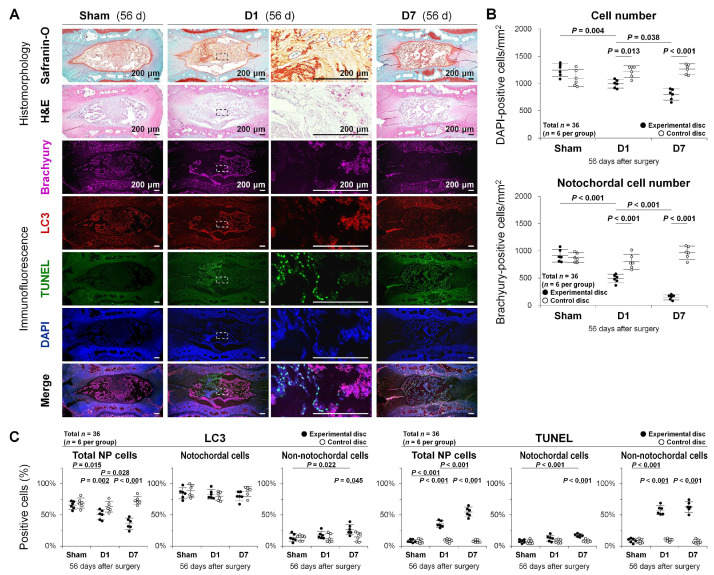
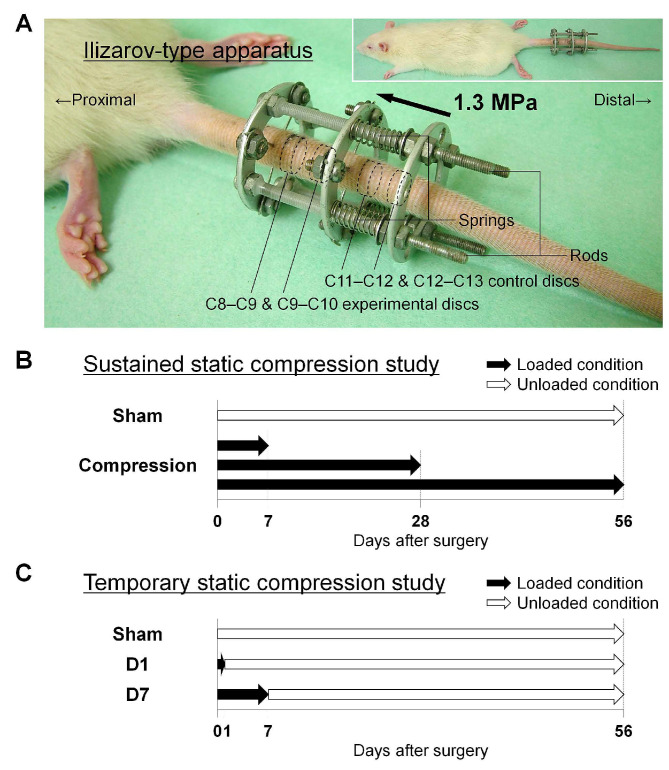
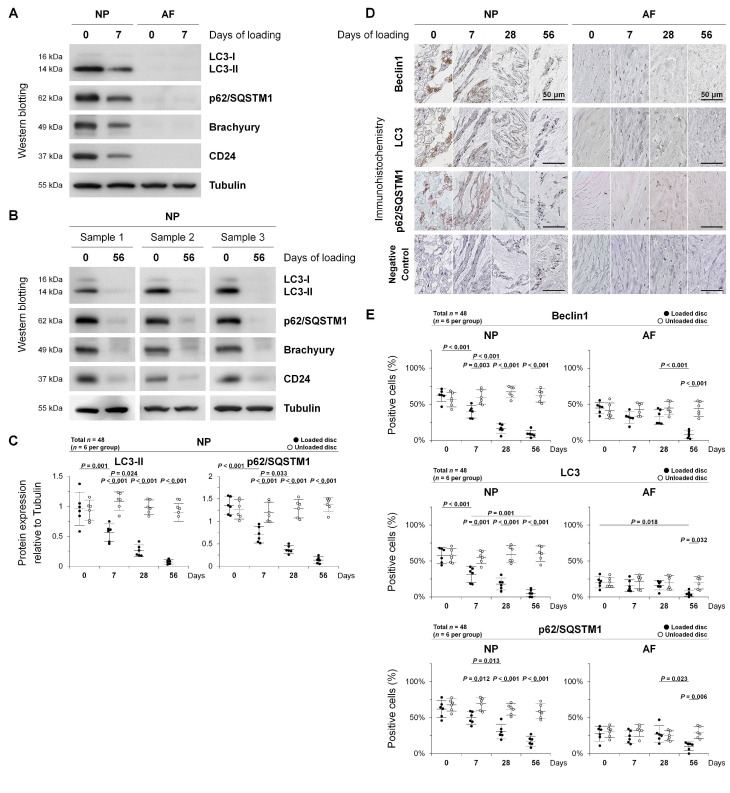
The intervertebral disc is the largest avascular low-nutrient organ in the body. Thus, resident cells may utilize autophagy, a stress-response survival mechanism, by self-digesting and recycling damaged components. Our objective was to elucidate the involvement of autophagy in rat experimental disc degeneration. In vitro, the comparison between human and rat disc nucleus pulposus (NP) and annulus fibrosus (AF) cells found increased autophagic flux under serum deprivation rather in humans than in rats and in NP cells than in AF cells of rats ( = 6). In vivo, time-course Western blotting showed more distinct basal autophagy in rat tail disc NP tissues than in AF tissues; however, both decreased under sustained static compression ( = 24). Then, immunohistochemistry displayed abundant autophagy-related protein expression in large vacuolated disc NP notochordal cells of sham rats. Under temporary static compression ( = 18), multi-color immunofluorescence further identified rapidly decreased brachyury-positive notochordal cells with robust expression of autophagic microtubule-associated protein 1 light chain 3 (LC3) and transiently increased brachyury-negative non-notochordal cells with weaker LC3 expression. Notably, terminal deoxynucleotidyl transferase dUTP nick end labeling-positive apoptotic death was predominant in brachyury-negative non-notochordal cells. Based on the observed notochordal cell autophagy impairment and non-notochordal cell apoptosis induction under unphysiological mechanical loading, further investigation is warranted to clarify possible autophagy-induced protection against notochordal cell disappearance, the earliest sign of disc degeneration, through limiting apoptosis.
椎间盘是人体中最大的无血管低营养器官。因此,驻留细胞可能通过自噬(一种应激反应生存机制)来自我消化和回收受损的成分。我们的目的是阐明自噬在大鼠实验性椎间盘退变中的作用。在体外,比较人源和大鼠椎间盘核髓核(NP)和纤维环(AF)细胞发现,血清剥夺时,NP 细胞的自噬流增加比 AF 细胞更为明显(=6)。在体内,时程 Western 印迹显示大鼠尾椎间盘 NP 组织的基础自噬比 AF 组织更为明显;然而,在持续静态压缩下,两者均下降(=24)。随后,免疫组织化学显示假手术大鼠大空泡 NP 组织中存在大量自噬相关蛋白表达。在短暂静态压缩下(=18),多色免疫荧光进一步鉴定出大量 brachyury 阳性的 NP 脊索细胞中迅速减少的自噬微管相关蛋白 1 轻链 3(LC3)表达,而短暂增加的 brachyury 阴性非脊索细胞中 LC3 表达较弱。值得注意的是,在 brachyury 阴性非脊索细胞中,末端脱氧核苷酸转移酶 dUTP 缺口末端标记阳性的凋亡死亡占主导地位。基于在非生理力学负荷下观察到的脊索细胞自噬受损和非脊索细胞凋亡诱导,进一步的研究是必要的,以阐明可能通过限制凋亡来保护脊索细胞免于消失,这是椎间盘退变的最早迹象。