Research Center for Endocrine and Metabolic Diseases, School of Medicine, Chungnam National University, 282 Munhwaro, Daejeon 35015, Korea.
Department of Medical Science, School of Medicine, Chungnam National University, 266 Munhwaro, Daejeon 35015, Korea.
Cells. 2021 May 24;10(6):1298. doi: 10.3390/cells10061298.
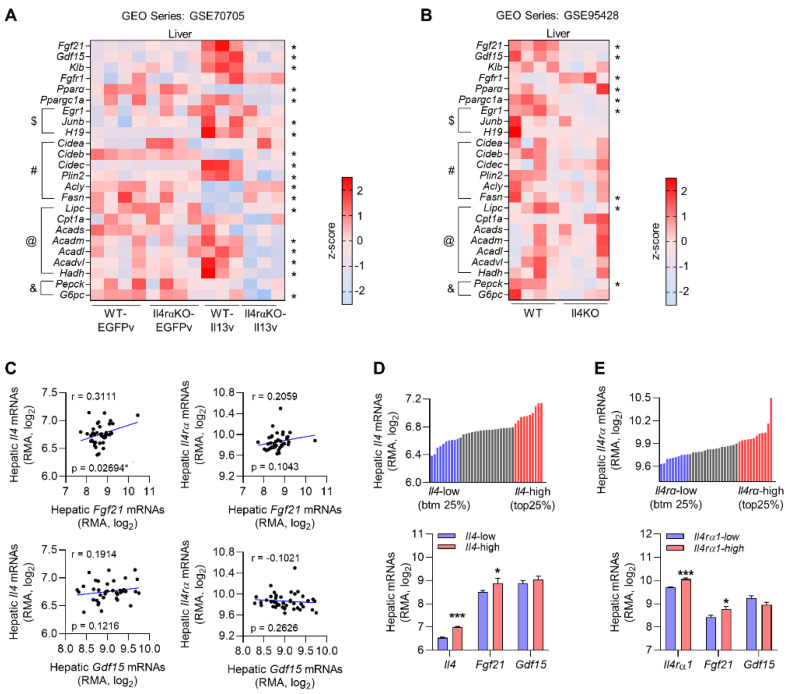
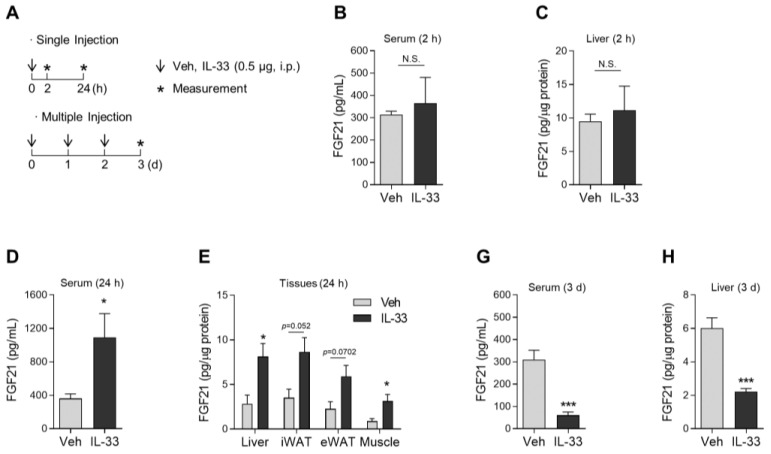
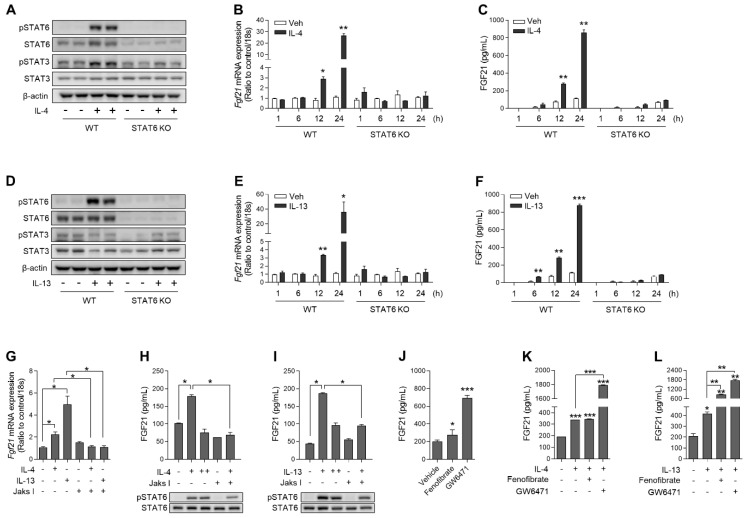
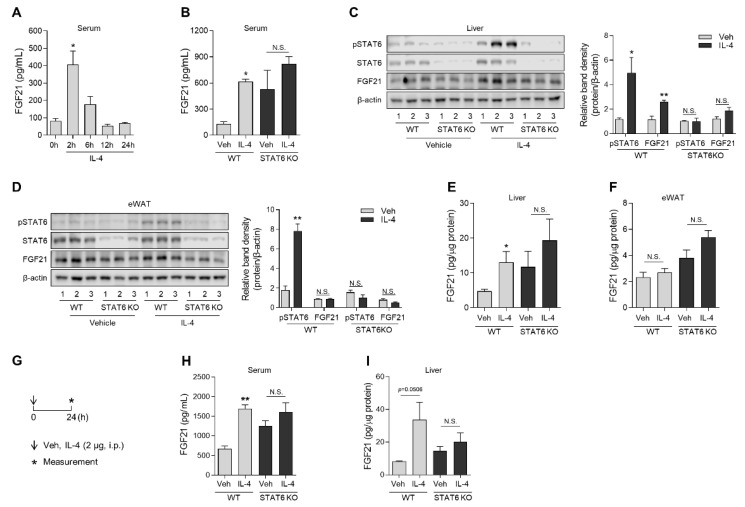
Interleukin-4 (IL-4) and IL-13 are the major T helper 2 (Th2) cytokines, and they are involved in the regulation of metabolism in the adipose tissue. The liver contains diverse innate and adaptive immune cells, but it remains to be determined whether Th2 cytokines modulate energy metabolism in the liver. Here, using gene expression data from the Gene Expression Omnibus (GEO) and the BXD mouse reference population, we determined that the Th2 cytokines IL-4 and IL-13 increase the secretion of fibroblast growth factor 21 (FGF21) in the liver. In vitro experiments confirmed that FGF21 was highly expressed in response to IL-4 and IL-13, and this response was abolished by the Janus kinase (JAK)-signal transducer and activator of transcription 6 (STAT6) blockade. Moreover, FGF21 expression in response to Th2 cytokines was augmented by selective peroxisome proliferator-activated receptor α (PPARα) inhibition. In vivo administration of IL-4 increased FGF21 protein levels in the liver in a STAT6-dependent manner, but FGF21 secretion in response to IL-4 was not observed in the epididymal white adipose tissue (eWAT) despite the activation of STAT6. Intraperitoneal administration of IL-33, an activator of type 2 immune responses, significantly increased the level of FGF21 in the serum and liver after 24 h, but repeated administration of IL-33 attenuated this effect. Taken together, these data demonstrate that the IL-4/IL-13-STAT6 axis regulates metabolic homeostasis through the induction of FGF21 in the liver.
白细胞介素 4(IL-4)和白细胞介素 13(IL-13)是主要的 T 辅助 2(Th2)细胞因子,它们参与调节脂肪组织中的代谢。肝脏含有多种先天和适应性免疫细胞,但 Th2 细胞因子是否调节肝脏中的能量代谢仍有待确定。在这里,我们使用基因表达综合数据库(GEO)和 BXD 小鼠参考群体中的基因表达数据,确定 Th2 细胞因子 IL-4 和 IL-13 增加了肝脏中成纤维细胞生长因子 21(FGF21)的分泌。体外实验证实,FGF21 对 IL-4 和 IL-13 的反应高度表达,并且这种反应被 Janus 激酶(JAK)-信号转导和转录激活因子 6(STAT6)阻断所消除。此外,选择性过氧化物酶体增殖物激活受体α(PPARα)抑制增强了 FGF21 对 Th2 细胞因子的表达。体内给予 IL-4 以 STAT6 依赖的方式增加了肝脏中 FGF21 的蛋白水平,但在附睾白色脂肪组织(eWAT)中未观察到 FGF21 对 IL-4 的反应,尽管 STAT6 被激活。白细胞介素 33(IL-33)是 2 型免疫反应的激活剂,腹腔内给予后 24 小时,血清和肝脏中的 FGF21 水平显著增加,但重复给予 IL-33 可减弱这种作用。综上所述,这些数据表明,IL-4/IL-13-STAT6 轴通过诱导肝脏中 FGF21 的表达来调节代谢稳态。