Beck Richard J, Weigelin Bettina, Beltman Joost B
Leiden Academic Centre for Drug Research, Division of Drug Discovery and Safety, Leiden University, 2333 CC Leiden, The Netherlands.
Department of Preclinical Imaging and Radiopharmacy, Eberhard Karls University of Tübingen, 72076 Tübingen, Germany.
Cancers (Basel). 2021 May 24;13(11):2567. doi: 10.3390/cancers13112567.
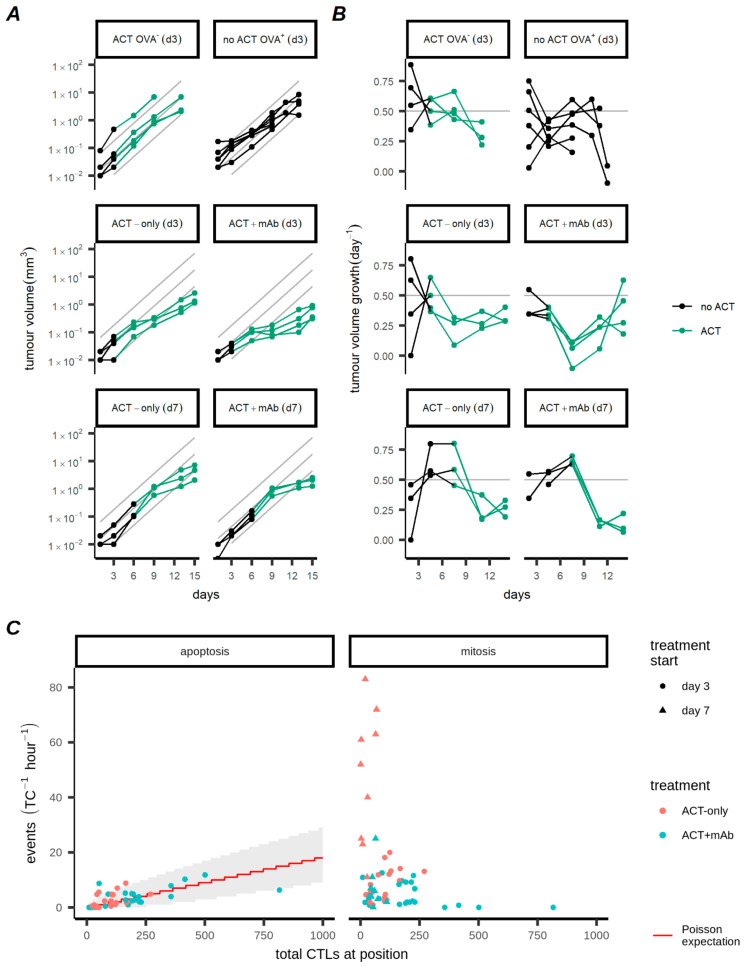
Several immunotherapeutic strategies for the treatment of cancer are under development. Two prominent strategies are adoptive cell transfer (ACT) of CTLs and modulation of CTL function with immune checkpoint inhibitors or with costimulatory antibodies. Despite some success with these approaches, there remains a lack of detailed and quantitative descriptions of the events following CTL transfer and the impact of immunomodulation. Here, we have applied ordinary differential equation models to two photon imaging data derived from a B16F10 murine melanoma. Models were parameterised with data from two different treatment conditions: either ACT-only, or ACT with intratumoural costimulation using a CD137 targeted antibody. Model dynamics and best fitting parameters were compared, in order to assess the mode of action of the CTLs and examine how the CD137 antibody influenced their activities. We found that the cytolytic activity of the transferred CTLs was minimal without CD137 costimulation, and that the CD137 targeted antibody did not enhance the per-capita killing ability of the transferred CTLs. Instead, the results of our modelling study suggest that an antiproliferative effect of CTLs exerted upon the tumour likely accounted for the majority of the reduction in tumour growth after CTL transfer. Moreover, we found that CD137 most likely improved tumour control via enhancement of this antiproliferative effect, as well as prolonging the period in which CTLs were inside the tumour, leading to a sustained duration of their antitumour effects following CD137 stimulation.
几种用于癌症治疗的免疫治疗策略正在研发中。两种主要策略是细胞毒性T淋巴细胞(CTL)的过继性细胞转移(ACT)以及用免疫检查点抑制剂或共刺激抗体调节CTL功能。尽管这些方法取得了一些成功,但仍然缺乏对CTL转移后事件以及免疫调节影响的详细定量描述。在此,我们将常微分方程模型应用于源自B16F10小鼠黑色素瘤的双光子成像数据。模型使用来自两种不同治疗条件的数据进行参数化:仅ACT,或使用靶向CD137的抗体进行肿瘤内共刺激的ACT。比较模型动力学和最佳拟合参数,以评估CTL的作用模式,并研究CD137抗体如何影响其活性。我们发现,在没有CD137共刺激的情况下,转移的CTL的溶细胞活性极小,并且靶向CD137的抗体并未增强转移的CTL的人均杀伤能力。相反,我们的建模研究结果表明,CTL对肿瘤施加的抗增殖作用可能是CTL转移后肿瘤生长减少的主要原因。此外,我们发现CD137最有可能通过增强这种抗增殖作用以及延长CTL在肿瘤内的时间来改善肿瘤控制,从而导致CD137刺激后其抗肿瘤作用的持续时间延长。