Ravikanth Vishnubhotla, Sasikala Mitnala, Naveen Vankadari, Latha Sabbu Sai, Parsa Kishore Venkata Laxmi, Vijayasarathy Ketavarapu, Amanchy Ramars, Avanthi Steffie, Govardhan Bale, Rakesh Kalapala, Kumari Daram Sarala, Srikaran Bojja, Rao Guduru Venkat, Reddy D Nageshwar
Institute of Translational Research, Department of Genomics and Molecular Biology, Asian Institute of Gastroenterology, AIG Hospitals, Survey No 136, Plot No 2/3/4/5, 1, Mindspace Road, Gachibowli, Hyderabad 500032, Telangana, India.
Monash Biomedicine Discovery Institute and Department of Biochemistry and Molecular Biology, Monash University, Victoria 3800, Australia.
Meta Gene. 2021 Sep;29:100930. doi: 10.1016/j.mgene.2021.100930. Epub 2021 May 28.
Mortality due to COVID-19 caused by SARS-CoV-2 infection varies among populations. Functional relevance of genetic variations in Angiotensin-converting enzyme 2 () and Transmembrane serine protease 2 (), two crucial host factors for viral entry, might explain some of this variation.
In this comparative study in Indian subjects, we recruited 510 COVID-19 patients and retrieved DNA from 520 controls from a repository. Associations between variants in and with disease severity were identified by whole exome sequencing (WES, = 20) and targeted genotyping ( = 1010). Molecular dynamic simulations (MDS) were performed to explore functional relevance of the variants. Cleavage of spike glycoprotein by wild and variant TMPRSS2 was determined in HEK293T cells. Potential effects of confounders on the association between genotype and disease severity were tested (Mantel-Haenszel test).
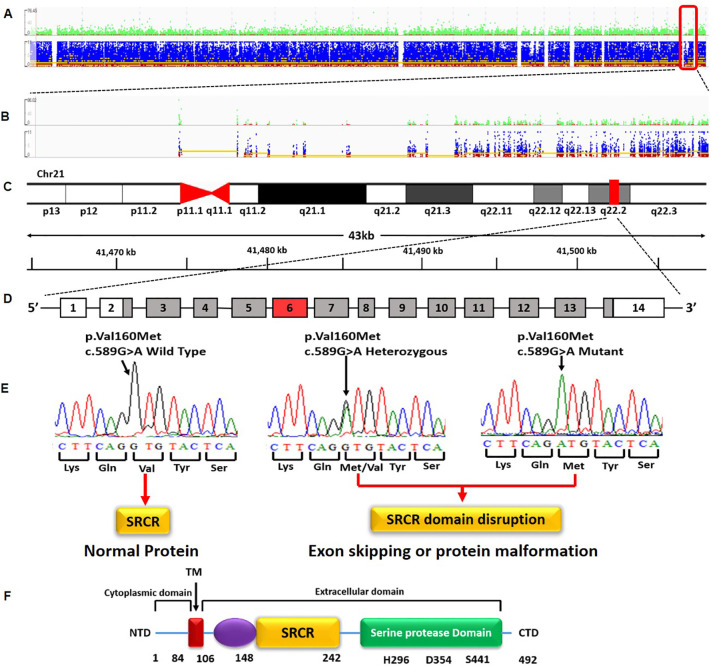
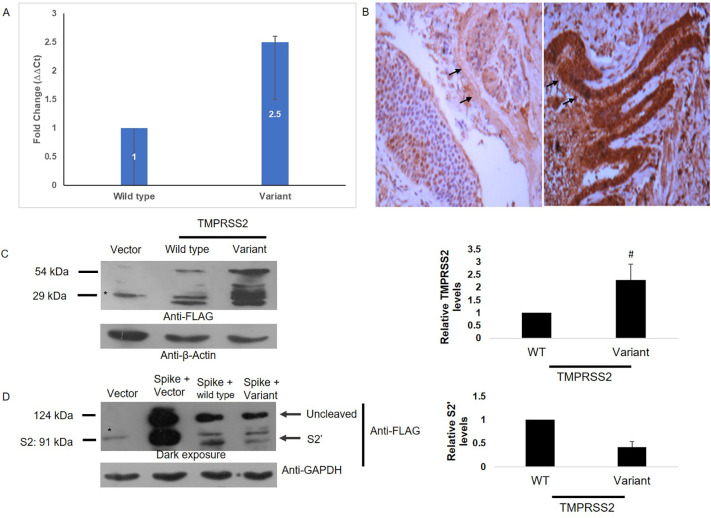
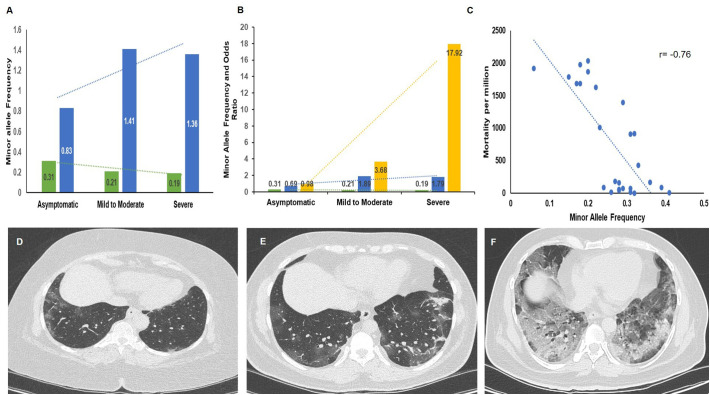
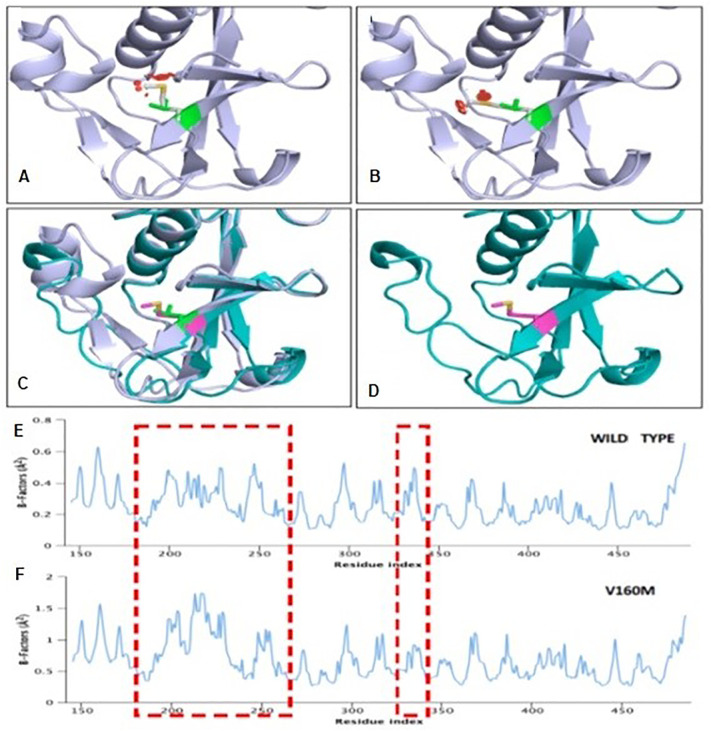
WES identified deleterious variant in (rs12329760, G > A, p. V160M). The minor allele frequency (MAF) was 0·27 in controls, 0·31 in asymptomatic, 0·21 in mild-to-moderately affected and 0·19 in severely affected COVID-19 patients. Risk of severity increased with decreasing MAF: Asymptomatic: Odds ratio-0·69 (95% CI-0·52-0·93; = 0·01); mild-to-moderate: Odds ratio-1·89 (95% CI-1·22-2.92;p = 0·004) and severe: Odds ratio-1·79 (95% CI-1·11-2.88;p = 0·01). No confounding effect of diabetes and hypertension were observed on the risk of developing severe COVID-19 disease with respect to genotype. MDS revealed decreased stability of TMPRSS2 with 160 M variant. Spike glycoprotein cleavage by TMPRSS2 reduced ~2·4-fold in cells expressing 160 M variant.
We demonstrate association of variant rs12329760 with decreased disease severity in COVID-19 patients from India.
严重急性呼吸综合征冠状病毒2(SARS-CoV-2)感染所致的2019冠状病毒病(COVID-19)死亡率在不同人群中存在差异。血管紧张素转换酶2(ACE2)和跨膜丝氨酸蛋白酶2(TMPRSS2)是病毒进入的两个关键宿主因子,其基因变异的功能相关性可能解释了部分这种差异。
在这项针对印度受试者的比较研究中,我们招募了510例COVID-19患者,并从一个储存库中提取了520例对照的DNA。通过全外显子组测序(WES,n = 20)和靶向基因分型(n = 1010)确定ACE2和TMPRSS2基因变异与疾病严重程度之间的关联。进行分子动力学模拟(MDS)以探索这些变异的功能相关性。在HEK293T细胞中测定野生型和变异型TMPRSS2对刺突糖蛋白的切割作用。测试了混杂因素对基因型与疾病严重程度之间关联的潜在影响(Mantel-Haenszel检验)。
WES在ACE2中鉴定出有害变异(rs12329760,G>A,p.V160M)。次要等位基因频率(MAF)在对照中为0.27,无症状患者中为0.31,轻度至中度患者中为0.21,重度COVID-19患者中为0.19。严重程度风险随MAF降低而增加:无症状:比值比-0.69(95%置信区间-0.52-0.93;P = 0.01);轻度至中度:比值比-1.89(95%置信区间-1.22-2.92;P = 0.004);重度:比值比-1.79(95%置信区间-1.11-2.88;P = 0.01)。未观察到糖尿病和高血压对基因型相关的严重COVID-19疾病发生风险有混杂影响。MDS显示160M变异型TMPRSS2的稳定性降低。在表达160M变异型的细胞中,TMPRSS2对刺突糖蛋白的切割作用降低了约2.4倍。
我们证明了印度COVID-19患者中ACE2变异rs12329760与疾病严重程度降低相关。