Wang Yingchan, Jiang Yuchao, Su Wenjun, Xu Lihua, Wei Yanyan, Tang Yingying, Zhang Tianhong, Tang Xiaochen, Hu Yegang, Cui Huiru, Wang Jinhong, Yao Dezhong, Luo Cheng, Wang Jijun
Shanghai Key Laboratory of Psychotic Disorders, Shanghai Mental Health Center, Shanghai Jiao Tong University School of Medicine, Shanghai, 200030, People's Republic of China.
The Clinical Hospital of Chengdu Brain Science Institute, MOE Key Lab for Neuroinformation, Center for Information in Medicine, School of life Science and technology, University of Electronic Science and Technology of China, Chengdu, 610054, People's Republic of China.
Neuropsychiatr Dis Treat. 2021 May 18;17:1505-1516. doi: 10.2147/NDT.S305117. eCollection 2021.
This study investigated temporal dynamics in degree centrality (DC) of the brain functional connectome in first-episode schizophrenia with different short-term treatment responses.
A total of 127 first-episode patients (FEPs) with schizophrenia and 133 healthy controls (HCs) were recruited in this study. All subjects underwent resting-state functional magnetic resonance imaging. FEPs were scanned at baseline (pretreatment) and at follow-up (posttreatment), while HCs were scanned only at baseline. The patients were exposed to naturalistic antipsychotic treatment for 12 weeks, and classified as schizophrenia responders (SRs) or nonresponders (NRs). Voxel-wise dynamic DC analyses were conducted among the SRs (n=75), NRs (n=52), and HCs (n=133) to assess temporal variability in functional connectivity across the entire neuronal network.
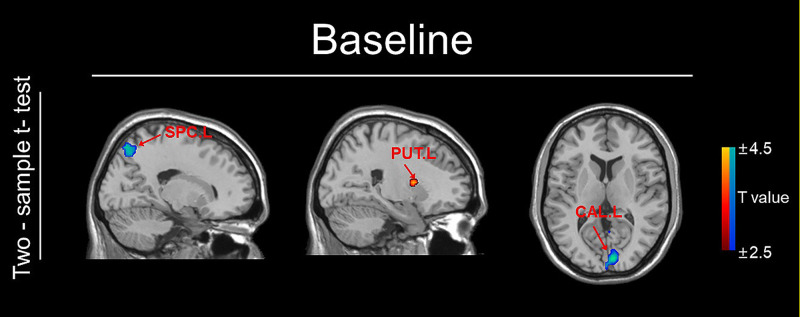
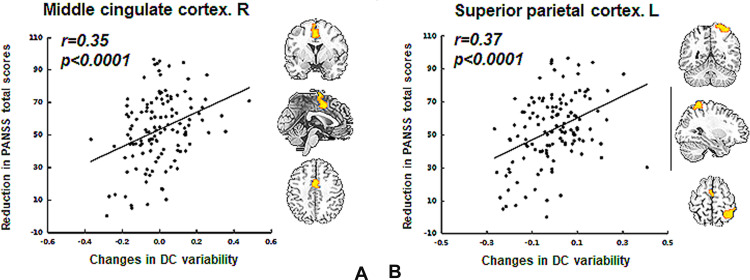
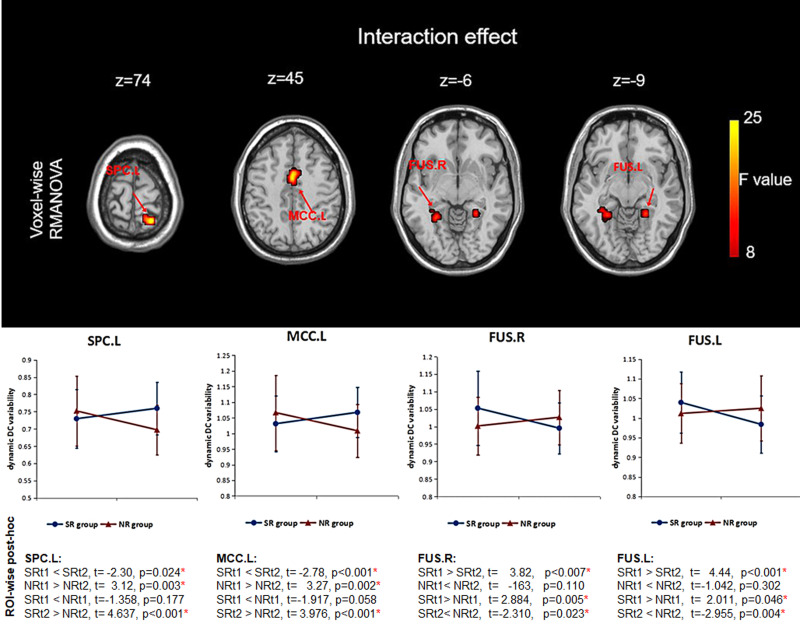
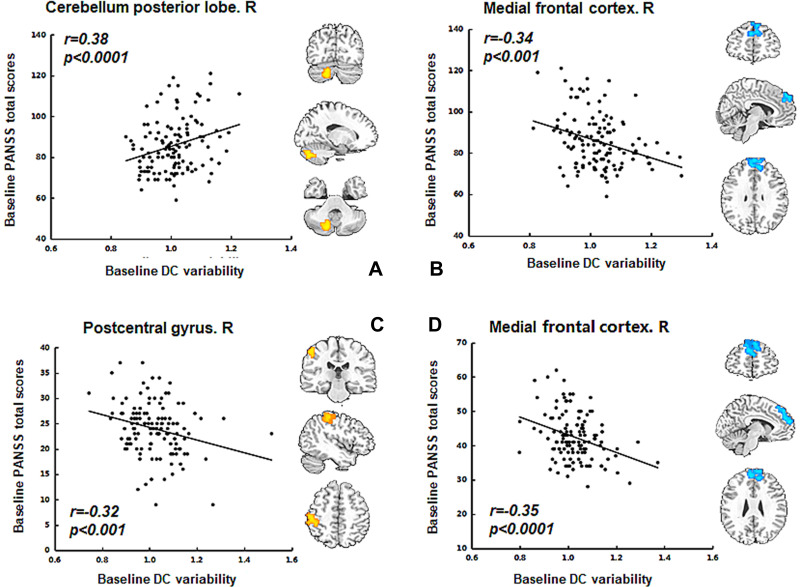
The SRs and NRs showed dissimilar dynamic DC at baseline, with differences mainly involving the temporal lobe. Different DC alteration was observed in the left fusiform gyrus, right fusiform gyrus, left middle cingulate cortex, and left superior parietal gyrus in the SRs and NRs pre- and posttreatment. SRs group and NRs presented opposite changing patterns of dynamic DC in particular regions of the brain.
These findings indicate that dynamic DC abnormalities exist in unmedicated patients with schizophrenia. The NRs differed from the SRs in dynamic DC not only at baseline but in the characteristics of changes before and after treatment as well. Our study may contribute to understanding pathophysiology in schizophrenia with different treatment responses.
本研究调查了首发精神分裂症患者不同短期治疗反应下脑功能连接组度中心性(DC)的时间动态变化。
本研究共招募了127例首发精神分裂症患者(FEPs)和133名健康对照者(HCs)。所有受试者均接受静息态功能磁共振成像检查。FEPs在基线期(治疗前)和随访期(治疗后)进行扫描,而HCs仅在基线期进行扫描。患者接受自然状态下的抗精神病药物治疗12周,并分为精神分裂症反应者(SRs)或无反应者(NRs)。对SRs(n = 75)、NRs(n = 52)和HCs(n = 133)进行基于体素的动态DC分析,以评估整个神经元网络功能连接的时间变异性。
SRs和NRs在基线期显示出不同的动态DC,差异主要涉及颞叶。在SRs和NRs治疗前和治疗后的左侧梭状回、右侧梭状回、左侧中央扣带回皮质和左侧顶上小叶观察到不同的DC改变。SRs组和NRs在大脑特定区域呈现出相反的动态DC变化模式。
这些发现表明未用药的精神分裂症患者存在动态DC异常。NRs与SRs不仅在基线期的动态DC不同,而且在治疗前后的变化特征也不同。我们的研究可能有助于理解不同治疗反应的精神分裂症的病理生理学。