Therkildsen Christina, Jensen Lars Henrik, Rasmussen Maria, Bernstein Inge
Department of Surgical Gastroenterology, Copenhagen University Hospital, Copenhagen, Denmark.
The Danish HNPCC Register, Department of Clinical Research, Copenhagen University Hospital, Amager and Hvidovre, Copenhagen, Denmark.
Clin Exp Gastroenterol. 2021 May 24;14:181-197. doi: 10.2147/CEG.S278054. eCollection 2021.
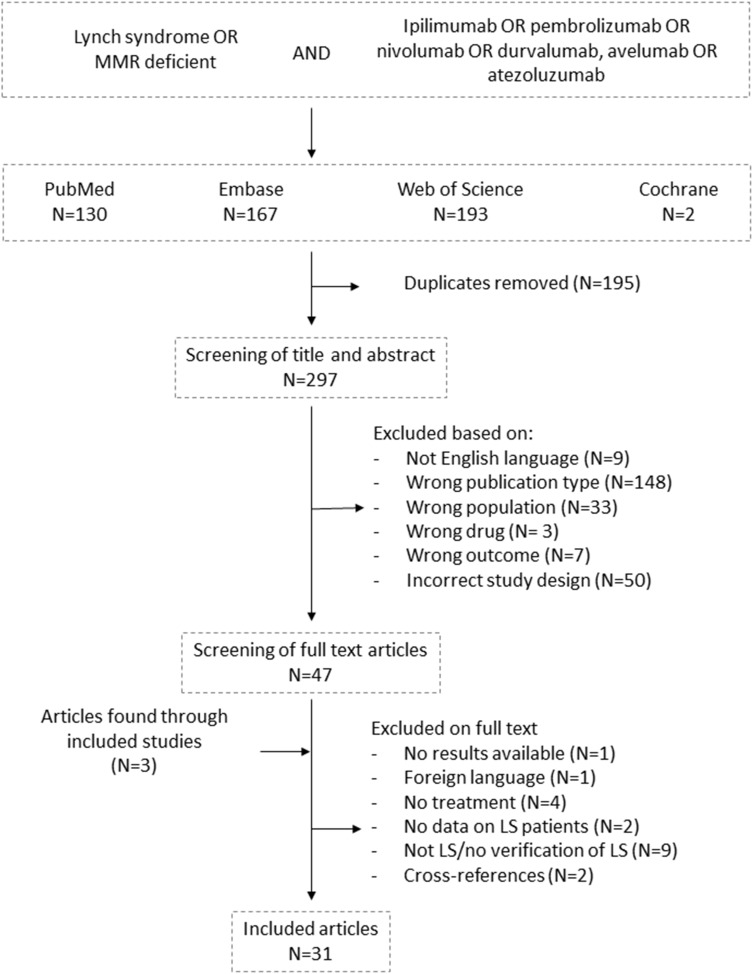
During the recent years, immune checkpoint-based therapy has proven highly effective in microsatellite instable (MSI) solid tumors irrespective of organ site. MSI tumors are associated with a defective mismatch repair (MMR) system and a highly immune-infiltrative tumor microenvironment-both characteristics of Lynch syndrome. Lynch syndrome is a multi-tumor syndrome that not only confers a high risk of colorectal and endometrial cancer but also cancer in, eg the upper urinary tract, ovaries, and small bowel. Since the genetic predisposition for Lynch syndrome are pathogenic variants in one of the four MMR genes, or , most of the Lynch syndrome cancers show MMR deficiency, MSI, and activation of the immune response system. Hence, Lynch syndrome cancer patients may be optimal candidates for immune checkpoint-based therapies. However, molecular differences have been described between sporadic MSI tumors (developed due to promoter hypermethylation) and Lynch syndrome tumors, which may result in different treatment responses. Furthermore, the response profile of the rare Lynch syndrome cases may be masked by the more frequent cases of sporadic MSI tumors in large clinical trials. With this review, we systematically collected response data on Lynch syndrome patients treated with FDA- and EMA-approved immune checkpoint-based drugs (pembrolizumab, atezolizumab, durvalumab, avelumab, ipilimumab, and nivolumab) to elucidate the objective response rate and progression-free survival of cancer in Lynch syndrome patients. Herein, we report Lynch syndrome-related objective response rates between 46 and 71% for colorectal cancer and 14-100% for noncolorectal cancer in unselected cohorts as well as an overview of the Lynch syndrome case reports. To date, no difference in the response rates has been reported between Lynch syndrome and sporadic MSI cancer patients.
近年来,基于免疫检查点的疗法已被证明在微卫星高度不稳定(MSI)实体瘤中具有高度疗效,无论肿瘤发生在哪个器官部位。MSI肿瘤与错配修复(MMR)系统缺陷以及高度免疫浸润性肿瘤微环境相关,这两者都是林奇综合征的特征。林奇综合征是一种多肿瘤综合征,不仅会增加患结直肠癌和子宫内膜癌的风险,还会增加患例如上尿路、卵巢和小肠癌症的风险。由于林奇综合征的遗传易感性是四个MMR基因( 或 )之一的致病变异,大多数林奇综合征相关癌症表现出MMR缺陷、MSI以及免疫反应系统激活。因此,林奇综合征癌症患者可能是基于免疫检查点疗法的最佳候选者。然而,散发性MSI肿瘤(由于 启动子高甲基化而发生)与林奇综合征肿瘤之间存在分子差异,这可能导致不同的治疗反应。此外,在大型临床试验中,罕见的林奇综合征病例的反应情况可能会被更常见的散发性MSI肿瘤病例所掩盖。在本综述中,我们系统收集了接受美国食品药品监督管理局(FDA)和欧洲药品管理局(EMA)批准的基于免疫检查点药物(帕博利珠单抗、阿特珠单抗、度伐利尤单抗、阿维鲁单抗、伊匹木单抗和纳武利尤单抗)治疗的林奇综合征患者的反应数据,以阐明林奇综合征患者癌症的客观缓解率和无进展生存期。在此,我们报告了在未选择的队列中,结直肠癌的林奇综合征相关客观缓解率在46%至71%之间,非结直肠癌的客观缓解率在14%至100%之间,并对林奇综合征病例报告进行了概述。迄今为止,尚未报道林奇综合征患者与散发性MSI癌症患者在缓解率上存在差异。