1Department of Medicine, Memorial Sloan Kettering Cancer Center.
2Tri-Institutional Program in Computational Biology and Medicine, Weill Cornell Medical College; and.
J Natl Compr Canc Netw. 2021 Feb 2;19(2):130-133. doi: 10.6004/jnccn.2020.7680. Print 2021 Feb.
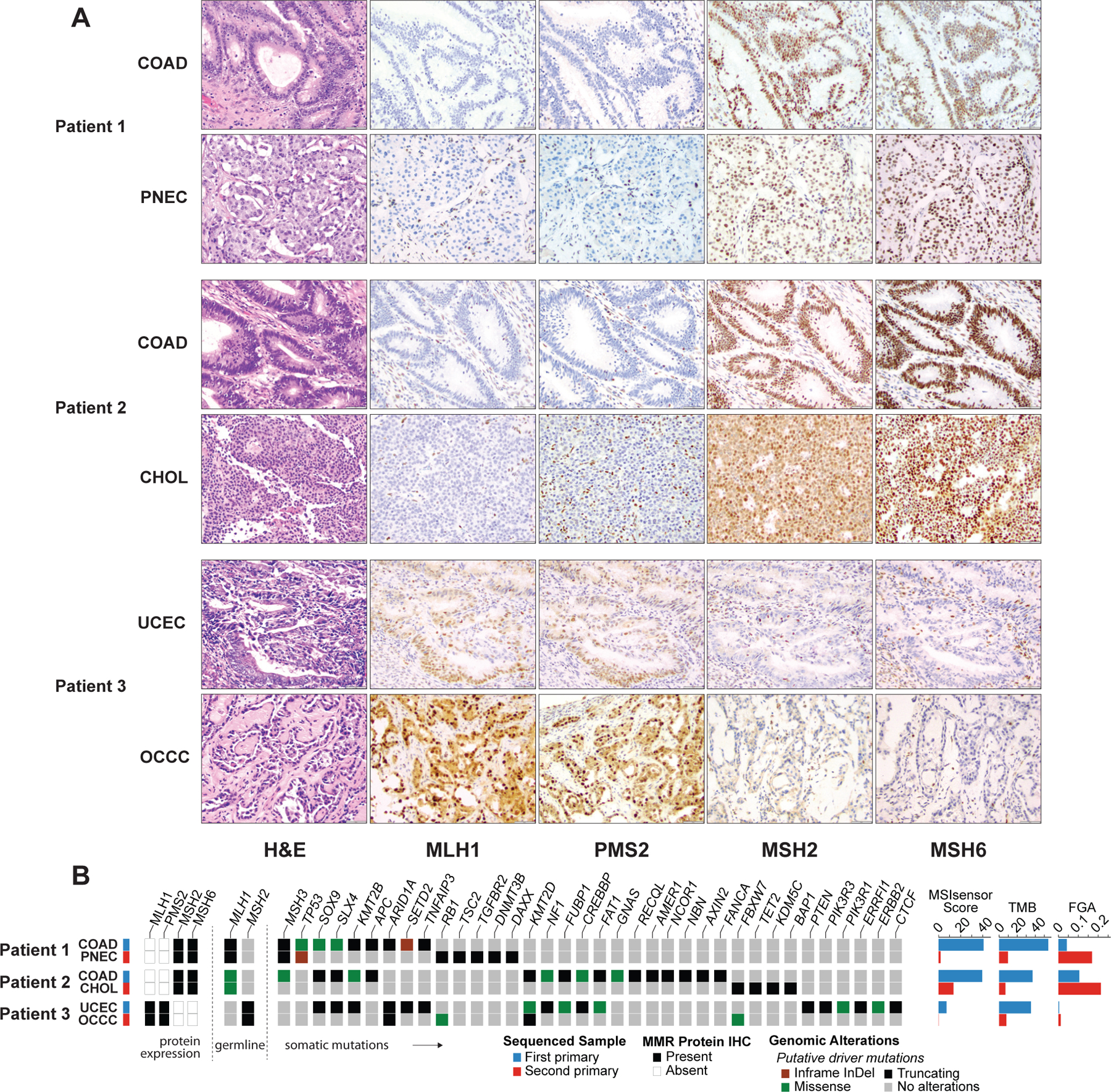
Lynch syndrome is a heritable cancer syndrome caused by a heterozygous germline mutation in DNA mismatch repair (MMR) genes. MMR-deficient (dMMR) tumors are particularly sensitive to immune checkpoint inhibitors, an effect attributed to the higher mutation rate in these cancers. However, approximately 15% to 30% of patients with dMMR cancers do not respond to immunotherapy. This report describes 3 patients with Lynch syndrome who each had 2 primary malignancies: 1 with dMMR and a high tumor mutational burden (TMB), and 1 with dMMR but, unexpectedly, a low TMB. Two of these patients received immunotherapy for their TMB-low tumors but experienced no response. We have found that not all Lynch-associated dMMR tumors have a high TMB and propose that tumors with dMMR and TMB discordance may be resistant to immunotherapy. The possibility of dMMR/TMB discordance should be considered, particularly in less-typical Lynch cancers, in which TMB evaluation could guide the use of immune checkpoint inhibitors.
林奇综合征是一种遗传性癌症综合征,由 DNA 错配修复(MMR)基因中的杂合胚系突变引起。MMR 缺陷(dMMR)肿瘤对免疫检查点抑制剂特别敏感,这种效应归因于这些癌症中更高的突变率。然而,约 15%至 30%的 dMMR 癌症患者对免疫治疗无反应。本报告描述了 3 例林奇综合征患者,他们每人都有 2 种原发性恶性肿瘤:1 种为 dMMR 且具有高肿瘤突变负担(TMB),1 种为 dMMR,但出乎意料的是 TMB 较低。其中 2 例患者因 TMB 低的肿瘤接受免疫治疗,但未出现应答。我们发现并非所有与林奇综合征相关的 dMMR 肿瘤都具有高 TMB,并提出 dMMR/TMB 不相符的肿瘤可能对免疫治疗有抗性。应考虑 dMMR/TMB 不相符的可能性,特别是在不太典型的林奇癌症中,TMB 评估可指导免疫检查点抑制剂的使用。