Wang Panxing, Wang Haijiang, Qiu Guanglin, Liu Jiahuang, Fan Lin, Liao Xinhua, Che Xiangming
Department of General Surgery, The First Affiliated Hospital of Xi'an Jiaotong University, Xi'an, Shanxi Province, People's Republic of China.
Cancer Manag Res. 2021 May 25;13:4191-4201. doi: 10.2147/CMAR.S311347. eCollection 2021.
Inflammation and nutrition play vital roles in the development of gastric cancer (GC). We combined the preoperative fibrinogen with prognostic nutritional index (PNI) to create a novel scoring system named as the fibrinogen and prognostic nutritional index (FPNI) score and establish a more effective model.
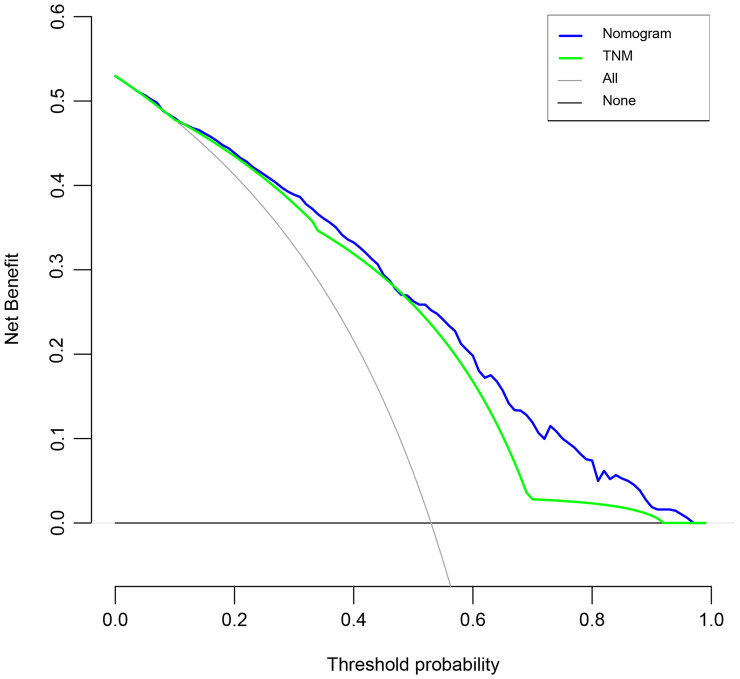
A total of 689 patients with gastric adenocarcinoma who underwent gastrectomy from January 2012 to December 2016 were reviewed. We measured correlations between FPNI score and clinicopathological variables and overall survival (OS). A nomogram predicting OS was constructed. Its predictive performance was verified using the concordance index, calibration curves, receiver operating characteristic curves, decision curve analysis and time-dependent receiver operating characteristic analysis.
We observed that the FPNI score was an independent predictor of OS in patients with gastric cancer ( < 0.05). A high FPNI score was significantly related to older age at surgery, tumor size ≥4.6 cm, high ASA score, advanced TNM stage and poor outcome (both < 0.05). And the FPNI score remained an independent indicator at various TNM stages ( < 0.05). Ultimately, the nomogram based on FPNI score, age, tumor size, histological grade and TNM stage showed a better predictive ability than TNM alone.
The preoperative FPNI score is a novel, simple, and effective predictor of OS in patients with GC. Furthermore, the nomogram involving FPNI score will help clinicians to optimize individualized treatment plans.
炎症和营养在胃癌(GC)的发生发展中起着至关重要的作用。我们将术前纤维蛋白原与预后营养指数(PNI)相结合,创建了一种名为纤维蛋白原与预后营养指数(FPNI)评分的新型评分系统,并建立了一个更有效的模型。
回顾性分析了2012年1月至2016年12月期间接受胃切除术的689例胃腺癌患者。我们测量了FPNI评分与临床病理变量及总生存期(OS)之间的相关性。构建了预测OS的列线图。使用一致性指数、校准曲线、受试者工作特征曲线、决策曲线分析和时间依赖性受试者工作特征分析验证了其预测性能。
我们观察到FPNI评分是胃癌患者OS的独立预测因子(<0.05)。高FPNI评分与手术时年龄较大、肿瘤大小≥4.6 cm、高ASA评分、晚期TNM分期及不良预后显著相关(均<0.05)。并且FPNI评分在各个TNM分期均为独立指标(<0.05)。最终,基于FPNI评分、年龄、肿瘤大小、组织学分级和TNM分期的列线图显示出比单独的TNM更好的预测能力。
术前FPNI评分是GC患者OS的一种新颖、简单且有效的预测因子。此外,包含FPNI评分的列线图将有助于临床医生优化个体化治疗方案。