Alshehri Nojoud, Bin-Shuwaish Mohammed
Restorative Dental Sciences Department, College of Dentistry, King Saud University, Riyadh, Kingdom of Saudi Arabia.
Clin Cosmet Investig Dent. 2021 May 27;13:211-221. doi: 10.2147/CCIDE.S307545. eCollection 2021.
To evaluate the effect of amalgam contamination, different surface treatments, and adhesive protocols on dentin shear bond strength (SBS) to bulk-fill composite resin material.
Eighty teeth were fixed in molds, and the dentin was exposed and then polished. Sixty teeth were restored by amalgam and thermocycled to 10,000 cycles (5°C and 55°C, 30-second dwell time). The rest were restored with composite materials without amalgam predecessor. The samples were divided into G1 (with dentin pretreatment with 2% chlorhexidine gluconate), G2 (0.5 mm of dentin was removed), G3 (no surface modification), and G4 (samples were restored with bulk-fill composite). The bonded specimens were subdivided based on the adhesive protocol of the universal adhesive system used into etch-and-rinse and self-etch groups. Acid etching was done using 32% phosphoric acid. Composite resin was used for build-up using mold and glass. Specimens were cured and left for 24 h in distilled water at room temperature for polymerization reaction, underwent thermocycling for 5000 cycles, and were subjected to knife-edge shear bond testing. Descriptive statistics, independent -tests, and one-way analysis of variance followed by pairwise comparisons were used to analyze the results.
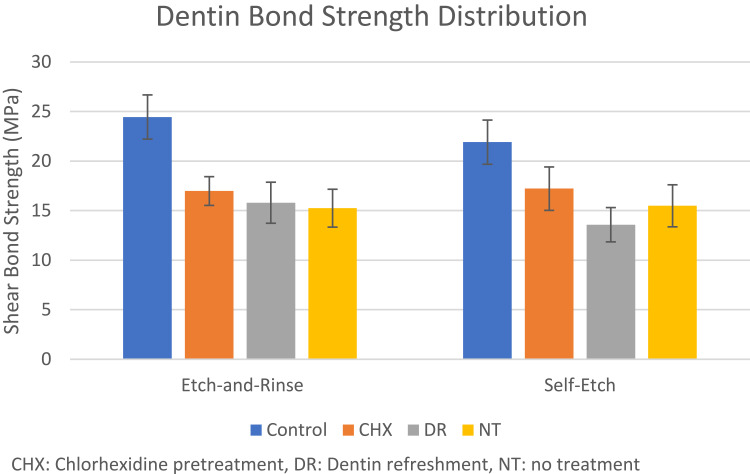
The highest mean SBS values were found in the control group where acid etching was used (24.46±2.24 MPa), followed by self-etching in the same group (21.92±2.54 MPa). Lower SBS values were associated with the amalgam-contaminated group. The lowest values were found in the dentin refreshment group when the self-etching mode was used (13.59±1.73 MPa). Chlorhexidine treatment improved the mean SBS value compared with the no treatment or dentin refreshment groups for both adhesive protocols.
Amalgam contamination may affect SBS values. Acid etching improved SBS for non-contaminated dentin. Chlorhexidine improved SBS for amalgam-contaminated dentin as a surface treatment but had no significant effect.
评估汞合金污染、不同表面处理以及粘结方案对牙本质与大块充填复合树脂材料之间剪切粘结强度(SBS)的影响。
80颗牙齿固定于模具中,暴露牙本质后进行抛光。60颗牙齿用汞合金修复并热循环10000次(5°C和55°C,停留时间30秒)。其余牙齿用无汞合金前驱体的复合材料修复。样本分为G1组(用2%葡萄糖酸氯己定进行牙本质预处理)、G2组(去除0.5mm牙本质)、G3组(未进行表面改性)和G4组(用大块充填复合材料修复样本)。根据所使用的通用粘结系统的粘结方案,将粘结标本再细分为酸蚀冲洗组和自酸蚀组。使用32%磷酸进行酸蚀。使用模具和玻璃用复合树脂进行堆塑。标本固化后在室温蒸馏水中放置24小时以进行聚合反应,进行5000次热循环,并进行刃口剪切粘结测试。使用描述性统计、独立样本t检验和单因素方差分析以及随后的两两比较来分析结果。
在使用酸蚀的对照组中发现最高的平均SBS值(24.46±2.24MPa),其次是同一组中的自酸蚀(21.92±2.54MPa)。较低的SBS值与汞合金污染组相关。在使用自酸蚀模式时,牙本质更新组的值最低(13.59±1.73MPa)。对于两种粘结方案,与未处理组或牙本质更新组相比,氯己定处理提高了平均SBS值。
汞合金污染可能影响SBS值。酸蚀可提高未受污染牙本质的SBS。氯己定作为一种表面处理可提高汞合金污染牙本质的SBS,但效果不显著。