Nae Jenny, Creaby Mark W, Cronström Anna, Ageberg Eva
Health Sciences, Lund University, Lund, Sweden.
School of Exercise Science, Australian Catholic University, Brisbane, Queensland, Australia.
BMJ Open Sport Exerc Med. 2021 May 19;7(2):e001045. doi: 10.1136/bmjsem-2021-001045. eCollection 2021.
There is limited research on sex differences in postural orientation (ie, alignment between body segments) in people with knee injury measured with a clinically applicable method. An understanding of the relationship between postural orientation and physical function may help guide decision making in rehabilitation. The aims were to evaluate (1) sex differences in visual assessment of Postural Orientation Errors (POEs) and (2) the association between POEs and objective and patient-reported physical function, in men and women with anterior cruciate ligament reconstruction (ACLR).
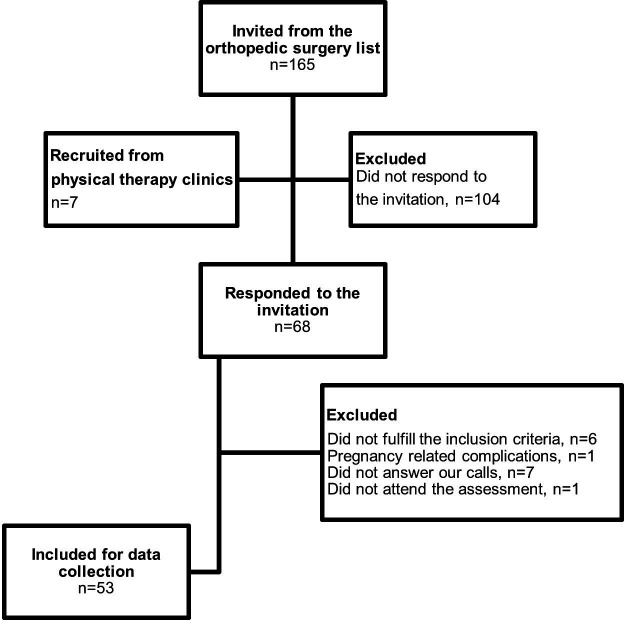
Twenty-four women and 29 men (mean 26.7 (SD 6.5) years) with ACLR were included. Six POEs (lower extremity and trunk) were scored from a video of five tasks with varying difficulty to compute POE scores (total and subscores). Objective physical function was evaluated with the single-leg hop for distance and side hop. Patient-reported physical function was evaluated using patient-reported outcome measures (PROMs).
Women had significantly more POEs than men (median difference 5.5-25, p≤0.028). More POEs were associated with shorter hop distance and fewer side hops in women (r= -0.425 to -0.518, p<0.038), but not in men (r<0.301, p>0.05). No associations were found between POE scores and PROMs, in either sex (r< -0.246, p>0.05).
Women with ACLR seem to have more POEs compared with men, indicating worse postural orientation. More POEs were associated with worse hop performance, suggesting that POE scores may be used as criteria for rehabilitation progression. The lack of associations between POE scores and PROMs indicate that these measures complement each other.
对于采用临床适用方法测量的膝关节损伤患者的姿势定向(即身体各部分之间的对齐)性别差异,相关研究有限。了解姿势定向与身体功能之间的关系可能有助于指导康复决策。本研究旨在评估:(1)前交叉韧带重建(ACLR)的男性和女性在姿势定向误差(POE)视觉评估中的性别差异;(2)POE与客观和患者报告的身体功能之间的关联。
纳入24名女性和29名男性(平均年龄26.7(标准差6.5)岁),均接受了ACLR。从五个难度不同的任务视频中对六项POE(下肢和躯干)进行评分,以计算POE分数(总分和子分数)。通过单腿跳远距离和侧跳评估客观身体功能。使用患者报告结局量表(PROMs)评估患者报告的身体功能。
女性的POE明显多于男性(中位数差异5.5 - 25,p≤0.028)。更多的POE与女性较短的跳远距离和较少的侧跳次数相关(r = -0.425至-0.518,p<0.038),但与男性无关(r<0.301,p>0.05)。在任何性别中,均未发现POE分数与PROMs之间存在关联(r< -0.246,p>0.05)。
与男性相比,接受ACLR的女性似乎有更多的POE,表明姿势定向更差。更多的POE与更差的跳跃表现相关,这表明POE分数可作为康复进展的标准。POE分数与PROMs之间缺乏关联表明这些测量方法相互补充。