Zhang Nan, Yao Lihua, Wang Peilin, Liu Zhongchun
Department of Psychiatry, Renmin Hospital of Wuhan University, Jiefang Rd. 238, 430060, Wuhan, China.
Transl Neurosci. 2021 May 26;12(1):218-236. doi: 10.1515/tnsci-2020-0167. eCollection 2021 Jan 1.
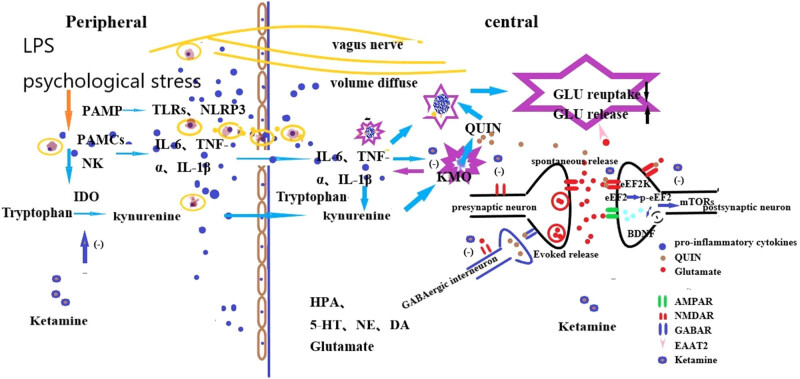
Major depressive disorder (MDD) is a common mental health disorder that brings severe disease burden worldwide. Traditional antidepressants are mainly targeted at monoamine neurotransmitters, with low remission rates and high recurrence rates. Ketamine is a noncompetitive glutamate -methyl-d-aspartate receptor (NMDAR) antagonist, and its rapid and powerful antidepressant effects have come to light. Its antidepressant mechanism is still unclarified. Research found that ketamine had not only antagonistic effect on NMDAR but also strong immunomodulatory effect, both of which were closely related to the pathophysiology of MDD. Although there are many related studies, they are relatively heterogeneous. Therefore, this review mainly describes the immune mechanisms involved in MDD and how ketamine plays an antidepressant role by regulating peripheral and central immune system, including peripheral inflammatory cytokines, central microglia, and astrocytes. This review summarizes the related research, finds out the deficiencies of current research, and provides ideas for future research and the development of novel antidepressants.
重度抑郁症(MDD)是一种常见的精神健康障碍,在全球范围内带来了沉重的疾病负担。传统抗抑郁药主要针对单胺类神经递质,缓解率低且复发率高。氯胺酮是一种非竞争性谷氨酸 - 甲基 - d - 天冬氨酸受体(NMDAR)拮抗剂,其快速而强大的抗抑郁作用已被发现。但其抗抑郁机制仍不明确。研究发现,氯胺酮不仅对NMDAR有拮抗作用,还具有强大的免疫调节作用,这两者都与MDD的病理生理学密切相关。尽管有许多相关研究,但它们相对异质性较大。因此,本综述主要描述了MDD涉及的免疫机制,以及氯胺酮如何通过调节外周和中枢免疫系统发挥抗抑郁作用,包括外周炎性细胞因子、中枢小胶质细胞和星形胶质细胞。本综述总结了相关研究,找出了当前研究的不足,并为未来研究和新型抗抑郁药的开发提供思路。